

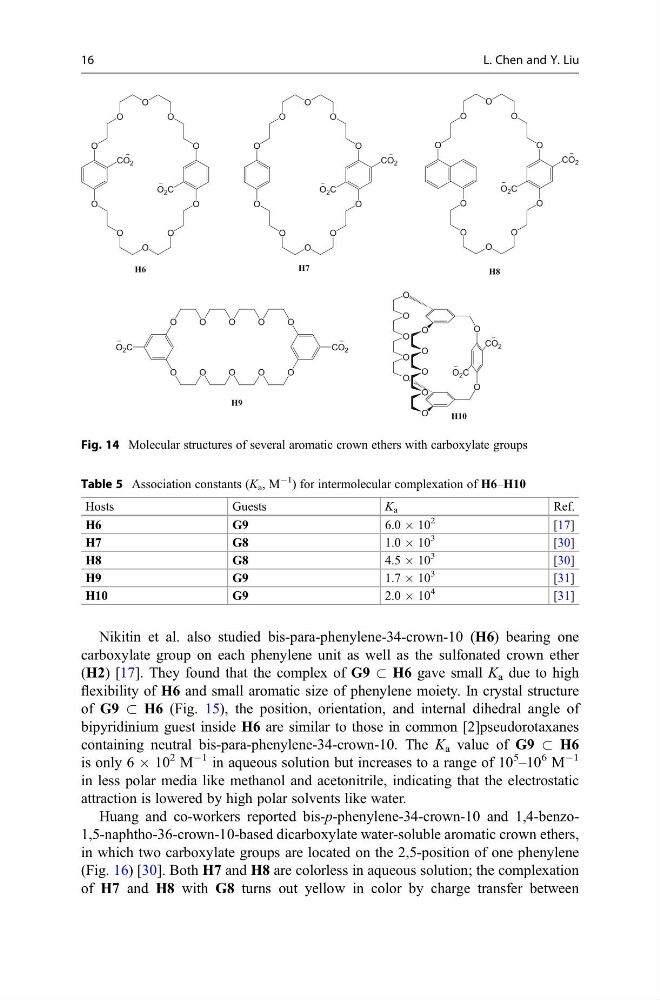
Nikitin et al. also studied bis-para-phenylene-34-crown-10 (H6) bearing one
carboxylate group on each phenylene unit as well as the sulfonated crown ether
(H2) [17]. They found that the complex of G9 & H6 gave small K a due to high
flexibility of H6 and small aromatic size of phenylene moiety. In crystal structure
of G9 & H6 (Fig. 15), the position, orientation, and internal dihedral angle of
bipyridinium guest inside H6 are similar to those in common [2]pseudorotaxanes
containing neutral bis-para-phenylene-34-crown-10. The K a value of G9 & H6
is only 6 Â 10
2 M
À1 in aqueous solution but increases to a range of 10
5
–10
6 M
À1
in less polar media like methanol and acetonitrile, indicating that the electrostatic
attraction is lowered by high polar solvents like water.
Huang and co-workers reported bis-p-phenylene-34-crown-10 and 1,4-benzo1,5-naphtho-36-crown-10-based dicarboxylate water-soluble aromatic crown ethers,
in which two carboxylate groups are located on the 2,5-position of one phenylene
(Fig. 16) [30]. Both H7 and H8 are colorless in aqueous solution; the complexation
of H7 and H8 with G8 turns out yellow in color by charge transfer between
O
O
O
O
O
CO 2
O
O
O
O
O
O 2 C
O
O
O
O
O
O
O
O
O
O 2 C
O
CO 2
O
O
CO 2
O 2 C
O
O
O
O
O
O
O
O
O
O
O
O
O
O
O
O
O
O
O
O
O 2 C
CO 2
O
O
O
O
O
CO 2
O
O
O
O
O
O 2 C
H6
H7
H8
H9
H10
Fig. 14 Molecular structures of several aromatic crown ethers with carboxylate groups
Table 5 Association constants (K a , M
À1
) for intermolecular complexation of H6–H10
Hosts
Guests
K a
Ref.
H6
G9
6.0 Â 10
2
[17]
H7
G8
1.0 Â 10
3
[30]
H8
G8
4.5 Â 10
3
[30]
H9
G9
1.7 Â 10
3
[31]
H10
G9
2.0 Â 10
4
[31]
16
L. Chen and Y. Liu
carboxylate group on each phenylene unit as well as the sulfonated crown ether
(H2) [17]. They found that the complex of G9 & H6 gave small K a due to high
flexibility of H6 and small aromatic size of phenylene moiety. In crystal structure
of G9 & H6 (Fig. 15), the position, orientation, and internal dihedral angle of
bipyridinium guest inside H6 are similar to those in common [2]pseudorotaxanes
containing neutral bis-para-phenylene-34-crown-10. The K a value of G9 & H6
is only 6 Â 10
2 M
À1 in aqueous solution but increases to a range of 10
5
–10
6 M
À1
in less polar media like methanol and acetonitrile, indicating that the electrostatic
attraction is lowered by high polar solvents like water.
Huang and co-workers reported bis-p-phenylene-34-crown-10 and 1,4-benzo1,5-naphtho-36-crown-10-based dicarboxylate water-soluble aromatic crown ethers,
in which two carboxylate groups are located on the 2,5-position of one phenylene
(Fig. 16) [30]. Both H7 and H8 are colorless in aqueous solution; the complexation
of H7 and H8 with G8 turns out yellow in color by charge transfer between
O
O
O
O
O
CO 2
O
O
O
O
O
O 2 C
O
O
O
O
O
O
O
O
O
O 2 C
O
CO 2
O
O
CO 2
O 2 C
O
O
O
O
O
O
O
O
O
O
O
O
O
O
O
O
O
O
O
O
O 2 C
CO 2
O
O
O
O
O
CO 2
O
O
O
O
O
O 2 C
H6
H7
H8
H9
H10
Fig. 14 Molecular structures of several aromatic crown ethers with carboxylate groups
Table 5 Association constants (K a , M
À1
) for intermolecular complexation of H6–H10
Hosts
Guests
K a
Ref.
H6
G9
6.0 Â 10
2
[17]
H7
G8
1.0 Â 10
3
[30]
H8
G8
4.5 Â 10
3
[30]
H9
G9
1.7 Â 10
3
[31]
H10
G9
2.0 Â 10
4
[31]
16
L. Chen and Y. Liu