

In comparison with H4 which prefers to bind guests with large π-conjugation
size, H5 has smaller cavity and more intensive anionic electrostatic field; it prefers to
bind guests with only small positive groups like pyridinium and quinolium. In 2013
Liu et al. reported that G18, which acts as important coenzyme NAD
+ in biological
process, was included into the conformationally rigid cavity of H5 at neutral pH to
show moderate binding strength of 10
3 M
À1 [24]. In contrary, the host H4 with larger
cavity has no intermolecular interaction with G18. In 2016 they consequently
investigated the interactions of several stilbazolium dye guests (G19 and G20)
containing pyridinium moiety. The obtained data show that the two guests have
strong binding strength with H5 (K a = 10
5
–10
6 M
À1 ). On the other hand, G19 and
G20 usually show very poor emission in aqueous solution due to the relaxation of
twisted intramolecular charge transfer (TICT) on locally excited state. DFT and
TDDFT methods revealed that free dye guests are not coplanar but twisted by
large twist angle. The twist angle increases in the excited state, which quenches
the dye emission through TICT relaxation path. The binding in cavity of H5 lowers
twisted angle of dye guests to a small value which leads to increase of fluorescent
intensity. More dyes with TICT relaxation (G21–G24) were studied to associate with
H5, in which the fluorescent emissions of dyes were enhanced to high intensity, as
well as G19 and G20 [27]. Association constants of G19–G24 were determined by
ITC experiments. It can be seen that the K a values were mainly located in the range
of 10
5
–10
6 M
À1 ; the variation of structures of dyes exerts only small influence to the
K a values.
1.4
Carboxylated Aromatic Crown Ethers
Besides the aforementioned conventional disulfonated and tetrasulfonated crown
ethers, carboxylated aromatic crown ethers (Fig. 14) also have good water solubility
and guest binding ability like sulfonated crown ethers. Moreover, the negative
charge of carboxylate group can be removed by acidifying, which makes the
complexation to be controlled by change of pH. Several association constants of
carboxylated aromatic crown ethers are listed in Table 5.
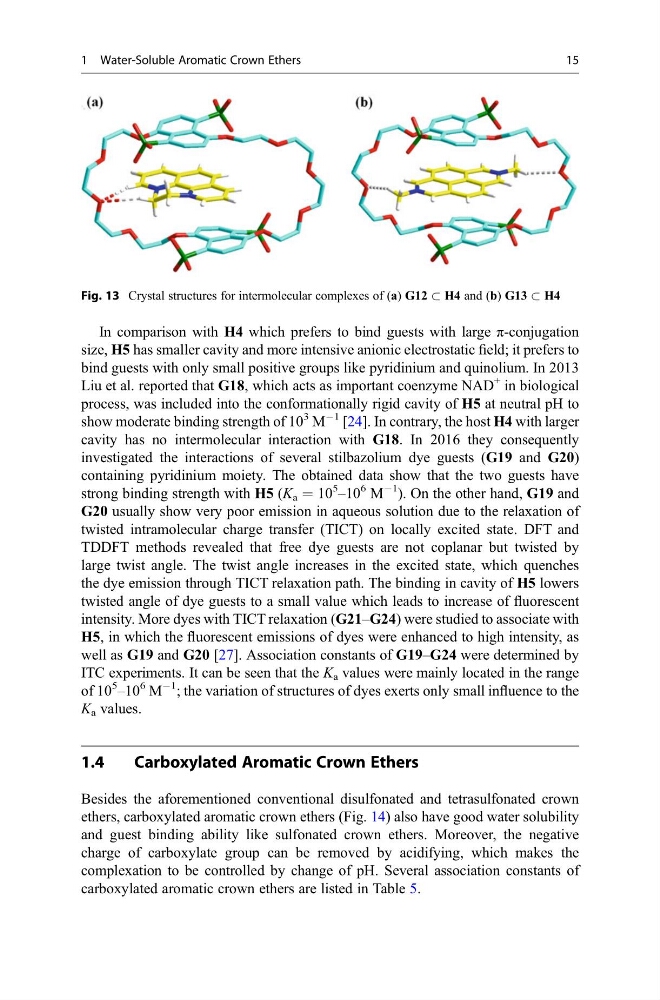
Fig. 13 Crystal structures for intermolecular complexes of (a) G12 & H4 and (b) G13 & H4
1 Water-Soluble Aromatic Crown Ethers
15
size, H5 has smaller cavity and more intensive anionic electrostatic field; it prefers to
bind guests with only small positive groups like pyridinium and quinolium. In 2013
Liu et al. reported that G18, which acts as important coenzyme NAD
+ in biological
process, was included into the conformationally rigid cavity of H5 at neutral pH to
show moderate binding strength of 10
3 M
À1 [24]. In contrary, the host H4 with larger
cavity has no intermolecular interaction with G18. In 2016 they consequently
investigated the interactions of several stilbazolium dye guests (G19 and G20)
containing pyridinium moiety. The obtained data show that the two guests have
strong binding strength with H5 (K a = 10
5
–10
6 M
À1 ). On the other hand, G19 and
G20 usually show very poor emission in aqueous solution due to the relaxation of
twisted intramolecular charge transfer (TICT) on locally excited state. DFT and
TDDFT methods revealed that free dye guests are not coplanar but twisted by
large twist angle. The twist angle increases in the excited state, which quenches
the dye emission through TICT relaxation path. The binding in cavity of H5 lowers
twisted angle of dye guests to a small value which leads to increase of fluorescent
intensity. More dyes with TICT relaxation (G21–G24) were studied to associate with
H5, in which the fluorescent emissions of dyes were enhanced to high intensity, as
well as G19 and G20 [27]. Association constants of G19–G24 were determined by
ITC experiments. It can be seen that the K a values were mainly located in the range
of 10
5
–10
6 M
À1 ; the variation of structures of dyes exerts only small influence to the
K a values.
1.4
Carboxylated Aromatic Crown Ethers
Besides the aforementioned conventional disulfonated and tetrasulfonated crown
ethers, carboxylated aromatic crown ethers (Fig. 14) also have good water solubility
and guest binding ability like sulfonated crown ethers. Moreover, the negative
charge of carboxylate group can be removed by acidifying, which makes the
complexation to be controlled by change of pH. Several association constants of
carboxylated aromatic crown ethers are listed in Table 5.
Fig. 13 Crystal structures for intermolecular complexes of (a) G12 & H4 and (b) G13 & H4
1 Water-Soluble Aromatic Crown Ethers
15