

guest of G16 with larger molecular size prefers to form three times more stable
complex with H4 than H5. Both guest selectivity and host selectivity are observed
due to size-fit relationship. This selectivity was adopted to construct a specific
binding system containing four host-guest components. The mixture containing
equivalent molar of H4, H5, G9, and G16 in D 2 O solution shows only resonances
corresponding to G9 & H5 and G16 & H4; no resonances of G9 & H4 and
G16 & H5 were observed, which were also proven by high resolution mass
spectrometer.
2,7-Dimethyldiazapyrenium (G13) is an important π-electron-poor cation, which
has four more π-conjugation electrons than bipyridinium guests. Stoddart et al. firstly
investigated interactions of G13 and 2,7-dibenzyldiazapyrenium (G14) with
unsulfonated 1,5-dinaphtho-38-crown-10 in organic solution [29]. They found that
G13 and G14 formed stoichiometric 1:1 complexes with K a values ranging from 10
4
to 10
5 M
À1 . In 2013 Liu et al. investigated the complexation of G13 and G14
with corresponding tetrasulfonated host (H4) by ITC experiments [25]. G13 forms
highly stable complex with H4 which reaches up to 10
8 M
À1 in aqueous solution.
Thermodynamic parameters show that the complexation is driven by very large
entropy change (ΔH = 47.84 kJ/mol) that are attributed to electrostatic attraction and
extensive π-stacking. The K a value of G13 & H4 is 350 times higher than that
of G8 & H4, indicating the large scale of π-stacking contributed to the most portion
of K a . However, the complex of G14 & H4 is smaller K a , giving positive entropy
changes. The binding strength of G13 with H4 is five times stronger than G14
because the N-substituent benzyl group on G14 is too large to hinder the complexation with H4 associated with less negative enthalpy change and more positive
entropy change. In comparison with G13 and G14, the guest G12 has similar
molecular size and small scale of π-conjugation; its binding strength with H4 is
smaller than G13 and G14, accompanied by lower enthalpy change. Crystal structures of G12 & H4 and G13 & H4 (Fig. 13) show that the guests G12 and G13
parallelly stack with naphthalene plane of H4, only few hydrogen bonds are found
between host and guests, indicating π-stacking is the dominant noncovalent interaction in their complexation.
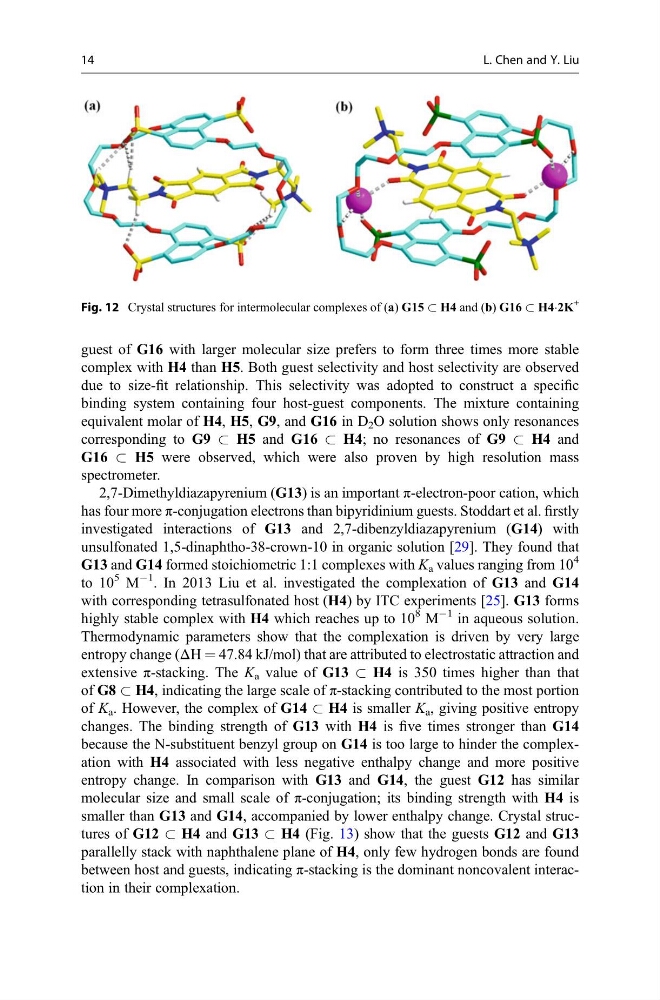
Fig. 12 Crystal structures for intermolecular complexes of (a) G15 & H4 and (b) G16 & H4Á2K
+
14
L. Chen and Y. Liu
complex with H4 than H5. Both guest selectivity and host selectivity are observed
due to size-fit relationship. This selectivity was adopted to construct a specific
binding system containing four host-guest components. The mixture containing
equivalent molar of H4, H5, G9, and G16 in D 2 O solution shows only resonances
corresponding to G9 & H5 and G16 & H4; no resonances of G9 & H4 and
G16 & H5 were observed, which were also proven by high resolution mass
spectrometer.
2,7-Dimethyldiazapyrenium (G13) is an important π-electron-poor cation, which
has four more π-conjugation electrons than bipyridinium guests. Stoddart et al. firstly
investigated interactions of G13 and 2,7-dibenzyldiazapyrenium (G14) with
unsulfonated 1,5-dinaphtho-38-crown-10 in organic solution [29]. They found that
G13 and G14 formed stoichiometric 1:1 complexes with K a values ranging from 10
4
to 10
5 M
À1 . In 2013 Liu et al. investigated the complexation of G13 and G14
with corresponding tetrasulfonated host (H4) by ITC experiments [25]. G13 forms
highly stable complex with H4 which reaches up to 10
8 M
À1 in aqueous solution.
Thermodynamic parameters show that the complexation is driven by very large
entropy change (ΔH = 47.84 kJ/mol) that are attributed to electrostatic attraction and
extensive π-stacking. The K a value of G13 & H4 is 350 times higher than that
of G8 & H4, indicating the large scale of π-stacking contributed to the most portion
of K a . However, the complex of G14 & H4 is smaller K a , giving positive entropy
changes. The binding strength of G13 with H4 is five times stronger than G14
because the N-substituent benzyl group on G14 is too large to hinder the complexation with H4 associated with less negative enthalpy change and more positive
entropy change. In comparison with G13 and G14, the guest G12 has similar
molecular size and small scale of π-conjugation; its binding strength with H4 is
smaller than G13 and G14, accompanied by lower enthalpy change. Crystal structures of G12 & H4 and G13 & H4 (Fig. 13) show that the guests G12 and G13
parallelly stack with naphthalene plane of H4, only few hydrogen bonds are found
between host and guests, indicating π-stacking is the dominant noncovalent interaction in their complexation.
Fig. 12 Crystal structures for intermolecular complexes of (a) G15 & H4 and (b) G16 & H4Á2K
+
14
L. Chen and Y. Liu