

which the long-chain guests lose more conformational freedom in complexation.
Although entropy contribution in binding process of H4 makes little difference as
H5, the higher association constants of H5 are mainly governed by inner repulsion in
the cavity of H5. Although there are flexible triethylene glycol chains in H5, the four
sulfonate groups in small cavity produce considerable inner charge repulsion to
preorganize the flexible crown ethers in a certain degree, resulting in a favorable
negative π-acceptant cavity. In this context, H5 is a specific host compared with the
other sulfonated crown ethers (H1–H4).
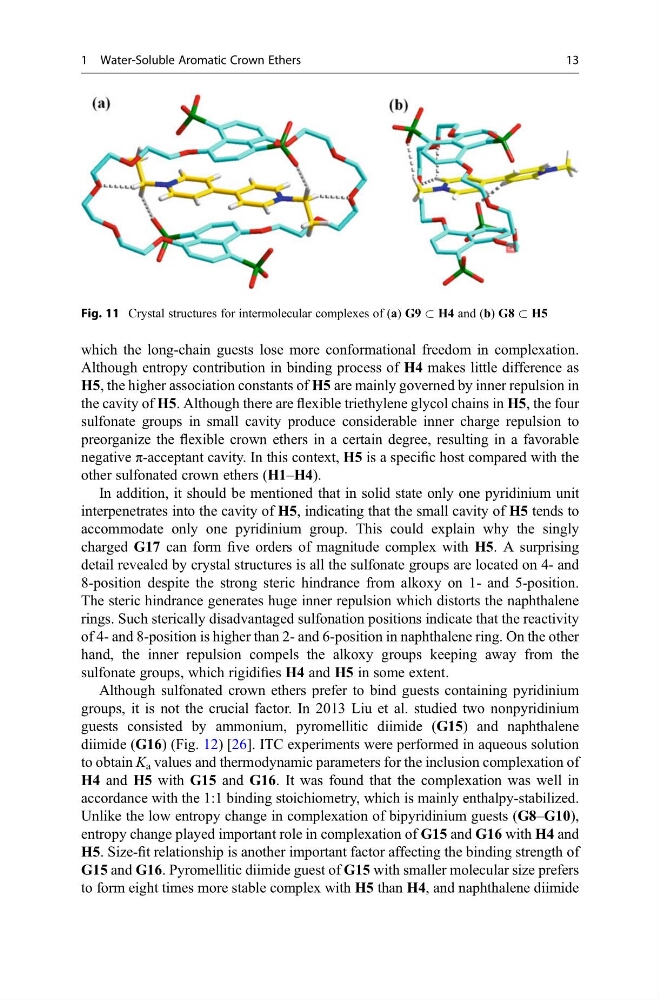
In addition, it should be mentioned that in solid state only one pyridinium unit
interpenetrates into the cavity of H5, indicating that the small cavity of H5 tends to
accommodate only one pyridinium group. This could explain why the singly
charged G17 can form five orders of magnitude complex with H5. A surprising
detail revealed by crystal structures is all the sulfonate groups are located on 4- and
8-position despite the strong steric hindrance from alkoxy on 1- and 5-position.
The steric hindrance generates huge inner repulsion which distorts the naphthalene
rings. Such sterically disadvantaged sulfonation positions indicate that the reactivity
of 4- and 8-position is higher than 2- and 6-position in naphthalene ring. On the other
hand, the inner repulsion compels the alkoxy groups keeping away from the
sulfonate groups, which rigidifies H4 and H5 in some extent.
Although sulfonated crown ethers prefer to bind guests containing pyridinium
groups, it is not the crucial factor. In 2013 Liu et al. studied two nonpyridinium
guests consisted by ammonium, pyromellitic diimide (G15) and naphthalene
diimide (G16) (Fig. 12) [26]. ITC experiments were performed in aqueous solution
to obtain K a values and thermodynamic parameters for the inclusion complexation of
H4 and H5 with G15 and G16. It was found that the complexation was well in
accordance with the 1:1 binding stoichiometry, which is mainly enthalpy-stabilized.
Unlike the low entropy change in complexation of bipyridinium guests (G8–G10),
entropy change played important role in complexation of G15 and G16 with H4 and
H5. Size-fit relationship is another important factor affecting the binding strength of
G15 and G16. Pyromellitic diimide guest of G15 with smaller molecular size prefers
to form eight times more stable complex with H5 than H4, and naphthalene diimide
Fig. 11 Crystal structures for intermolecular complexes of (a) G9 & H4 and (b) G8 & H5
1 Water-Soluble Aromatic Crown Ethers
13
Although entropy contribution in binding process of H4 makes little difference as
H5, the higher association constants of H5 are mainly governed by inner repulsion in
the cavity of H5. Although there are flexible triethylene glycol chains in H5, the four
sulfonate groups in small cavity produce considerable inner charge repulsion to
preorganize the flexible crown ethers in a certain degree, resulting in a favorable
negative π-acceptant cavity. In this context, H5 is a specific host compared with the
other sulfonated crown ethers (H1–H4).
In addition, it should be mentioned that in solid state only one pyridinium unit
interpenetrates into the cavity of H5, indicating that the small cavity of H5 tends to
accommodate only one pyridinium group. This could explain why the singly
charged G17 can form five orders of magnitude complex with H5. A surprising
detail revealed by crystal structures is all the sulfonate groups are located on 4- and
8-position despite the strong steric hindrance from alkoxy on 1- and 5-position.
The steric hindrance generates huge inner repulsion which distorts the naphthalene
rings. Such sterically disadvantaged sulfonation positions indicate that the reactivity
of 4- and 8-position is higher than 2- and 6-position in naphthalene ring. On the other
hand, the inner repulsion compels the alkoxy groups keeping away from the
sulfonate groups, which rigidifies H4 and H5 in some extent.
Although sulfonated crown ethers prefer to bind guests containing pyridinium
groups, it is not the crucial factor. In 2013 Liu et al. studied two nonpyridinium
guests consisted by ammonium, pyromellitic diimide (G15) and naphthalene
diimide (G16) (Fig. 12) [26]. ITC experiments were performed in aqueous solution
to obtain K a values and thermodynamic parameters for the inclusion complexation of
H4 and H5 with G15 and G16. It was found that the complexation was well in
accordance with the 1:1 binding stoichiometry, which is mainly enthalpy-stabilized.
Unlike the low entropy change in complexation of bipyridinium guests (G8–G10),
entropy change played important role in complexation of G15 and G16 with H4 and
H5. Size-fit relationship is another important factor affecting the binding strength of
G15 and G16. Pyromellitic diimide guest of G15 with smaller molecular size prefers
to form eight times more stable complex with H5 than H4, and naphthalene diimide
Fig. 11 Crystal structures for intermolecular complexes of (a) G9 & H4 and (b) G8 & H5
1 Water-Soluble Aromatic Crown Ethers
13