

π-electron-rich aromatic rings on hosts and π-electron-poor pyridinium rings of G8.
The inclusion properties were studied by this charge-transfer absorption. The K a of
G8 & H7 was determined to be 1.0 Â 10
3 M
À1 by analyzing the change of chargetransfer absorption, which is slightly higher than that of G9 & H6 reported by
Nikitin et al. The K a of G8 & H8 is 4.5 Â 10
3 M
À1 , revealing that naphtho unit on
H8 provides stronger π-stacking contributing to the host-guest complexation. The K a
value of G8 & H8, 4.5 Â 10
3 M
À1 , is about 3.3 times higher than that of G8 & H7.
This is due to that there is stronger π-stacking interaction in G8 & H8 because of the
existence of a naphthalene unit in H8.
Besides water-soluble aromatic crown ethers of H7 and H8, Huang et al. also
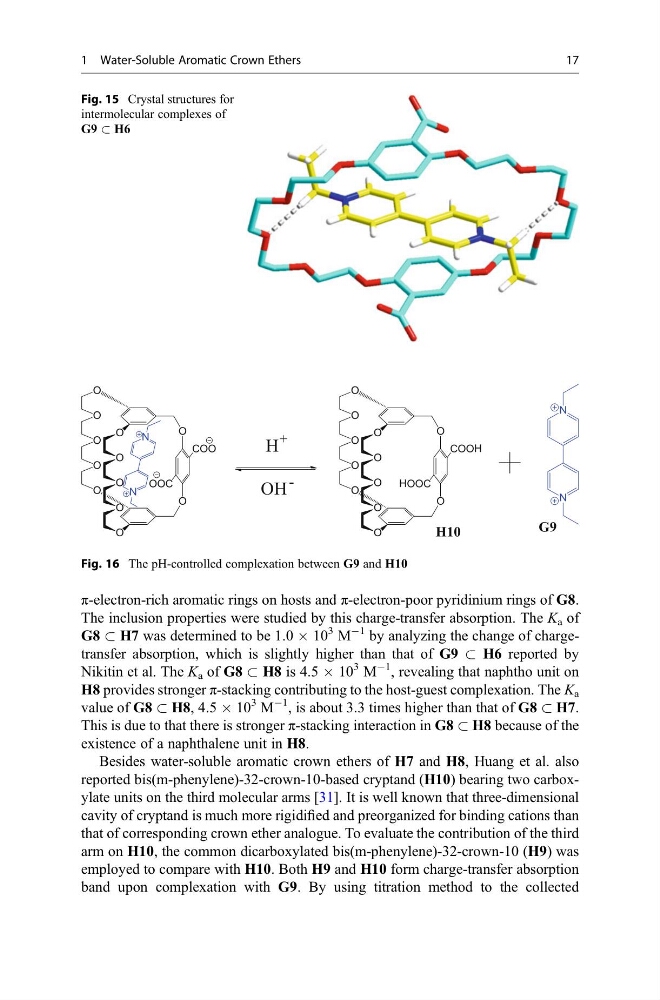
reported bis(m-phenylene)-32-crown-10-based cryptand (H10) bearing two carboxylate units on the third molecular arms [31]. It is well known that three-dimensional
cavity of cryptand is much more rigidified and preorganized for binding cations than
that of corresponding crown ether analogue. To evaluate the contribution of the third
arm on H10, the common dicarboxylated bis(m-phenylene)-32-crown-10 (H9) was
employed to compare with H10. Both H9 and H10 form charge-transfer absorption
band upon complexation with G9. By using titration method to the collected
Fig. 15 Crystal structures for
intermolecular complexes of
G9 & H6
O
O
COO
OOC
O
O
O
O
O
O
O
O
O
O
N
N
O
O
COOH
HOOC
O
O
O
O
O
O
O
O
O
O
N
N
H
+
OH -
H10
G9
Fig. 16 The pH-controlled complexation between G9 and H10
1 Water-Soluble Aromatic Crown Ethers
17
The inclusion properties were studied by this charge-transfer absorption. The K a of
G8 & H7 was determined to be 1.0 Â 10
3 M
À1 by analyzing the change of chargetransfer absorption, which is slightly higher than that of G9 & H6 reported by
Nikitin et al. The K a of G8 & H8 is 4.5 Â 10
3 M
À1 , revealing that naphtho unit on
H8 provides stronger π-stacking contributing to the host-guest complexation. The K a
value of G8 & H8, 4.5 Â 10
3 M
À1 , is about 3.3 times higher than that of G8 & H7.
This is due to that there is stronger π-stacking interaction in G8 & H8 because of the
existence of a naphthalene unit in H8.
Besides water-soluble aromatic crown ethers of H7 and H8, Huang et al. also
reported bis(m-phenylene)-32-crown-10-based cryptand (H10) bearing two carboxylate units on the third molecular arms [31]. It is well known that three-dimensional
cavity of cryptand is much more rigidified and preorganized for binding cations than
that of corresponding crown ether analogue. To evaluate the contribution of the third
arm on H10, the common dicarboxylated bis(m-phenylene)-32-crown-10 (H9) was
employed to compare with H10. Both H9 and H10 form charge-transfer absorption
band upon complexation with G9. By using titration method to the collected
Fig. 15 Crystal structures for
intermolecular complexes of
G9 & H6
O
O
COO
OOC
O
O
O
O
O
O
O
O
O
O
N
N
O
O
COOH
HOOC
O
O
O
O
O
O
O
O
O
O
N
N
H
+
OH -
H10
G9
Fig. 16 The pH-controlled complexation between G9 and H10
1 Water-Soluble Aromatic Crown Ethers
17