

14.3.2 Cyclodextrin-Based Multivalency Drug Carriers
Attachment of biorecognizable sugar ligands in several copies to a cyclomaltooligosaccharide (such as cyclodextrin) at precise positions via covalent bonds to form
multivalent conjugates has been demonstrated in some specific delivery systems.
Moreover, the commercial availability of the native CDs, their very good biocompatibility, and the convenience of position- and face-selective functionalization
allow strict control of the valency of the sugar ligand attachment to CDs [32].
Carbohydrate ligands play a very important role in biological recognition, and
the recognition processes are strongly related to their density in the specific region.
Therefore, multivalent oligosaccharides display a significant improvement in
biorecognizable ability. The cyclodextrin family can be employed as platforms
after functionalization to conjugate saccharides, forming multivalency derivatives
[33–36]. These multivalency derivatives are very good carriers for site-specific
drug delivery. The hydroxyls on both the primary rim and the secondary rim can be
substituted by other functional groups through selectively functionalized reactions
to obtain mono-CD glycoconjugates, bis-selective CD glycoconjugates, faceselective CD glycoconjugates, dual-face CD glycoconjugates, and hyperbranched
glycoconjugates (Fig. 5).
14.3.2.1 Cyclodextrin-Monobranched Glycocluster
The concept of a CD–glycodendritic architecture, based on a single primary position
of CDs connected to a branched saccharide through a spacer, seems to be well
adapted for molecule encapsulation for site-specific drug delivery. The CD system
shuttles the drug to the lectin (receptor) under the recognition of the glycocluster to
improve the density of the drug at the specific position in order to enhance treatment
and avoid side effects (Fig. 6).
In view of the above description, Zhao and Astruc [37] designed a molecular
system consisting of a dual β-CD cavity conjugated with hexavalent α-mannose
(α-Man) saccharides to complex the antimitotic drug docetaxel (Taxotere). The
distance between two CDs was appropriate for two phenyl rings, which were easy
to complex with Taxotere (Fig. 7). After a macrophage mannose receptor (MMR)
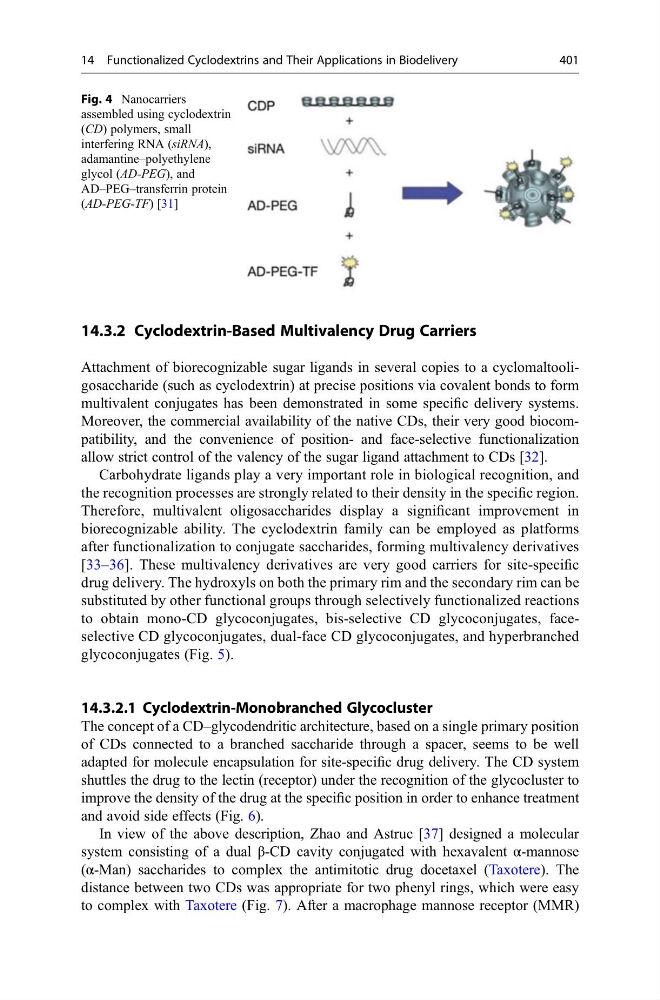
Fig. 4 Nanocarriers
assembled using cyclodextrin
(CD) polymers, small
interfering RNA (siRNA),
adamantine–polyethylene
glycol (AD-PEG), and
AD–PEG–transferrin protein
(AD-PEG-TF) [31]
14 Functionalized Cyclodextrins and Their Applications in Biodelivery
401
Attachment of biorecognizable sugar ligands in several copies to a cyclomaltooligosaccharide (such as cyclodextrin) at precise positions via covalent bonds to form
multivalent conjugates has been demonstrated in some specific delivery systems.
Moreover, the commercial availability of the native CDs, their very good biocompatibility, and the convenience of position- and face-selective functionalization
allow strict control of the valency of the sugar ligand attachment to CDs [32].
Carbohydrate ligands play a very important role in biological recognition, and
the recognition processes are strongly related to their density in the specific region.
Therefore, multivalent oligosaccharides display a significant improvement in
biorecognizable ability. The cyclodextrin family can be employed as platforms
after functionalization to conjugate saccharides, forming multivalency derivatives
[33–36]. These multivalency derivatives are very good carriers for site-specific
drug delivery. The hydroxyls on both the primary rim and the secondary rim can be
substituted by other functional groups through selectively functionalized reactions
to obtain mono-CD glycoconjugates, bis-selective CD glycoconjugates, faceselective CD glycoconjugates, dual-face CD glycoconjugates, and hyperbranched
glycoconjugates (Fig. 5).
14.3.2.1 Cyclodextrin-Monobranched Glycocluster
The concept of a CD–glycodendritic architecture, based on a single primary position
of CDs connected to a branched saccharide through a spacer, seems to be well
adapted for molecule encapsulation for site-specific drug delivery. The CD system
shuttles the drug to the lectin (receptor) under the recognition of the glycocluster to
improve the density of the drug at the specific position in order to enhance treatment
and avoid side effects (Fig. 6).
In view of the above description, Zhao and Astruc [37] designed a molecular
system consisting of a dual β-CD cavity conjugated with hexavalent α-mannose
(α-Man) saccharides to complex the antimitotic drug docetaxel (Taxotere). The
distance between two CDs was appropriate for two phenyl rings, which were easy
to complex with Taxotere (Fig. 7). After a macrophage mannose receptor (MMR)
Fig. 4 Nanocarriers
assembled using cyclodextrin
(CD) polymers, small
interfering RNA (siRNA),
adamantine–polyethylene
glycol (AD-PEG), and
AD–PEG–transferrin protein
(AD-PEG-TF) [31]
14 Functionalized Cyclodextrins and Their Applications in Biodelivery
401