

14.2.2.2 Bridging Cyclodextrin Strategy
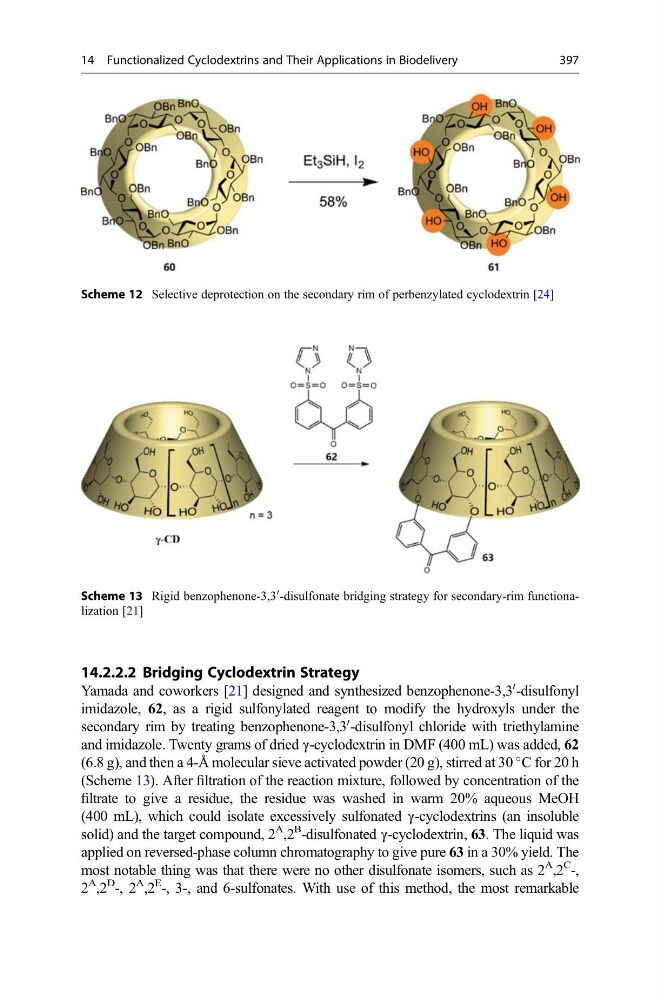
Yamada and coworkers [21] designed and synthesized benzophenone-3,3
0 -disulfonyl
imidazole, 62, as a rigid sulfonylated reagent to modify the hydroxyls under the
secondary rim by treating benzophenone-3,3
0 -disulfonyl chloride with triethylamine
and imidazole. Twenty grams of dried γ-cyclodextrin in DMF (400 mL) was added, 62
(6.8 g), and then a 4-Å molecular sieve activated powder (20 g), stirred at 30
C for 20 h
(Scheme 13). After filtration of the reaction mixture, followed by concentration of the
filtrate to give a residue, the residue was washed in warm 20% aqueous MeOH
(400 mL), which could isolate excessively sulfonated γ-cyclodextrins (an insoluble
solid) and the target compound, 2
A
,2
B
-disulfonated γ-cyclodextrin, 63. The liquid was
applied on reversed-phase column chromatography to give pure 63 in a 30% yield. The
most notable thing was that there were no other disulfonate isomers, such as 2
A
,2
C
-,
2
A
,2
D
-, 2
A
,2
E
-, 3-, and 6-sulfonates. With use of this method, the most remarkable
Scheme 12 Selective deprotection on the secondary rim of perbenzylated cyclodextrin [24]
Scheme 13 Rigid benzophenone-3,3
0 -disulfonate bridging strategy for secondary-rim functionalization [21]
14 Functionalized Cyclodextrins and Their Applications in Biodelivery
397
Yamada and coworkers [21] designed and synthesized benzophenone-3,3
0 -disulfonyl
imidazole, 62, as a rigid sulfonylated reagent to modify the hydroxyls under the
secondary rim by treating benzophenone-3,3
0 -disulfonyl chloride with triethylamine
and imidazole. Twenty grams of dried γ-cyclodextrin in DMF (400 mL) was added, 62
(6.8 g), and then a 4-Å molecular sieve activated powder (20 g), stirred at 30
C for 20 h
(Scheme 13). After filtration of the reaction mixture, followed by concentration of the
filtrate to give a residue, the residue was washed in warm 20% aqueous MeOH
(400 mL), which could isolate excessively sulfonated γ-cyclodextrins (an insoluble
solid) and the target compound, 2
A
,2
B
-disulfonated γ-cyclodextrin, 63. The liquid was
applied on reversed-phase column chromatography to give pure 63 in a 30% yield. The
most notable thing was that there were no other disulfonate isomers, such as 2
A
,2
C
-,
2
A
,2
D
-, 2
A
,2
E
-, 3-, and 6-sulfonates. With use of this method, the most remarkable
Scheme 12 Selective deprotection on the secondary rim of perbenzylated cyclodextrin [24]
Scheme 13 Rigid benzophenone-3,3
0 -disulfonate bridging strategy for secondary-rim functionalization [21]
14 Functionalized Cyclodextrins and Their Applications in Biodelivery
397