

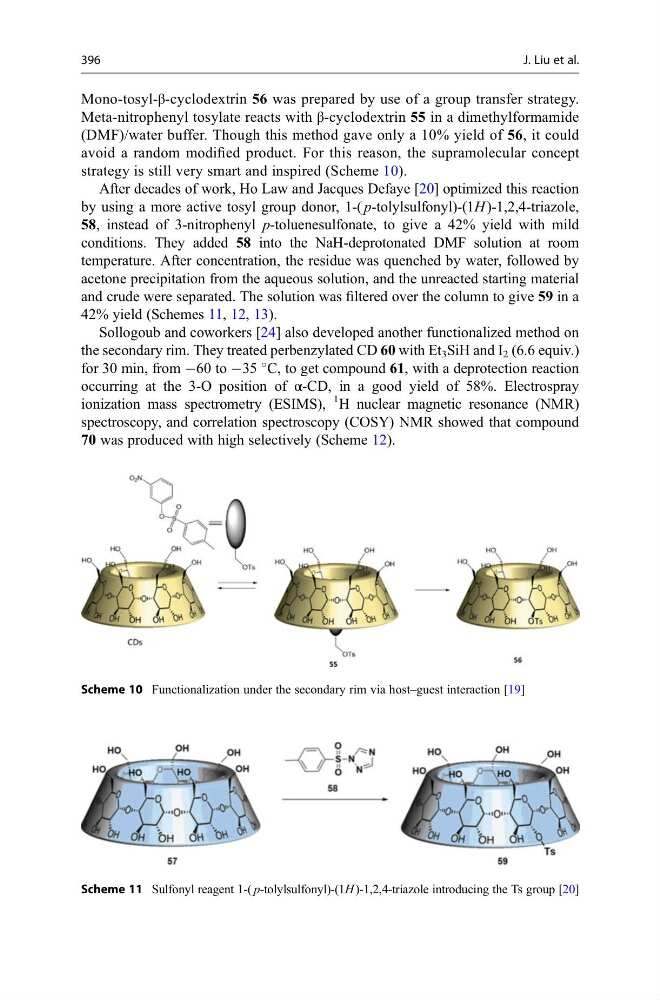
Mono-tosyl-β-cyclodextrin 56 was prepared by use of a group transfer strategy.
Meta-nitrophenyl tosylate reacts with β-cyclodextrin 55 in a dimethylformamide
(DMF)/water buffer. Though this method gave only a 10% yield of 56, it could
avoid a random modified product. For this reason, the supramolecular concept
strategy is still very smart and inspired (Scheme 10).
After decades of work, Ho Law and Jacques Defaye [20] optimized this reaction
by using a more active tosyl group donor, 1-( p-tolylsulfonyl)-(1H )-1,2,4-triazole,
58, instead of 3-nitrophenyl p-toluenesulfonate, to give a 42% yield with mild
conditions. They added 58 into the NaH-deprotonated DMF solution at room
temperature. After concentration, the residue was quenched by water, followed by
acetone precipitation from the aqueous solution, and the unreacted starting material
and crude were separated. The solution was filtered over the column to give 59 in a
42% yield (Schemes 11, 12, 13).
Sollogoub and coworkers [24] also developed another functionalized method on
the secondary rim. They treated perbenzylated CD 60 with Et 3 SiH and I 2 (6.6 equiv.)
for 30 min, from À60 to À35
C, to get compound 61, with a deprotection reaction
occurring at the 3-O position of α-CD, in a good yield of 58%. Electrospray
ionization mass spectrometry (ESIMS),
1 H nuclear magnetic resonance (NMR)
spectroscopy, and correlation spectroscopy (COSY) NMR showed that compound
70 was produced with high selectively (Scheme 12).
Scheme 10 Functionalization under the secondary rim via host–guest interaction [19]
Scheme 11 Sulfonyl reagent 1-( p-tolylsulfonyl)-(1H )-1,2,4-triazole introducing the Ts group [20]
396
J. Liu et al.
Meta-nitrophenyl tosylate reacts with β-cyclodextrin 55 in a dimethylformamide
(DMF)/water buffer. Though this method gave only a 10% yield of 56, it could
avoid a random modified product. For this reason, the supramolecular concept
strategy is still very smart and inspired (Scheme 10).
After decades of work, Ho Law and Jacques Defaye [20] optimized this reaction
by using a more active tosyl group donor, 1-( p-tolylsulfonyl)-(1H )-1,2,4-triazole,
58, instead of 3-nitrophenyl p-toluenesulfonate, to give a 42% yield with mild
conditions. They added 58 into the NaH-deprotonated DMF solution at room
temperature. After concentration, the residue was quenched by water, followed by
acetone precipitation from the aqueous solution, and the unreacted starting material
and crude were separated. The solution was filtered over the column to give 59 in a
42% yield (Schemes 11, 12, 13).
Sollogoub and coworkers [24] also developed another functionalized method on
the secondary rim. They treated perbenzylated CD 60 with Et 3 SiH and I 2 (6.6 equiv.)
for 30 min, from À60 to À35
C, to get compound 61, with a deprotection reaction
occurring at the 3-O position of α-CD, in a good yield of 58%. Electrospray
ionization mass spectrometry (ESIMS),
1 H nuclear magnetic resonance (NMR)
spectroscopy, and correlation spectroscopy (COSY) NMR showed that compound
70 was produced with high selectively (Scheme 12).
Scheme 10 Functionalization under the secondary rim via host–guest interaction [19]
Scheme 11 Sulfonyl reagent 1-( p-tolylsulfonyl)-(1H )-1,2,4-triazole introducing the Ts group [20]
396
J. Liu et al.