

benefit was that they developed a mild nonalkaline reaction condition that could avoid
decomposition of the sulfonates because of the existing bases (Scheme 13).
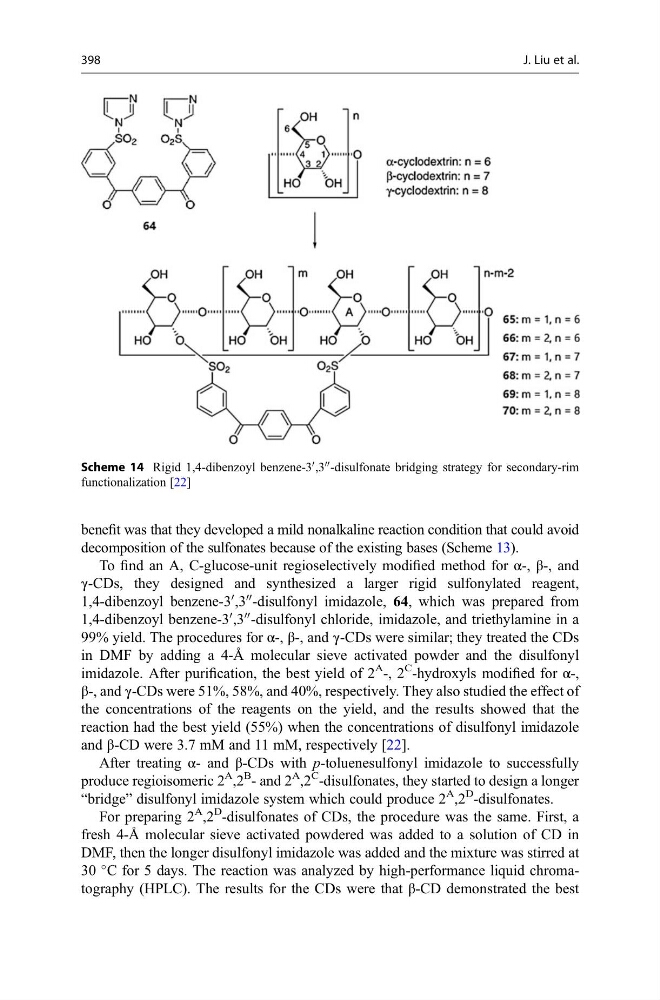
To find an A, C-glucose-unit regioselectively modified method for α-, β-, and
γ-CDs, they designed and synthesized a larger rigid sulfonylated reagent,
1,4-dibenzoyl benzene-3
0 ,3
00 -disulfonyl imidazole, 64, which was prepared from
1,4-dibenzoyl benzene-3
0 ,3
00 -disulfonyl chloride, imidazole, and triethylamine in a
99% yield. The procedures for α-, β-, and γ-CDs were similar; they treated the CDs
in DMF by adding a 4-Å molecular sieve activated powder and the disulfonyl
imidazole. After purification, the best yield of 2
A
-, 2
C -hydroxyls modified for α-,
β-, and γ-CDs were 51%, 58%, and 40%, respectively. They also studied the effect of
the concentrations of the reagents on the yield, and the results showed that the
reaction had the best yield (55%) when the concentrations of disulfonyl imidazole
and β-CD were 3.7 mM and 11 mM, respectively [22].
After treating α- and β-CDs with p-toluenesulfonyl imidazole to successfully
produce regioisomeric 2
A
,2
B
- and 2
A ,2
C -disulfonates, they started to design a longer
“bridge” disulfonyl imidazole system which could produce 2
A ,2
D -disulfonates.
For preparing 2
A ,2
D -disulfonates of CDs, the procedure was the same. First, a
fresh 4-Å molecular sieve activated powdered was added to a solution of CD in
DMF, then the longer disulfonyl imidazole was added and the mixture was stirred at
30
C for 5 days. The reaction was analyzed by high-performance liquid chromatography (HPLC). The results for the CDs were that β-CD demonstrated the best
Scheme 14 Rigid 1,4-dibenzoyl benzene-3
0 ,3
00 -disulfonate bridging strategy for secondary-rim
functionalization [22]
398
J. Liu et al.
decomposition of the sulfonates because of the existing bases (Scheme 13).
To find an A, C-glucose-unit regioselectively modified method for α-, β-, and
γ-CDs, they designed and synthesized a larger rigid sulfonylated reagent,
1,4-dibenzoyl benzene-3
0 ,3
00 -disulfonyl imidazole, 64, which was prepared from
1,4-dibenzoyl benzene-3
0 ,3
00 -disulfonyl chloride, imidazole, and triethylamine in a
99% yield. The procedures for α-, β-, and γ-CDs were similar; they treated the CDs
in DMF by adding a 4-Å molecular sieve activated powder and the disulfonyl
imidazole. After purification, the best yield of 2
A
-, 2
C -hydroxyls modified for α-,
β-, and γ-CDs were 51%, 58%, and 40%, respectively. They also studied the effect of
the concentrations of the reagents on the yield, and the results showed that the
reaction had the best yield (55%) when the concentrations of disulfonyl imidazole
and β-CD were 3.7 mM and 11 mM, respectively [22].
After treating α- and β-CDs with p-toluenesulfonyl imidazole to successfully
produce regioisomeric 2
A
,2
B
- and 2
A ,2
C -disulfonates, they started to design a longer
“bridge” disulfonyl imidazole system which could produce 2
A ,2
D -disulfonates.
For preparing 2
A ,2
D -disulfonates of CDs, the procedure was the same. First, a
fresh 4-Å molecular sieve activated powdered was added to a solution of CD in
DMF, then the longer disulfonyl imidazole was added and the mixture was stirred at
30
C for 5 days. The reaction was analyzed by high-performance liquid chromatography (HPLC). The results for the CDs were that β-CD demonstrated the best
Scheme 14 Rigid 1,4-dibenzoyl benzene-3
0 ,3
00 -disulfonate bridging strategy for secondary-rim
functionalization [22]
398
J. Liu et al.