

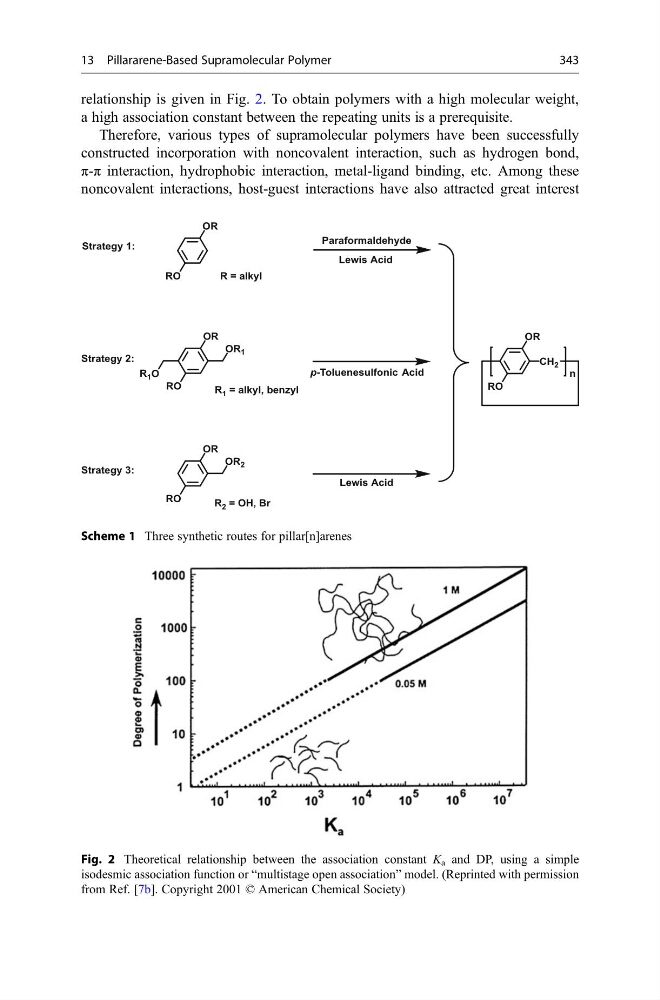
relationship is given in Fig. 2. To obtain polymers with a high molecular weight,
a high association constant between the repeating units is a prerequisite.
Therefore, various types of supramolecular polymers have been successfully
constructed incorporation with noncovalent interaction, such as hydrogen bond,
π-π interaction, hydrophobic interaction, metal-ligand binding, etc. Among these
noncovalent interactions, host-guest interactions have also attracted great interest
OR
RO
R = alkyl
OR
RO
R 1 O
OR 1
R 1 = alkyl, benzyl
OR
RO
OR 2
R 2 = OH, Br
Strategy 1:
Strategy 2:
Strategy 3:
Paraformaldehyde
Lewis Acid
p-Toluenesulfonic Acid
Lewis Acid
OR
RO
CH 2
n
Scheme 1 Three synthetic routes for pillar[n]arenes
Fig. 2 Theoretical relationship between the association constant K a and DP, using a simple
isodesmic association function or “multistage open association” model. (Reprinted with permission
from Ref. [7b]. Copyright 2001 © American Chemical Society)
13 Pillararene-Based Supramolecular Polymer
343
a high association constant between the repeating units is a prerequisite.
Therefore, various types of supramolecular polymers have been successfully
constructed incorporation with noncovalent interaction, such as hydrogen bond,
π-π interaction, hydrophobic interaction, metal-ligand binding, etc. Among these
noncovalent interactions, host-guest interactions have also attracted great interest
OR
RO
R = alkyl
OR
RO
R 1 O
OR 1
R 1 = alkyl, benzyl
OR
RO
OR 2
R 2 = OH, Br
Strategy 1:
Strategy 2:
Strategy 3:
Paraformaldehyde
Lewis Acid
p-Toluenesulfonic Acid
Lewis Acid
OR
RO
CH 2
n
Scheme 1 Three synthetic routes for pillar[n]arenes
Fig. 2 Theoretical relationship between the association constant K a and DP, using a simple
isodesmic association function or “multistage open association” model. (Reprinted with permission
from Ref. [7b]. Copyright 2001 © American Chemical Society)
13 Pillararene-Based Supramolecular Polymer
343