

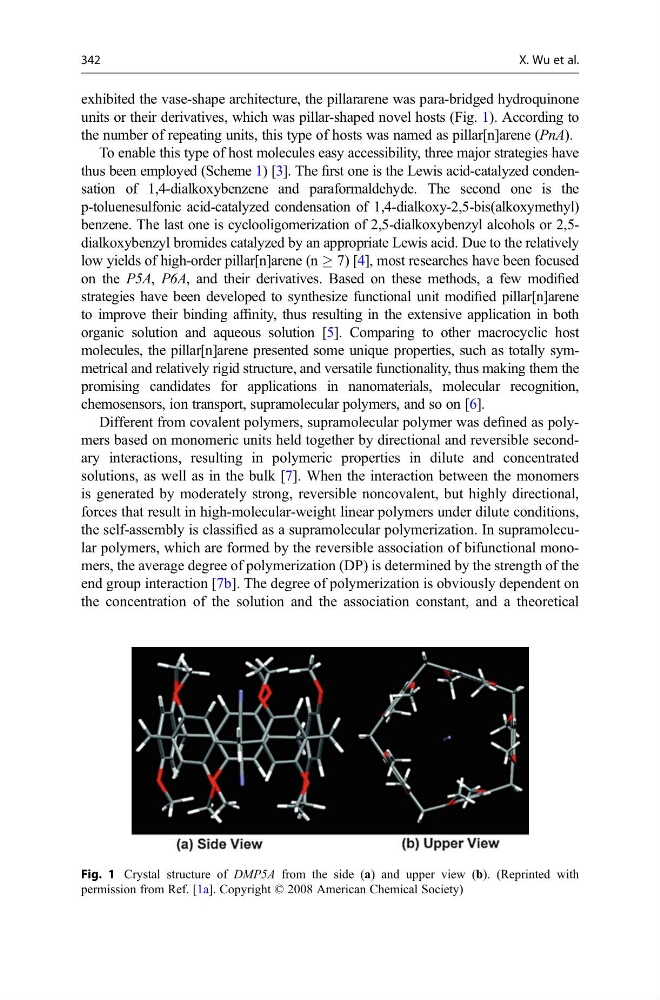
exhibited the vase-shape architecture, the pillararene was para-bridged hydroquinone
units or their derivatives, which was pillar-shaped novel hosts (Fig. 1). According to
the number of repeating units, this type of hosts was named as pillar[n]arene (PnA).
To enable this type of host molecules easy accessibility, three major strategies have
thus been employed (Scheme 1) [3]. The first one is the Lewis acid-catalyzed condensation of 1,4-dialkoxybenzene and paraformaldehyde. The second one is the
p-toluenesulfonic acid-catalyzed condensation of 1,4-dialkoxy-2,5-bis(alkoxymethyl)
benzene. The last one is cyclooligomerization of 2,5-dialkoxybenzyl alcohols or 2,5dialkoxybenzyl bromides catalyzed by an appropriate Lewis acid. Due to the relatively
low yields of high-order pillar[n]arene (n ! 7) [4], most researches have been focused
on the P5A, P6A, and their derivatives. Based on these methods, a few modified
strategies have been developed to synthesize functional unit modified pillar[n]arene
to improve their binding affinity, thus resulting in the extensive application in both
organic solution and aqueous solution [5]. Comparing to other macrocyclic host
molecules, the pillar[n]arene presented some unique properties, such as totally symmetrical and relatively rigid structure, and versatile functionality, thus making them the
promising candidates for applications in nanomaterials, molecular recognition,
chemosensors, ion transport, supramolecular polymers, and so on [6].
Different from covalent polymers, supramolecular polymer was defined as polymers based on monomeric units held together by directional and reversible secondary interactions, resulting in polymeric properties in dilute and concentrated
solutions, as well as in the bulk [7]. When the interaction between the monomers
is generated by moderately strong, reversible noncovalent, but highly directional,
forces that result in high-molecular-weight linear polymers under dilute conditions,
the self-assembly is classified as a supramolecular polymerization. In supramolecular polymers, which are formed by the reversible association of bifunctional monomers, the average degree of polymerization (DP) is determined by the strength of the
end group interaction [7b]. The degree of polymerization is obviously dependent on
the concentration of the solution and the association constant, and a theoretical
Fig. 1 Crystal structure of DMP5A from the side (a) and upper view (b). (Reprinted with
permission from Ref. [1a]. Copyright © 2008 American Chemical Society)
342
X. Wu et al.
units or their derivatives, which was pillar-shaped novel hosts (Fig. 1). According to
the number of repeating units, this type of hosts was named as pillar[n]arene (PnA).
To enable this type of host molecules easy accessibility, three major strategies have
thus been employed (Scheme 1) [3]. The first one is the Lewis acid-catalyzed condensation of 1,4-dialkoxybenzene and paraformaldehyde. The second one is the
p-toluenesulfonic acid-catalyzed condensation of 1,4-dialkoxy-2,5-bis(alkoxymethyl)
benzene. The last one is cyclooligomerization of 2,5-dialkoxybenzyl alcohols or 2,5dialkoxybenzyl bromides catalyzed by an appropriate Lewis acid. Due to the relatively
low yields of high-order pillar[n]arene (n ! 7) [4], most researches have been focused
on the P5A, P6A, and their derivatives. Based on these methods, a few modified
strategies have been developed to synthesize functional unit modified pillar[n]arene
to improve their binding affinity, thus resulting in the extensive application in both
organic solution and aqueous solution [5]. Comparing to other macrocyclic host
molecules, the pillar[n]arene presented some unique properties, such as totally symmetrical and relatively rigid structure, and versatile functionality, thus making them the
promising candidates for applications in nanomaterials, molecular recognition,
chemosensors, ion transport, supramolecular polymers, and so on [6].
Different from covalent polymers, supramolecular polymer was defined as polymers based on monomeric units held together by directional and reversible secondary interactions, resulting in polymeric properties in dilute and concentrated
solutions, as well as in the bulk [7]. When the interaction between the monomers
is generated by moderately strong, reversible noncovalent, but highly directional,
forces that result in high-molecular-weight linear polymers under dilute conditions,
the self-assembly is classified as a supramolecular polymerization. In supramolecular polymers, which are formed by the reversible association of bifunctional monomers, the average degree of polymerization (DP) is determined by the strength of the
end group interaction [7b]. The degree of polymerization is obviously dependent on
the concentration of the solution and the association constant, and a theoretical
Fig. 1 Crystal structure of DMP5A from the side (a) and upper view (b). (Reprinted with
permission from Ref. [1a]. Copyright © 2008 American Chemical Society)
342
X. Wu et al.