

because there are multiple and cooperative noncovalent interactions in the inclusion
complexes of hosts and guests. In this chapter, the supramolecular polymer
constructed by pillar[n]arene was summarized, as well as their potential application,
which is mainly focused on the pillar[5]arene and pillar[6]arene. And we hope it can
provide inspiration for the constructions of smart materials based on pillar[n]arenes.
13.2 Construction of Pillar[N]Arene-Based Supramolecular
Polymer
13.2.1 Supramolecular Polymer Formed by Host-Guest Interaction
As a new generation of macrocyclic molecules, pillar[n]arene exhibited excellent
host-guest properties due to their rigid structures, electron-rich cavities, and easy
modification. Traditionally, the main driving forces to form the host-guest complexation were C-H•••π, C-H•••O, and cation•••π interaction. Based on these fundamental researches to explore the suitable guest molecules for this type host molecules,
tremendous supramolecular polymers have also been successfully constructed.
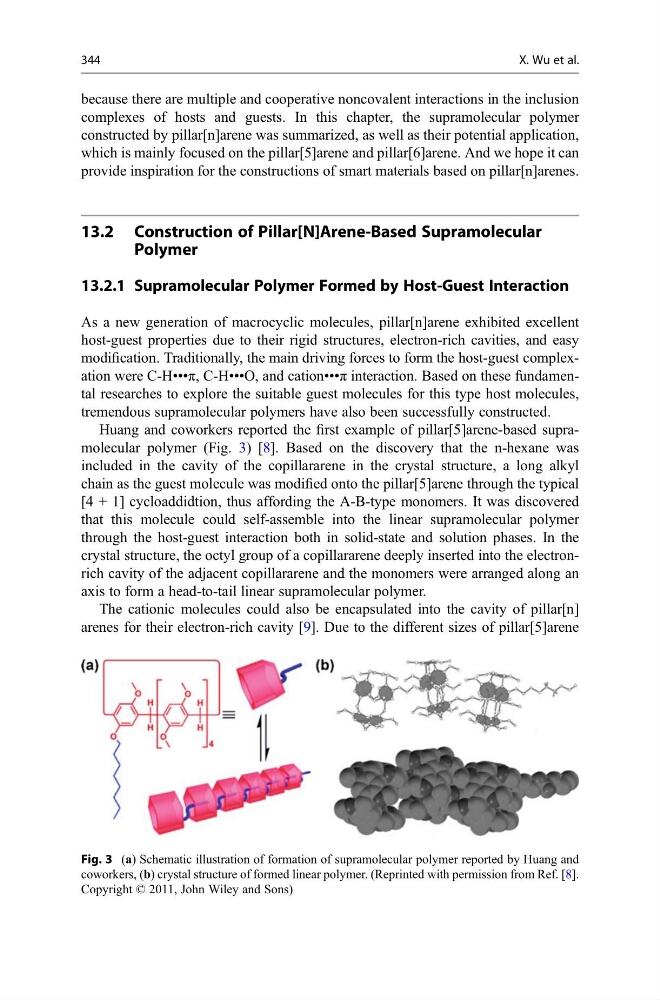
Huang and coworkers reported the first example of pillar[5]arene-based supramolecular polymer (Fig. 3) [8]. Based on the discovery that the n-hexane was
included in the cavity of the copillararene in the crystal structure, a long alkyl
chain as the guest molecule was modified onto the pillar[5]arene through the typical
[4 + 1] cycloaddidtion, thus affording the A-B-type monomers. It was discovered
that this molecule could self-assemble into the linear supramolecular polymer
through the host-guest interaction both in solid-state and solution phases. In the
crystal structure, the octyl group of a copillararene deeply inserted into the electronrich cavity of the adjacent copillararene and the monomers were arranged along an
axis to form a head-to-tail linear supramolecular polymer.
The cationic molecules could also be encapsulated into the cavity of pillar[n]
arenes for their electron-rich cavity [9]. Due to the different sizes of pillar[5]arene
Fig. 3 (a) Schematic illustration of formation of supramolecular polymer reported by Huang and
coworkers, (b) crystal structure of formed linear polymer. (Reprinted with permission from Ref. [8].
Copyright © 2011, John Wiley and Sons)
344
X. Wu et al.
complexes of hosts and guests. In this chapter, the supramolecular polymer
constructed by pillar[n]arene was summarized, as well as their potential application,
which is mainly focused on the pillar[5]arene and pillar[6]arene. And we hope it can
provide inspiration for the constructions of smart materials based on pillar[n]arenes.
13.2 Construction of Pillar[N]Arene-Based Supramolecular
Polymer
13.2.1 Supramolecular Polymer Formed by Host-Guest Interaction
As a new generation of macrocyclic molecules, pillar[n]arene exhibited excellent
host-guest properties due to their rigid structures, electron-rich cavities, and easy
modification. Traditionally, the main driving forces to form the host-guest complexation were C-H•••π, C-H•••O, and cation•••π interaction. Based on these fundamental researches to explore the suitable guest molecules for this type host molecules,
tremendous supramolecular polymers have also been successfully constructed.
Huang and coworkers reported the first example of pillar[5]arene-based supramolecular polymer (Fig. 3) [8]. Based on the discovery that the n-hexane was
included in the cavity of the copillararene in the crystal structure, a long alkyl
chain as the guest molecule was modified onto the pillar[5]arene through the typical
[4 + 1] cycloaddidtion, thus affording the A-B-type monomers. It was discovered
that this molecule could self-assemble into the linear supramolecular polymer
through the host-guest interaction both in solid-state and solution phases. In the
crystal structure, the octyl group of a copillararene deeply inserted into the electronrich cavity of the adjacent copillararene and the monomers were arranged along an
axis to form a head-to-tail linear supramolecular polymer.
The cationic molecules could also be encapsulated into the cavity of pillar[n]
arenes for their electron-rich cavity [9]. Due to the different sizes of pillar[5]arene
Fig. 3 (a) Schematic illustration of formation of supramolecular polymer reported by Huang and
coworkers, (b) crystal structure of formed linear polymer. (Reprinted with permission from Ref. [8].
Copyright © 2011, John Wiley and Sons)
344
X. Wu et al.