

622 Æ 2 M
À1 (Entry 67), mainly driven by electrostatic interactions. In particular, the
critical aggregation concentration of the inclusion complex between 44CBP3-TM
and G25
À was evaluated to be 1.24 Â 10
À5 M, which is lower than that of G25
À
alone. It is believed that the supra-amphiphile forms through the host–guest recognition motif. TEM and DLS experiments assisted in the visualization of the
self-assembly sizes and morphologies of the supra-amphiphiles. As shown in
Fig. 12, TEM confirmed that 44CBP3-TM and G25
À could self-assemble into
regular nanoparticles with a diameter of ~18 nm in water, drastically different
from the smaller micelles formed by G25
À alone. The DLS results showed that
the average diameter of the aggregates was ~19 nm, in agreement with the
corresponding value obtained from the TEM images.
Self-assembly has become a powerful method for the construction of functional
nanoarchitecture, especially the formation of supramolecular organic gels by selfassembly of low-molecular-weight building blocks. Recently, our group reported the
synthesis of terphen[n]arenes and quaterphen[n]arenes. Meanwhile, the macrocyclic
pentamers and hexamers exhibit interesting self-assembly behavior, which leads
to the formation of gels (G-TP5, G-TP6, G-QP5, and G-QP6) in organic solvent
through intermolecular πÁ Á Áπ interactions [27]. Powder X-ray diffraction experiments confirmed that organogel formation was governed by multiple πÁ Á Áπ stacking
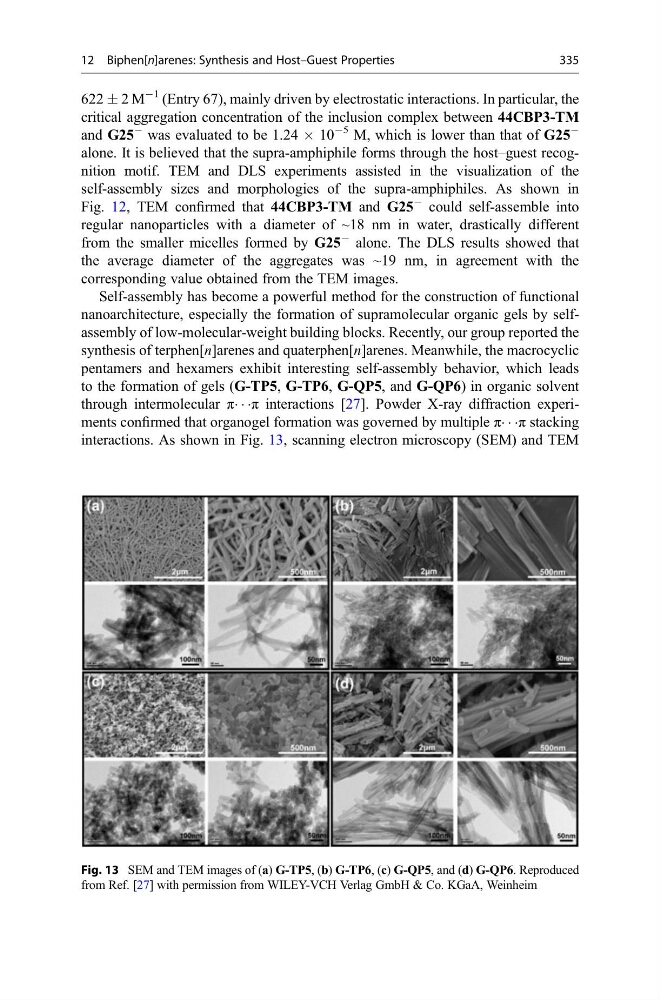
interactions. As shown in Fig. 13, scanning electron microscopy (SEM) and TEM
Fig. 13 SEM and TEM images of (a) G-TP5, (b) G-TP6, (c) G-QP5, and (d) G-QP6. Reproduced
from Ref. [27] with permission from WILEY-VCH Verlag GmbH & Co. KGaA, Weinheim
12 Biphen[n]arenes: Synthesis and Host–Guest Properties
335
À1 (Entry 67), mainly driven by electrostatic interactions. In particular, the
critical aggregation concentration of the inclusion complex between 44CBP3-TM
and G25
À was evaluated to be 1.24 Â 10
À5 M, which is lower than that of G25
À
alone. It is believed that the supra-amphiphile forms through the host–guest recognition motif. TEM and DLS experiments assisted in the visualization of the
self-assembly sizes and morphologies of the supra-amphiphiles. As shown in
Fig. 12, TEM confirmed that 44CBP3-TM and G25
À could self-assemble into
regular nanoparticles with a diameter of ~18 nm in water, drastically different
from the smaller micelles formed by G25
À alone. The DLS results showed that
the average diameter of the aggregates was ~19 nm, in agreement with the
corresponding value obtained from the TEM images.
Self-assembly has become a powerful method for the construction of functional
nanoarchitecture, especially the formation of supramolecular organic gels by selfassembly of low-molecular-weight building blocks. Recently, our group reported the
synthesis of terphen[n]arenes and quaterphen[n]arenes. Meanwhile, the macrocyclic
pentamers and hexamers exhibit interesting self-assembly behavior, which leads
to the formation of gels (G-TP5, G-TP6, G-QP5, and G-QP6) in organic solvent
through intermolecular πÁ Á Áπ interactions [27]. Powder X-ray diffraction experiments confirmed that organogel formation was governed by multiple πÁ Á Áπ stacking
interactions. As shown in Fig. 13, scanning electron microscopy (SEM) and TEM
Fig. 13 SEM and TEM images of (a) G-TP5, (b) G-TP6, (c) G-QP5, and (d) G-QP6. Reproduced
from Ref. [27] with permission from WILEY-VCH Verlag GmbH & Co. KGaA, Weinheim
12 Biphen[n]arenes: Synthesis and Host–Guest Properties
335