

of the gels displayed that they had diverse morphologies with interwoven fibers,
nanosheets, or entangled macropore networks.
Radioactive iodine, with very long half-life of 1.57 Â 10
7 years, is produced in
the process of fossil fuel combustion from the nuclear power industry and spread
rapidly in air and water. Thus, it is significant to capture and store radioactive iodine
from nuclear fuel processing by appropriate adsorbents. Interestingly, these xerogels
displayed a good ability to capture iodine not only in aqueous solution but also in the
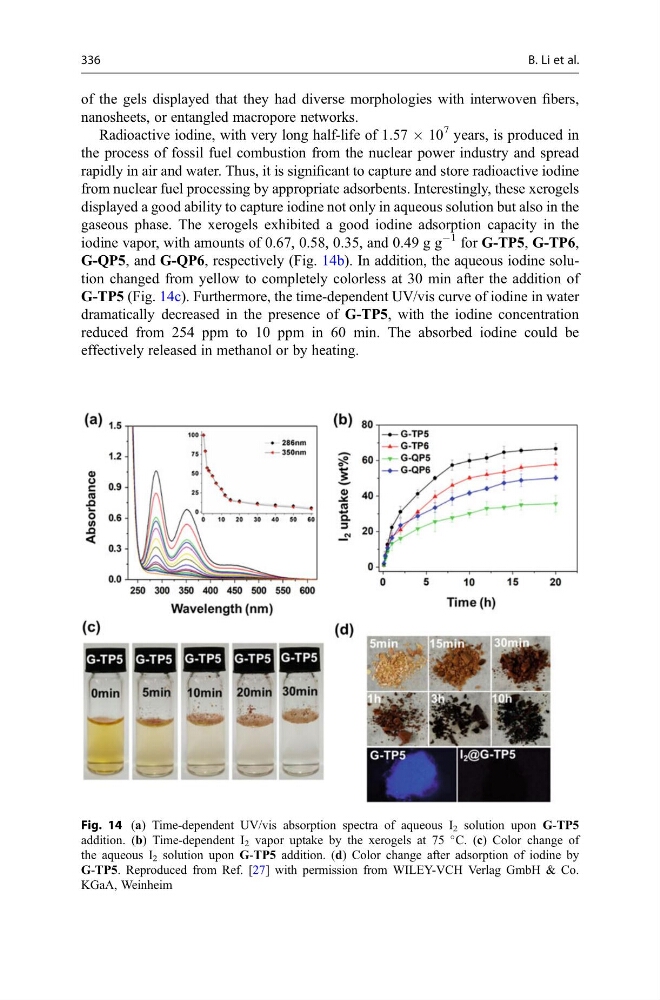
gaseous phase. The xerogels exhibited a good iodine adsorption capacity in the
iodine vapor, with amounts of 0.67, 0.58, 0.35, and 0.49 g g
À1 for G-TP5, G-TP6,
G-QP5, and G-QP6, respectively (Fig. 14b). In addition, the aqueous iodine solution changed from yellow to completely colorless at 30 min after the addition of
G-TP5 (Fig. 14c). Furthermore, the time-dependent UV/vis curve of iodine in water
dramatically decreased in the presence of G-TP5, with the iodine concentration
reduced from 254 ppm to 10 ppm in 60 min. The absorbed iodine could be
effectively released in methanol or by heating.
Fig. 14 (a) Time-dependent UV/vis absorption spectra of aqueous I 2 solution upon G-TP5
addition. (b) Time-dependent I 2 vapor uptake by the xerogels at 75
C. (c) Color change of
the aqueous I 2 solution upon G-TP5 addition. (d) Color change after adsorption of iodine by
G-TP5. Reproduced from Ref. [27] with permission from WILEY-VCH Verlag GmbH & Co.
KGaA, Weinheim
336
B. Li et al.
nanosheets, or entangled macropore networks.
Radioactive iodine, with very long half-life of 1.57 Â 10
7 years, is produced in
the process of fossil fuel combustion from the nuclear power industry and spread
rapidly in air and water. Thus, it is significant to capture and store radioactive iodine
from nuclear fuel processing by appropriate adsorbents. Interestingly, these xerogels
displayed a good ability to capture iodine not only in aqueous solution but also in the
gaseous phase. The xerogels exhibited a good iodine adsorption capacity in the
iodine vapor, with amounts of 0.67, 0.58, 0.35, and 0.49 g g
À1 for G-TP5, G-TP6,
G-QP5, and G-QP6, respectively (Fig. 14b). In addition, the aqueous iodine solution changed from yellow to completely colorless at 30 min after the addition of
G-TP5 (Fig. 14c). Furthermore, the time-dependent UV/vis curve of iodine in water
dramatically decreased in the presence of G-TP5, with the iodine concentration
reduced from 254 ppm to 10 ppm in 60 min. The absorbed iodine could be
effectively released in methanol or by heating.
Fig. 14 (a) Time-dependent UV/vis absorption spectra of aqueous I 2 solution upon G-TP5
addition. (b) Time-dependent I 2 vapor uptake by the xerogels at 75
C. (c) Color change of
the aqueous I 2 solution upon G-TP5 addition. (d) Color change after adsorption of iodine by
G-TP5. Reproduced from Ref. [27] with permission from WILEY-VCH Verlag GmbH & Co.
KGaA, Weinheim
336
B. Li et al.