

which provides a much lower critical aggregation concentration of 5.20 Â 10
À6 M as
compared to that of G9
+ alone 5.65 Â 10
À5 M, suggesting the formation of a stable
host–guest complex with 44BP3. They can self-assemble into vesicular structures in
water, as confirmed by transmission electron microscopy (TEM). In addition,
dynamic laser scattering (DLS) experiments showed that the average diameter
of aggregates was about 130 nm, with a clear Tyndall effect (Fig. 11). Of note, the
self-assembling system was pH-responsive. When the pH was decreased to 4.0, the
model guest pyrene contained in the hydrophobic layer of the vesicles could be
released with the collapse of the vesicles. This study provides a potential possibility
for delivery systems based on biphen[n]arene.
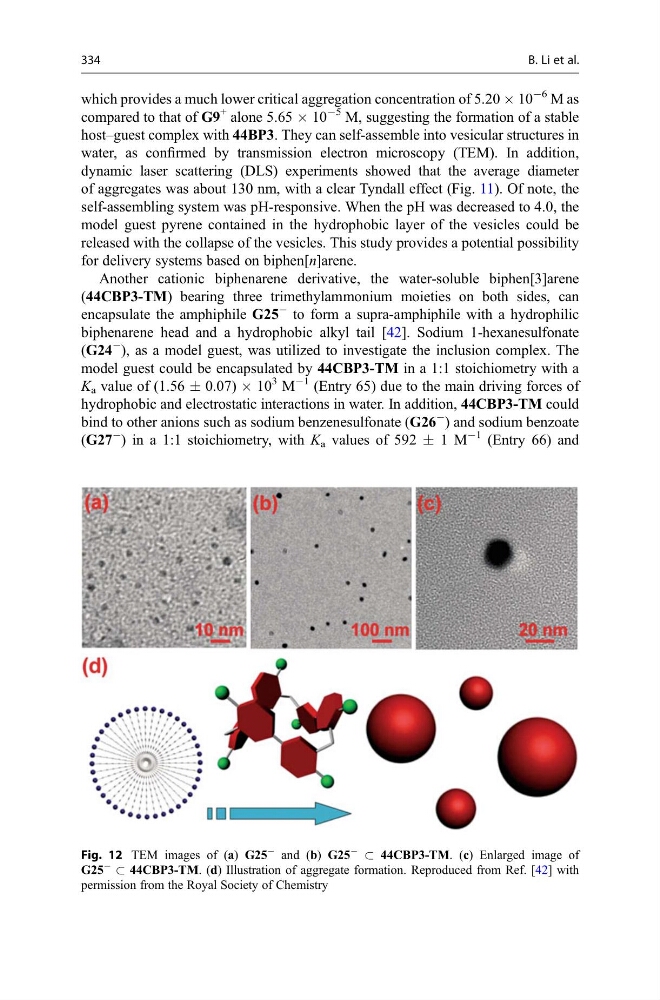
Another cationic biphenarene derivative, the water-soluble biphen[3]arene
(44CBP3-TM) bearing three trimethylammonium moieties on both sides, can
encapsulate the amphiphile G25
À to form a supra-amphiphile with a hydrophilic
biphenarene head and a hydrophobic alkyl tail [42]. Sodium 1-hexanesulfonate
(G24
À
), as a model guest, was utilized to investigate the inclusion complex. The
model guest could be encapsulated by 44CBP3-TM in a 1:1 stoichiometry with a
K a value of (1.56 Æ 0.07) Â 10
3 M
À1 (Entry 65) due to the main driving forces of
hydrophobic and electrostatic interactions in water. In addition, 44CBP3-TM could
bind to other anions such as sodium benzenesulfonate (G26
À ) and sodium benzoate
(G27
À
) in a 1:1 stoichiometry, with K a values of 592 Æ 1 M
À1 (Entry 66) and
Fig. 12 TEM images of (a) G25
À and (b) G25
À & 44CBP3-TM. (c) Enlarged image of
G25
À & 44CBP3-TM. (d) Illustration of aggregate formation. Reproduced from Ref. [42] with
permission from the Royal Society of Chemistry
334
B. Li et al.
À6 M as
compared to that of G9
+ alone 5.65 Â 10
À5 M, suggesting the formation of a stable
host–guest complex with 44BP3. They can self-assemble into vesicular structures in
water, as confirmed by transmission electron microscopy (TEM). In addition,
dynamic laser scattering (DLS) experiments showed that the average diameter
of aggregates was about 130 nm, with a clear Tyndall effect (Fig. 11). Of note, the
self-assembling system was pH-responsive. When the pH was decreased to 4.0, the
model guest pyrene contained in the hydrophobic layer of the vesicles could be
released with the collapse of the vesicles. This study provides a potential possibility
for delivery systems based on biphen[n]arene.
Another cationic biphenarene derivative, the water-soluble biphen[3]arene
(44CBP3-TM) bearing three trimethylammonium moieties on both sides, can
encapsulate the amphiphile G25
À to form a supra-amphiphile with a hydrophilic
biphenarene head and a hydrophobic alkyl tail [42]. Sodium 1-hexanesulfonate
(G24
À
), as a model guest, was utilized to investigate the inclusion complex. The
model guest could be encapsulated by 44CBP3-TM in a 1:1 stoichiometry with a
K a value of (1.56 Æ 0.07) Â 10
3 M
À1 (Entry 65) due to the main driving forces of
hydrophobic and electrostatic interactions in water. In addition, 44CBP3-TM could
bind to other anions such as sodium benzenesulfonate (G26
À ) and sodium benzoate
(G27
À
) in a 1:1 stoichiometry, with K a values of 592 Æ 1 M
À1 (Entry 66) and
Fig. 12 TEM images of (a) G25
À and (b) G25
À & 44CBP3-TM. (c) Enlarged image of
G25
À & 44CBP3-TM. (d) Illustration of aggregate formation. Reproduced from Ref. [42] with
permission from the Royal Society of Chemistry
334
B. Li et al.