

22CBP4 (K a = (2.29 Æ 0.27) Â 10
6 M
À1 ) is 3.9 times greater than that of G39
+
(K a = (5.87 Æ 0.24) Â 10
5 M
À1 ) (Entries 77 and 78).
The easy accessibility, good water solubility, and favorable binding properties of
these water-soluble biphen[n]arenes make them suitable for many applications in the
biomedical field, such as chemical sensors, drug delivery, supramolecular amphiphiles, etc.
12.10 Self-Assembly
Macrocycle-based self-assembly blocks have been widely investigated in supramolecular chemistry. Developing biphenarene-based self-assembly blocks is an
efficient approach to translate biphenarenes into functional systems and materials
for practical applications.
The amphiphilic guest G9
+
, with a secondary ammonium-bearing hydrophilic
head and an alkyl chain-bearing hydrophobic tail, was employed for complexation
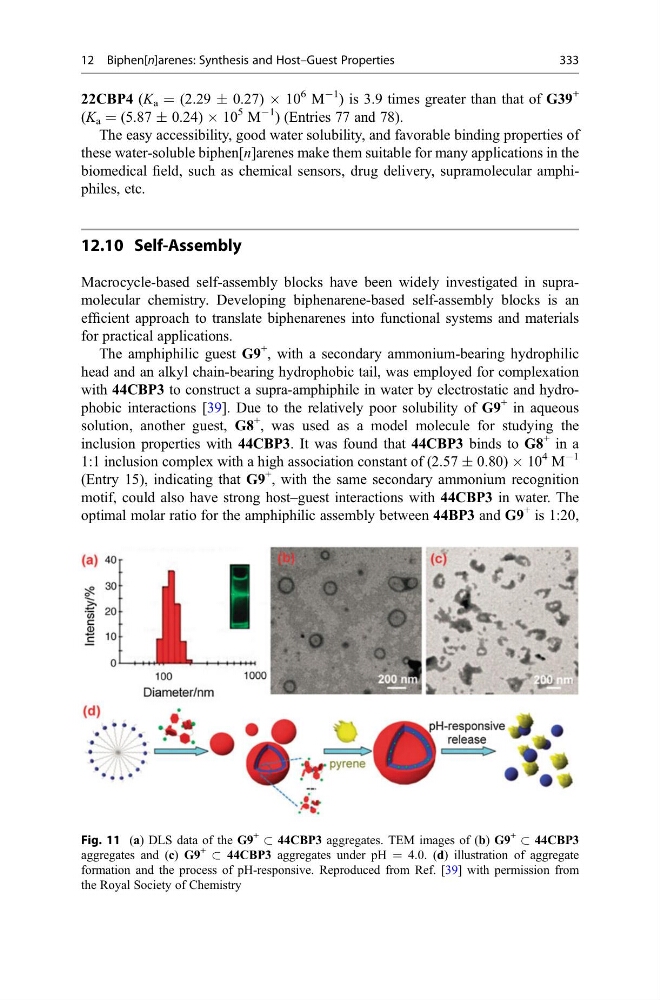
with 44CBP3 to construct a supra-amphiphile in water by electrostatic and hydrophobic interactions [39]. Due to the relatively poor solubility of G9
+ in aqueous
solution, another guest, G8
+ , was used as a model molecule for studying the
inclusion properties with 44CBP3. It was found that 44CBP3 binds to G8
+ in a
1:1 inclusion complex with a high association constant of (2.57 Æ 0.80) Â 10
4 M
À1
(Entry 15), indicating that G9
+ , with the same secondary ammonium recognition
motif, could also have strong host–guest interactions with 44CBP3 in water. The
optimal molar ratio for the amphiphilic assembly between 44BP3 and G9
+ is 1:20,
Fig. 11 (a) DLS data of the G9
+ & 44CBP3 aggregates. TEM images of (b) G9
+ & 44CBP3
aggregates and (c) G9
+ & 44CBP3 aggregates under pH = 4.0. (d) illustration of aggregate
formation and the process of pH-responsive. Reproduced from Ref. [39] with permission from
the Royal Society of Chemistry
12 Biphen[n]arenes: Synthesis and Host–Guest Properties
333
6 M
À1 ) is 3.9 times greater than that of G39
+
(K a = (5.87 Æ 0.24) Â 10
5 M
À1 ) (Entries 77 and 78).
The easy accessibility, good water solubility, and favorable binding properties of
these water-soluble biphen[n]arenes make them suitable for many applications in the
biomedical field, such as chemical sensors, drug delivery, supramolecular amphiphiles, etc.
12.10 Self-Assembly
Macrocycle-based self-assembly blocks have been widely investigated in supramolecular chemistry. Developing biphenarene-based self-assembly blocks is an
efficient approach to translate biphenarenes into functional systems and materials
for practical applications.
The amphiphilic guest G9
+
, with a secondary ammonium-bearing hydrophilic
head and an alkyl chain-bearing hydrophobic tail, was employed for complexation
with 44CBP3 to construct a supra-amphiphile in water by electrostatic and hydrophobic interactions [39]. Due to the relatively poor solubility of G9
+ in aqueous
solution, another guest, G8
+ , was used as a model molecule for studying the
inclusion properties with 44CBP3. It was found that 44CBP3 binds to G8
+ in a
1:1 inclusion complex with a high association constant of (2.57 Æ 0.80) Â 10
4 M
À1
(Entry 15), indicating that G9
+ , with the same secondary ammonium recognition
motif, could also have strong host–guest interactions with 44CBP3 in water. The
optimal molar ratio for the amphiphilic assembly between 44BP3 and G9
+ is 1:20,
Fig. 11 (a) DLS data of the G9
+ & 44CBP3 aggregates. TEM images of (b) G9
+ & 44CBP3
aggregates and (c) G9
+ & 44CBP3 aggregates under pH = 4.0. (d) illustration of aggregate
formation and the process of pH-responsive. Reproduced from Ref. [39] with permission from
the Royal Society of Chemistry
12 Biphen[n]arenes: Synthesis and Host–Guest Properties
333