

Considering the role of the macrocycle as a plug of the pores, in theory, this
reversible rotaxane-based nanovalve can be applied for loading and releasing many
other cargoes of similar sizes. Stimuli-responsive nanovalves could be fabricated
using other types of (pseudo)rotaxane systems responding to different signals,
including light, pH, enzyme, heat, or magnetic field [21]. These modes of valve
activations are designed for the automatic release of cargo in different environments,
such as cancer cells in living systems, known to be more acidic than other healthy
tissues. Hence, a pH-controlled drug release system can be designed in terms of a
loading-in-neutral and release-in-acid mode, which would be able to recognize
cancer cells and then release the drug to affect the target cancer cell selectively.
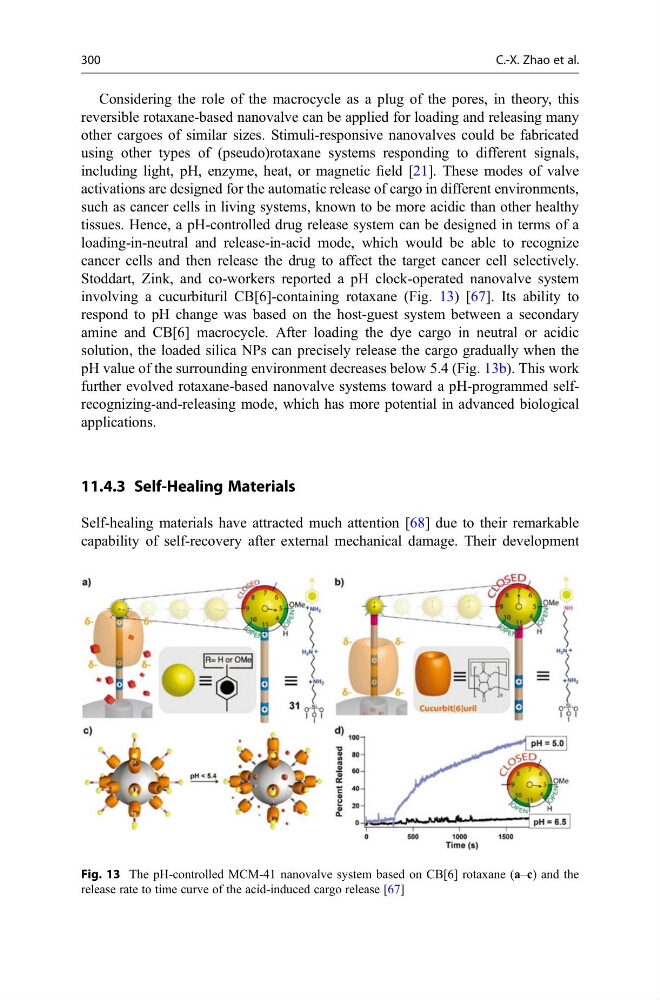
Stoddart, Zink, and co-workers reported a pH clock-operated nanovalve system
involving a cucurbituril CB[6]-containing rotaxane (Fig. 13) [67]. Its ability to
respond to pH change was based on the host-guest system between a secondary
amine and CB[6] macrocycle. After loading the dye cargo in neutral or acidic
solution, the loaded silica NPs can precisely release the cargo gradually when the
pH value of the surrounding environment decreases below 5.4 (Fig. 13b). This work
further evolved rotaxane-based nanovalve systems toward a pH-programmed selfrecognizing-and-releasing mode, which has more potential in advanced biological
applications.
11.4.3 Self-Healing Materials
Self-healing materials have attracted much attention [68] due to their remarkable
capability of self-recovery after external mechanical damage. Their development
Fig. 13 The pH-controlled MCM-41 nanovalve system based on CB[6] rotaxane (a–c) and the
release rate to time curve of the acid-induced cargo release [67]
300
C.-X. Zhao et al.
reversible rotaxane-based nanovalve can be applied for loading and releasing many
other cargoes of similar sizes. Stimuli-responsive nanovalves could be fabricated
using other types of (pseudo)rotaxane systems responding to different signals,
including light, pH, enzyme, heat, or magnetic field [21]. These modes of valve
activations are designed for the automatic release of cargo in different environments,
such as cancer cells in living systems, known to be more acidic than other healthy
tissues. Hence, a pH-controlled drug release system can be designed in terms of a
loading-in-neutral and release-in-acid mode, which would be able to recognize
cancer cells and then release the drug to affect the target cancer cell selectively.
Stoddart, Zink, and co-workers reported a pH clock-operated nanovalve system
involving a cucurbituril CB[6]-containing rotaxane (Fig. 13) [67]. Its ability to
respond to pH change was based on the host-guest system between a secondary
amine and CB[6] macrocycle. After loading the dye cargo in neutral or acidic
solution, the loaded silica NPs can precisely release the cargo gradually when the
pH value of the surrounding environment decreases below 5.4 (Fig. 13b). This work
further evolved rotaxane-based nanovalve systems toward a pH-programmed selfrecognizing-and-releasing mode, which has more potential in advanced biological
applications.
11.4.3 Self-Healing Materials
Self-healing materials have attracted much attention [68] due to their remarkable
capability of self-recovery after external mechanical damage. Their development
Fig. 13 The pH-controlled MCM-41 nanovalve system based on CB[6] rotaxane (a–c) and the
release rate to time curve of the acid-induced cargo release [67]
300
C.-X. Zhao et al.