

would prolong the lifetime of many materials considerably and would contribute to
the development of new classes of smart materials. In the last decades, much
progress has been made in the field of self-healing systems, which in many cases
involve the introduction of dynamic covalent/noncovalent bonding as key interaction [68c, d]. This strategy led to sticky interfaces that could undergo self-adhesion
after mechanical damage, providing polymeric materials with self-healing functions.
However, the introduction of dynamic interactions also increases the difficulty of
synthesis and decreases mechanical strength of the polymeric material. Therefore, it
is necessary to develop novel strategies for the construction of self-healing systems.
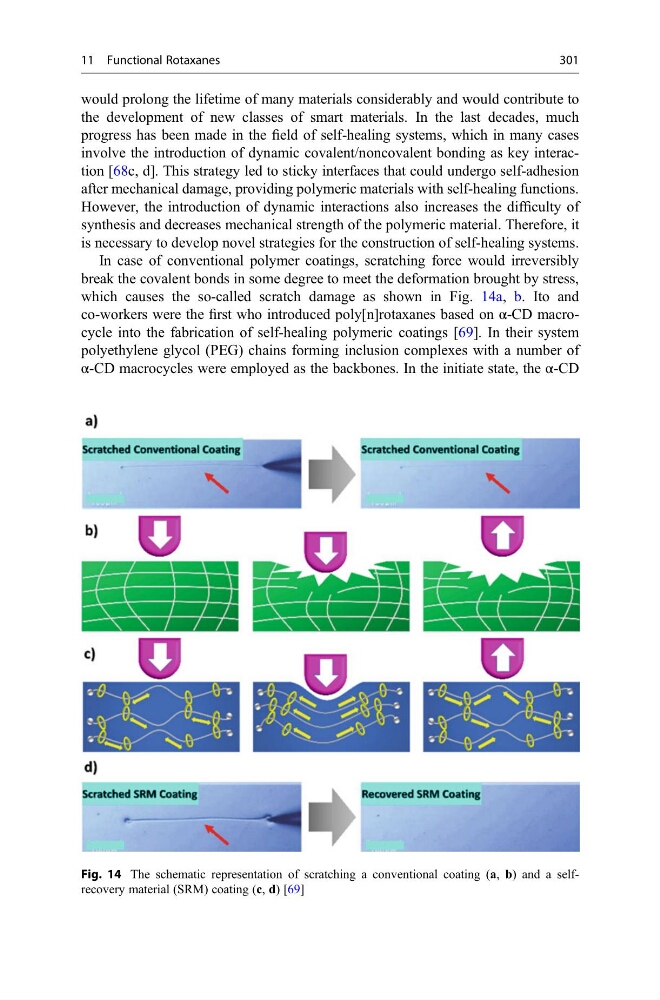
In case of conventional polymer coatings, scratching force would irreversibly
break the covalent bonds in some degree to meet the deformation brought by stress,
which causes the so-called scratch damage as shown in Fig. 14a, b. Ito and
co-workers were the first who introduced poly[n]rotaxanes based on α-CD macrocycle into the fabrication of self-healing polymeric coatings [69]. In their system
polyethylene glycol (PEG) chains forming inclusion complexes with a number of
α-CD macrocycles were employed as the backbones. In the initiate state, the α-CD
Fig. 14 The schematic representation of scratching a conventional coating (a, b) and a selfrecovery material (SRM) coating (c, d) [69]
11 Functional Rotaxanes
301
the development of new classes of smart materials. In the last decades, much
progress has been made in the field of self-healing systems, which in many cases
involve the introduction of dynamic covalent/noncovalent bonding as key interaction [68c, d]. This strategy led to sticky interfaces that could undergo self-adhesion
after mechanical damage, providing polymeric materials with self-healing functions.
However, the introduction of dynamic interactions also increases the difficulty of
synthesis and decreases mechanical strength of the polymeric material. Therefore, it
is necessary to develop novel strategies for the construction of self-healing systems.
In case of conventional polymer coatings, scratching force would irreversibly
break the covalent bonds in some degree to meet the deformation brought by stress,
which causes the so-called scratch damage as shown in Fig. 14a, b. Ito and
co-workers were the first who introduced poly[n]rotaxanes based on α-CD macrocycle into the fabrication of self-healing polymeric coatings [69]. In their system
polyethylene glycol (PEG) chains forming inclusion complexes with a number of
α-CD macrocycles were employed as the backbones. In the initiate state, the α-CD
Fig. 14 The schematic representation of scratching a conventional coating (a, b) and a selfrecovery material (SRM) coating (c, d) [69]
11 Functional Rotaxanes
301