

molecular machines in nanotechnology and molecular devices, especially those
working at single- to few-molecule level.
11.4.2 Controlled Drug Release System
The goal of realizing precisely controlled drug release in biological systems has been
pursued in the last decades, when many designs have been developed and realized in
some degree [65]. However, there is still much room for improvement in design
strategies toward stimuli-responsive loading and release of drugs. Rotaxanes, considering their excellent stimuli-responsive capability, are of great potential in this
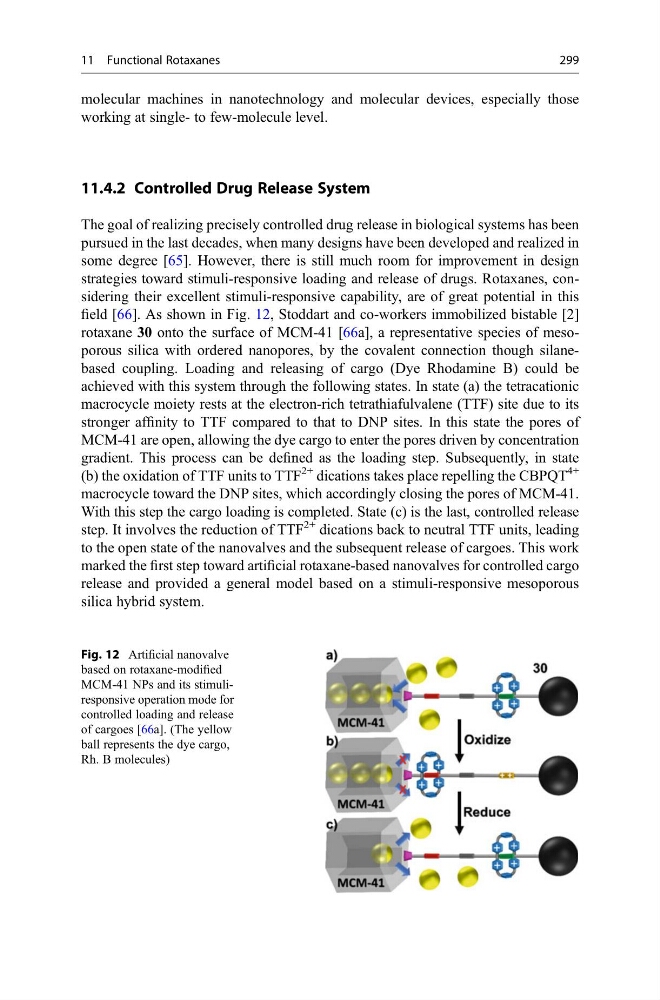
field [66]. As shown in Fig. 12, Stoddart and co-workers immobilized bistable [2]
rotaxane 30 onto the surface of MCM-41 [66a], a representative species of mesoporous silica with ordered nanopores, by the covalent connection though silanebased coupling. Loading and releasing of cargo (Dye Rhodamine B) could be
achieved with this system through the following states. In state (a) the tetracationic
macrocycle moiety rests at the electron-rich tetrathiafulvalene (TTF) site due to its
stronger affinity to TTF compared to that to DNP sites. In this state the pores of
MCM-41 are open, allowing the dye cargo to enter the pores driven by concentration
gradient. This process can be defined as the loading step. Subsequently, in state
(b) the oxidation of TTF units to TTF
2+ dications takes place repelling the CBPQT
4+
macrocycle toward the DNP sites, which accordingly closing the pores of MCM-41.
With this step the cargo loading is completed. State (c) is the last, controlled release
step. It involves the reduction of TTF
2+ dications back to neutral TTF units, leading
to the open state of the nanovalves and the subsequent release of cargoes. This work
marked the first step toward artificial rotaxane-based nanovalves for controlled cargo
release and provided a general model based on a stimuli-responsive mesoporous
silica hybrid system.
Fig. 12 Artificial nanovalve
based on rotaxane-modified
MCM-41 NPs and its stimuliresponsive operation mode for
controlled loading and release
of cargoes [66a]. (The yellow
ball represents the dye cargo,
Rh. B molecules)
11 Functional Rotaxanes
299
working at single- to few-molecule level.
11.4.2 Controlled Drug Release System
The goal of realizing precisely controlled drug release in biological systems has been
pursued in the last decades, when many designs have been developed and realized in
some degree [65]. However, there is still much room for improvement in design
strategies toward stimuli-responsive loading and release of drugs. Rotaxanes, considering their excellent stimuli-responsive capability, are of great potential in this
field [66]. As shown in Fig. 12, Stoddart and co-workers immobilized bistable [2]
rotaxane 30 onto the surface of MCM-41 [66a], a representative species of mesoporous silica with ordered nanopores, by the covalent connection though silanebased coupling. Loading and releasing of cargo (Dye Rhodamine B) could be
achieved with this system through the following states. In state (a) the tetracationic
macrocycle moiety rests at the electron-rich tetrathiafulvalene (TTF) site due to its
stronger affinity to TTF compared to that to DNP sites. In this state the pores of
MCM-41 are open, allowing the dye cargo to enter the pores driven by concentration
gradient. This process can be defined as the loading step. Subsequently, in state
(b) the oxidation of TTF units to TTF
2+ dications takes place repelling the CBPQT
4+
macrocycle toward the DNP sites, which accordingly closing the pores of MCM-41.
With this step the cargo loading is completed. State (c) is the last, controlled release
step. It involves the reduction of TTF
2+ dications back to neutral TTF units, leading
to the open state of the nanovalves and the subsequent release of cargoes. This work
marked the first step toward artificial rotaxane-based nanovalves for controlled cargo
release and provided a general model based on a stimuli-responsive mesoporous
silica hybrid system.
Fig. 12 Artificial nanovalve
based on rotaxane-modified
MCM-41 NPs and its stimuliresponsive operation mode for
controlled loading and release
of cargoes [66a]. (The yellow
ball represents the dye cargo,
Rh. B molecules)
11 Functional Rotaxanes
299