

the synthesis of some newly rising rotaxanes, such as [1]rotaxane, [c2]daisy chain,
poly[n]daisy chain molecular muscle, and hetero[n]rotaxane, will be discussed.
Since the late 1980s, the development of supramolecular chemistry, especially
macrocycle-based host-guest chemistry, provided a deep understanding of various
noncovalent intermolecular interactions and thus accelerated the development of the
so-called “template-directed” strategy as a general synthetic methodology of
rotaxanes [25]. Some templates, such as metal-ligand templates, hydrogen-bonding
templates, donor-acceptor templates, active metal templates, and radical templates
[8a, 25c], have been proved to be very effective in the facile fabrication of rotaxanes.
11.2.1 [2]rotaxanes
[2]rotaxane, consisting of a macrocycle component and a thread with two stoppers at
both ends, is commonly considered as the most typical and representative example
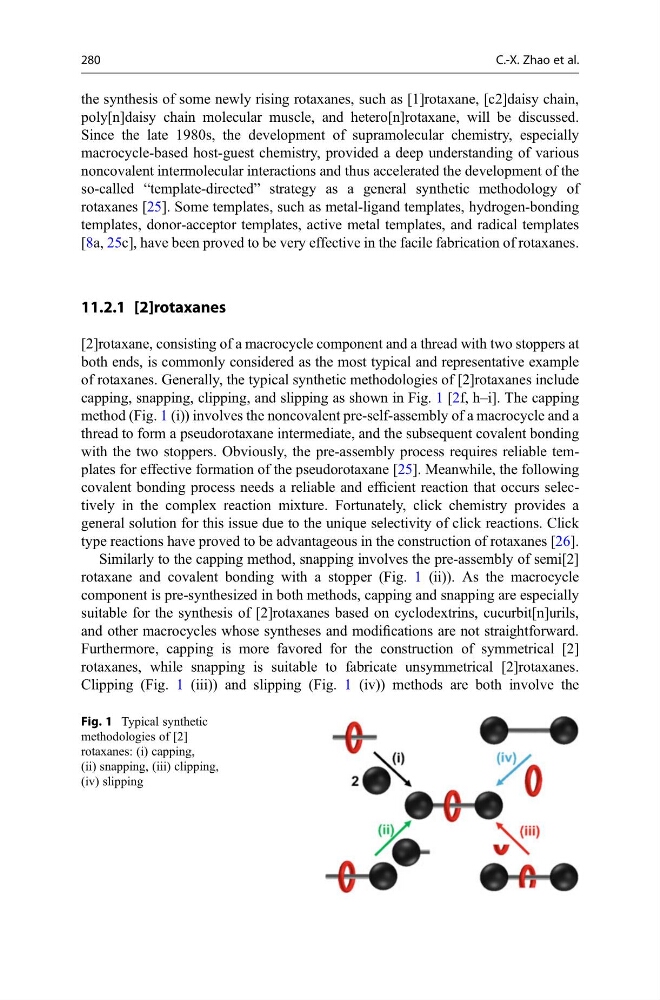
of rotaxanes. Generally, the typical synthetic methodologies of [2]rotaxanes include
capping, snapping, clipping, and slipping as shown in Fig. 1 [2f, h–i]. The capping
method (Fig. 1 (i)) involves the noncovalent pre-self-assembly of a macrocycle and a
thread to form a pseudorotaxane intermediate, and the subsequent covalent bonding
with the two stoppers. Obviously, the pre-assembly process requires reliable templates for effective formation of the pseudorotaxane [25]. Meanwhile, the following
covalent bonding process needs a reliable and efficient reaction that occurs selectively in the complex reaction mixture. Fortunately, click chemistry provides a
general solution for this issue due to the unique selectivity of click reactions. Click
type reactions have proved to be advantageous in the construction of rotaxanes [26].
Similarly to the capping method, snapping involves the pre-assembly of semi[2]
rotaxane and covalent bonding with a stopper (Fig. 1 (ii)). As the macrocycle
component is pre-synthesized in both methods, capping and snapping are especially
suitable for the synthesis of [2]rotaxanes based on cyclodextrins, cucurbit[n]urils,
and other macrocycles whose syntheses and modifications are not straightforward.
Furthermore, capping is more favored for the construction of symmetrical [2]
rotaxanes, while snapping is suitable to fabricate unsymmetrical [2]rotaxanes.
Clipping (Fig. 1 (iii)) and slipping (Fig. 1 (iv)) methods are both involve the
Fig. 1 Typical synthetic
methodologies of [2]
rotaxanes: (i) capping,
(ii) snapping, (iii) clipping,
(iv) slipping
280
C.-X. Zhao et al.
poly[n]daisy chain molecular muscle, and hetero[n]rotaxane, will be discussed.
Since the late 1980s, the development of supramolecular chemistry, especially
macrocycle-based host-guest chemistry, provided a deep understanding of various
noncovalent intermolecular interactions and thus accelerated the development of the
so-called “template-directed” strategy as a general synthetic methodology of
rotaxanes [25]. Some templates, such as metal-ligand templates, hydrogen-bonding
templates, donor-acceptor templates, active metal templates, and radical templates
[8a, 25c], have been proved to be very effective in the facile fabrication of rotaxanes.
11.2.1 [2]rotaxanes
[2]rotaxane, consisting of a macrocycle component and a thread with two stoppers at
both ends, is commonly considered as the most typical and representative example
of rotaxanes. Generally, the typical synthetic methodologies of [2]rotaxanes include
capping, snapping, clipping, and slipping as shown in Fig. 1 [2f, h–i]. The capping
method (Fig. 1 (i)) involves the noncovalent pre-self-assembly of a macrocycle and a
thread to form a pseudorotaxane intermediate, and the subsequent covalent bonding
with the two stoppers. Obviously, the pre-assembly process requires reliable templates for effective formation of the pseudorotaxane [25]. Meanwhile, the following
covalent bonding process needs a reliable and efficient reaction that occurs selectively in the complex reaction mixture. Fortunately, click chemistry provides a
general solution for this issue due to the unique selectivity of click reactions. Click
type reactions have proved to be advantageous in the construction of rotaxanes [26].
Similarly to the capping method, snapping involves the pre-assembly of semi[2]
rotaxane and covalent bonding with a stopper (Fig. 1 (ii)). As the macrocycle
component is pre-synthesized in both methods, capping and snapping are especially
suitable for the synthesis of [2]rotaxanes based on cyclodextrins, cucurbit[n]urils,
and other macrocycles whose syntheses and modifications are not straightforward.
Furthermore, capping is more favored for the construction of symmetrical [2]
rotaxanes, while snapping is suitable to fabricate unsymmetrical [2]rotaxanes.
Clipping (Fig. 1 (iii)) and slipping (Fig. 1 (iv)) methods are both involve the
Fig. 1 Typical synthetic
methodologies of [2]
rotaxanes: (i) capping,
(ii) snapping, (iii) clipping,
(iv) slipping
280
C.-X. Zhao et al.