

Nevertheless, some groups have successfully constructed functional systems of
rotaxanes immobilized on surfaces [18], interfaces [19], and even in a porous organic
framework [20]. These elegant hybrid systems were able to perform useful tasks, such
as controlled drug release [21], fluorescent sensing [22], and represented novel examples of smart surfaces [23] and self-healing materials [24], pointing toward promising
and exciting perspectives for the materials applications of immobilized rotaxanes.
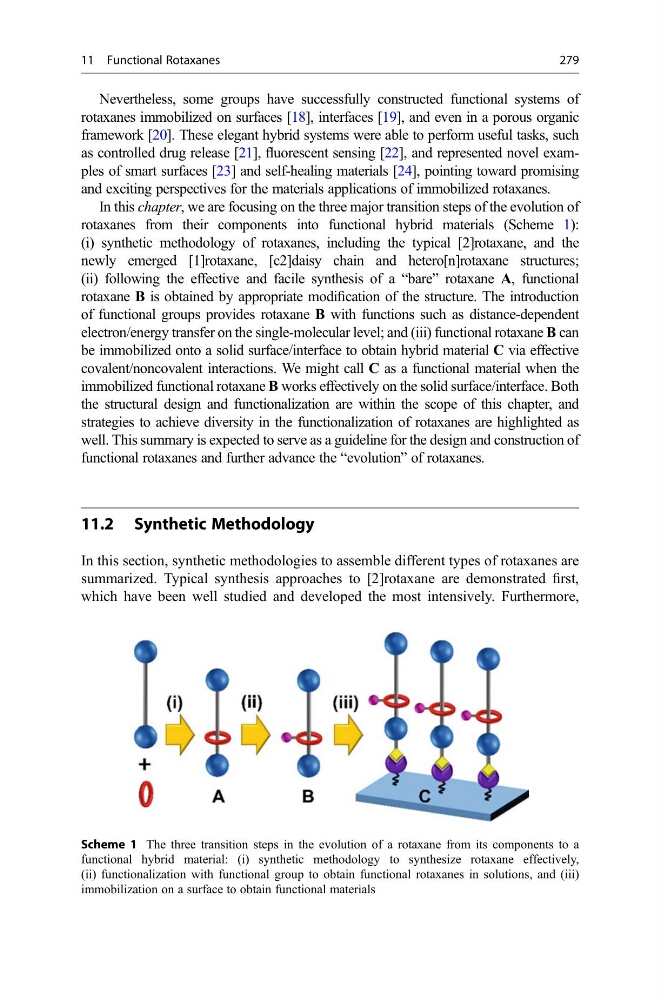
In this chapter, we are focusing on the three major transition steps of the evolution of
rotaxanes from their components into functional hybrid materials (Scheme 1):
(i) synthetic methodology of rotaxanes, including the typical [2]rotaxane, and the
newly emerged [1]rotaxane, [c2]daisy chain and hetero[n]rotaxane structures;
(ii) following the effective and facile synthesis of a “bare” rotaxane A, functional
rotaxane B is obtained by appropriate modification of the structure. The introduction
of functional groups provides rotaxane B with functions such as distance-dependent
electron/energy transfer on the single-molecular level; and (iii) functional rotaxane B can
be immobilized onto a solid surface/interface to obtain hybrid material C via effective
covalent/noncovalent interactions. We might call C as a functional material when the
immobilized functional rotaxane B works effectively on the solid surface/interface. Both
the structural design and functionalization are within the scope of this chapter, and
strategies to achieve diversity in the functionalization of rotaxanes are highlighted as
well. This summary is expected to serve as a guideline for the design and construction of
functional rotaxanes and further advance the “evolution” of rotaxanes.
11.2 Synthetic Methodology
In this section, synthetic methodologies to assemble different types of rotaxanes are
summarized. Typical synthesis approaches to [2]rotaxane are demonstrated first,
which have been well studied and developed the most intensively. Furthermore,
Scheme 1 The three transition steps in the evolution of a rotaxane from its components to a
functional hybrid material: (i) synthetic methodology to synthesize rotaxane effectively,
(ii) functionalization with functional group to obtain functional rotaxanes in solutions, and (iii)
immobilization on a surface to obtain functional materials
11 Functional Rotaxanes
279
rotaxanes immobilized on surfaces [18], interfaces [19], and even in a porous organic
framework [20]. These elegant hybrid systems were able to perform useful tasks, such
as controlled drug release [21], fluorescent sensing [22], and represented novel examples of smart surfaces [23] and self-healing materials [24], pointing toward promising
and exciting perspectives for the materials applications of immobilized rotaxanes.
In this chapter, we are focusing on the three major transition steps of the evolution of
rotaxanes from their components into functional hybrid materials (Scheme 1):
(i) synthetic methodology of rotaxanes, including the typical [2]rotaxane, and the
newly emerged [1]rotaxane, [c2]daisy chain and hetero[n]rotaxane structures;
(ii) following the effective and facile synthesis of a “bare” rotaxane A, functional
rotaxane B is obtained by appropriate modification of the structure. The introduction
of functional groups provides rotaxane B with functions such as distance-dependent
electron/energy transfer on the single-molecular level; and (iii) functional rotaxane B can
be immobilized onto a solid surface/interface to obtain hybrid material C via effective
covalent/noncovalent interactions. We might call C as a functional material when the
immobilized functional rotaxane B works effectively on the solid surface/interface. Both
the structural design and functionalization are within the scope of this chapter, and
strategies to achieve diversity in the functionalization of rotaxanes are highlighted as
well. This summary is expected to serve as a guideline for the design and construction of
functional rotaxanes and further advance the “evolution” of rotaxanes.
11.2 Synthetic Methodology
In this section, synthetic methodologies to assemble different types of rotaxanes are
summarized. Typical synthesis approaches to [2]rotaxane are demonstrated first,
which have been well studied and developed the most intensively. Furthermore,
Scheme 1 The three transition steps in the evolution of a rotaxane from its components to a
functional hybrid material: (i) synthetic methodology to synthesize rotaxane effectively,
(ii) functionalization with functional group to obtain functional rotaxanes in solutions, and (iii)
immobilization on a surface to obtain functional materials
11 Functional Rotaxanes
279