

dumbbell-like thread component. The former uses the dumbbell-like thread as the
template for the synthesis of the macrocycle, meaning that the macrocycle is formed
around the recognition station on the dumbbell-like thread. In the slipping route, the
macrocycle can overcome the blocking barrier and thread into the middle of two
stoppers at elevated temperatures [27].
In addition to these typical synthetic approaches, some novel strategies have been
developed and employed recently in the construction of [2]rotaxanes, such as threadingfollowed-by-shrinking [28] and threading-followed-by-swelling [29]. These involve the
controlled change of the differences in space between the macrocycle component and
the stoppers. Such strategies are expected to play a key role in the efficient construction
of more diverse rotaxanes and stimulating the development of additional synthetic
approaches to advance the evolution of rotaxanes.
11.2.2 [1]rotaxanes
In the family of rotaxanes, [1]rotaxane is unique as the macrocycle and thread
components are covalently bound in its structure. Compared to [2]rotaxane, [1]
rotaxane produces an coupled motion upon an external stimulus, meaning that the
motion of the macrocycle would also lead to the motion of the thread part, rather than
the independent motion of the macrocycle in a [2]rotaxane. Although achieving
stimuli-controlled motion on a single-molecular level seems crucial to operate
complex nano-machinery, only a little progress has been made toward the precise
control of molecular motion in a [1]rotaxane [30, 31].
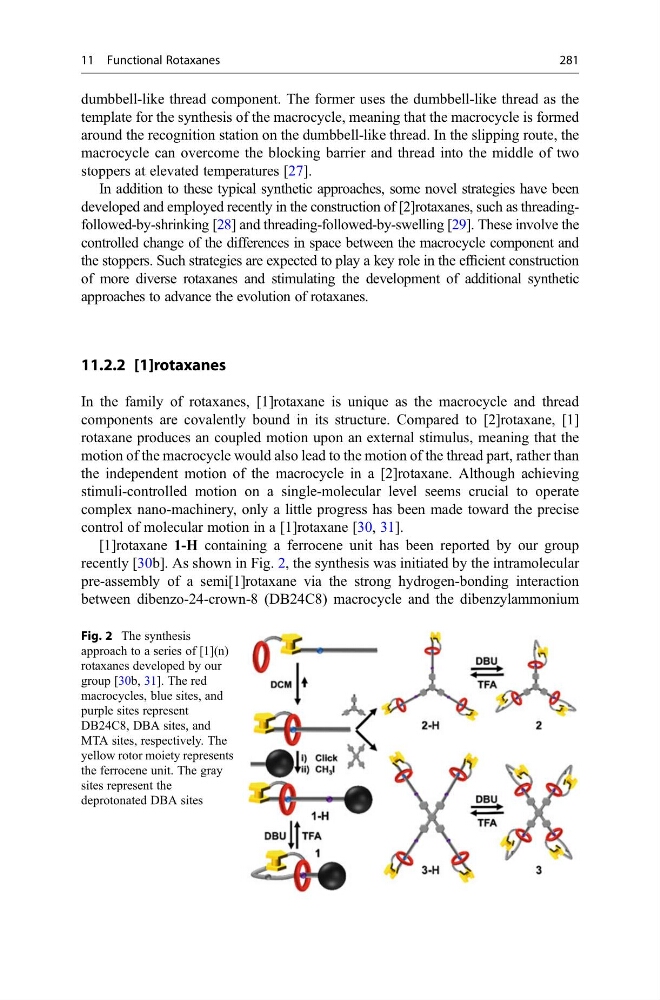
[1]rotaxane 1-H containing a ferrocene unit has been reported by our group
recently [30b]. As shown in Fig. 2, the synthesis was initiated by the intramolecular
pre-assembly of a semi[1]rotaxane via the strong hydrogen-bonding interaction
between dibenzo-24-crown-8 (DB24C8) macrocycle and the dibenzylammonium
Fig. 2 The synthesis
approach to a series of [1](n)
rotaxanes developed by our
group [30b, 31]. The red
macrocycles, blue sites, and
purple sites represent
DB24C8, DBA sites, and
MTA sites, respectively. The
yellow rotor moiety represents
the ferrocene unit. The gray
sites represent the
deprotonated DBA sites
11 Functional Rotaxanes
281
template for the synthesis of the macrocycle, meaning that the macrocycle is formed
around the recognition station on the dumbbell-like thread. In the slipping route, the
macrocycle can overcome the blocking barrier and thread into the middle of two
stoppers at elevated temperatures [27].
In addition to these typical synthetic approaches, some novel strategies have been
developed and employed recently in the construction of [2]rotaxanes, such as threadingfollowed-by-shrinking [28] and threading-followed-by-swelling [29]. These involve the
controlled change of the differences in space between the macrocycle component and
the stoppers. Such strategies are expected to play a key role in the efficient construction
of more diverse rotaxanes and stimulating the development of additional synthetic
approaches to advance the evolution of rotaxanes.
11.2.2 [1]rotaxanes
In the family of rotaxanes, [1]rotaxane is unique as the macrocycle and thread
components are covalently bound in its structure. Compared to [2]rotaxane, [1]
rotaxane produces an coupled motion upon an external stimulus, meaning that the
motion of the macrocycle would also lead to the motion of the thread part, rather than
the independent motion of the macrocycle in a [2]rotaxane. Although achieving
stimuli-controlled motion on a single-molecular level seems crucial to operate
complex nano-machinery, only a little progress has been made toward the precise
control of molecular motion in a [1]rotaxane [30, 31].
[1]rotaxane 1-H containing a ferrocene unit has been reported by our group
recently [30b]. As shown in Fig. 2, the synthesis was initiated by the intramolecular
pre-assembly of a semi[1]rotaxane via the strong hydrogen-bonding interaction
between dibenzo-24-crown-8 (DB24C8) macrocycle and the dibenzylammonium
Fig. 2 The synthesis
approach to a series of [1](n)
rotaxanes developed by our
group [30b, 31]. The red
macrocycles, blue sites, and
purple sites represent
DB24C8, DBA sites, and
MTA sites, respectively. The
yellow rotor moiety represents
the ferrocene unit. The gray
sites represent the
deprotonated DBA sites
11 Functional Rotaxanes
281