

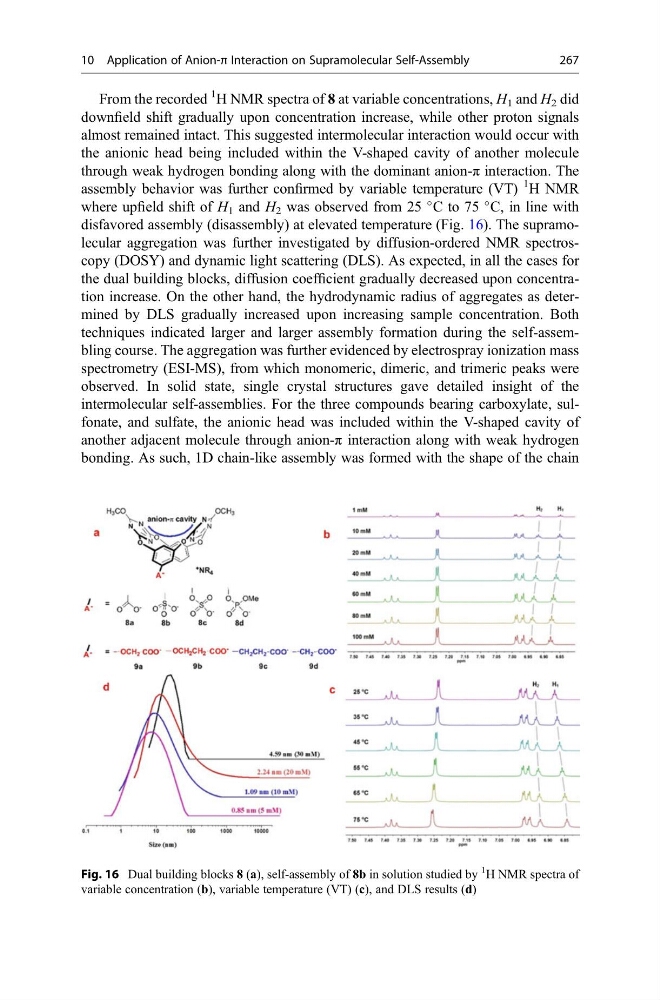
From the recorded
1 H NMR spectra of 8 at variable concentrations, H 1 and H 2 did
downfield shift gradually upon concentration increase, while other proton signals
almost remained intact. This suggested intermolecular interaction would occur with
the anionic head being included within the V-shaped cavity of another molecule
through weak hydrogen bonding along with the dominant anion-π interaction. The
assembly behavior was further confirmed by variable temperature (VT)
1 H NMR
where upfield shift of H 1 and H 2 was observed from 25
C to 75
C, in line with
disfavored assembly (disassembly) at elevated temperature (Fig. 16). The supramolecular aggregation was further investigated by diffusion-ordered NMR spectroscopy (DOSY) and dynamic light scattering (DLS). As expected, in all the cases for
the dual building blocks, diffusion coefficient gradually decreased upon concentration increase. On the other hand, the hydrodynamic radius of aggregates as determined by DLS gradually increased upon increasing sample concentration. Both
techniques indicated larger and larger assembly formation during the self-assembling course. The aggregation was further evidenced by electrospray ionization mass
spectrometry (ESI-MS), from which monomeric, dimeric, and trimeric peaks were
observed. In solid state, single crystal structures gave detailed insight of the
intermolecular self-assemblies. For the three compounds bearing carboxylate, sulfonate, and sulfate, the anionic head was included within the V-shaped cavity of
another adjacent molecule through anion-π interaction along with weak hydrogen
bonding. As such, 1D chain-like assembly was formed with the shape of the chain
Fig. 16 Dual building blocks 8 (a), self-assembly of 8b in solution studied by
1
H NMR spectra of
variable concentration (b), variable temperature (VT) (c), and DLS results (d)
10 Application of Anion-π Interaction on Supramolecular Self-Assembly
267
1 H NMR spectra of 8 at variable concentrations, H 1 and H 2 did
downfield shift gradually upon concentration increase, while other proton signals
almost remained intact. This suggested intermolecular interaction would occur with
the anionic head being included within the V-shaped cavity of another molecule
through weak hydrogen bonding along with the dominant anion-π interaction. The
assembly behavior was further confirmed by variable temperature (VT)
1 H NMR
where upfield shift of H 1 and H 2 was observed from 25
C to 75
C, in line with
disfavored assembly (disassembly) at elevated temperature (Fig. 16). The supramolecular aggregation was further investigated by diffusion-ordered NMR spectroscopy (DOSY) and dynamic light scattering (DLS). As expected, in all the cases for
the dual building blocks, diffusion coefficient gradually decreased upon concentration increase. On the other hand, the hydrodynamic radius of aggregates as determined by DLS gradually increased upon increasing sample concentration. Both
techniques indicated larger and larger assembly formation during the self-assembling course. The aggregation was further evidenced by electrospray ionization mass
spectrometry (ESI-MS), from which monomeric, dimeric, and trimeric peaks were
observed. In solid state, single crystal structures gave detailed insight of the
intermolecular self-assemblies. For the three compounds bearing carboxylate, sulfonate, and sulfate, the anionic head was included within the V-shaped cavity of
another adjacent molecule through anion-π interaction along with weak hydrogen
bonding. As such, 1D chain-like assembly was formed with the shape of the chain
Fig. 16 Dual building blocks 8 (a), self-assembly of 8b in solution studied by
1
H NMR spectra of
variable concentration (b), variable temperature (VT) (c), and DLS results (d)
10 Application of Anion-π Interaction on Supramolecular Self-Assembly
267