

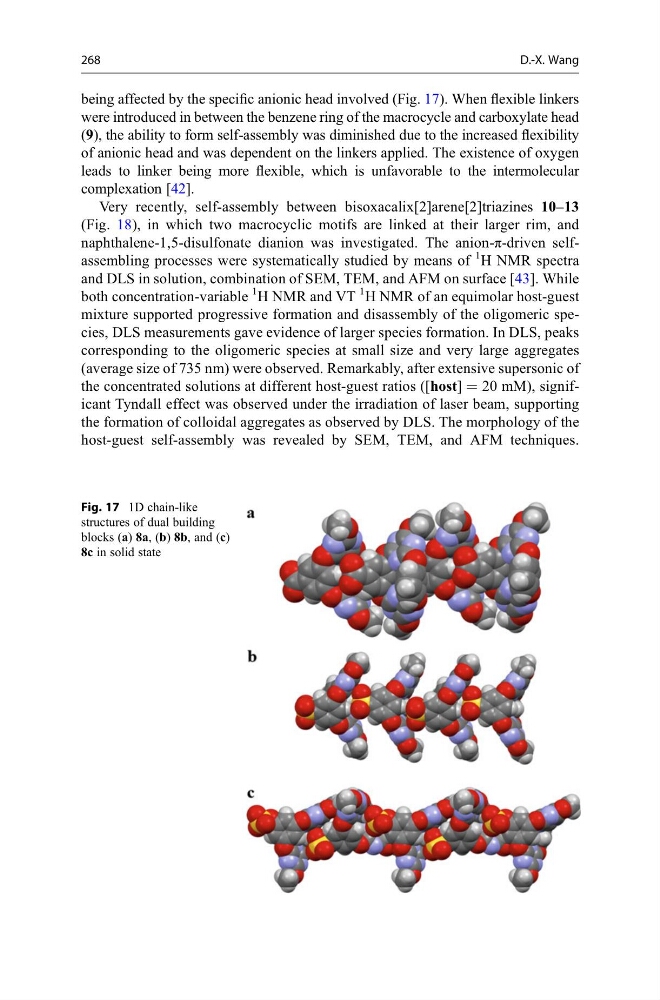
being affected by the specific anionic head involved (Fig. 17). When flexible linkers
were introduced in between the benzene ring of the macrocycle and carboxylate head
(9), the ability to form self-assembly was diminished due to the increased flexibility
of anionic head and was dependent on the linkers applied. The existence of oxygen
leads to linker being more flexible, which is unfavorable to the intermolecular
complexation [42].
Very recently, self-assembly between bisoxacalix[2]arene[2]triazines 10–13
(Fig. 18), in which two macrocyclic motifs are linked at their larger rim, and
naphthalene-1,5-disulfonate dianion was investigated. The anion-π-driven selfassembling processes were systematically studied by means of
1 H NMR spectra
and DLS in solution, combination of SEM, TEM, and AFM on surface [43]. While
both concentration-variable
1 H NMR and VT
1 H NMR of an equimolar host-guest
mixture supported progressive formation and disassembly of the oligomeric species, DLS measurements gave evidence of larger species formation. In DLS, peaks
corresponding to the oligomeric species at small size and very large aggregates
(average size of 735 nm) were observed. Remarkably, after extensive supersonic of
the concentrated solutions at different host-guest ratios ([host] = 20 mM), significant Tyndall effect was observed under the irradiation of laser beam, supporting
the formation of colloidal aggregates as observed by DLS. The morphology of the
host-guest self-assembly was revealed by SEM, TEM, and AFM techniques.
Fig. 17 1D chain-like
structures of dual building
blocks (a) 8a, (b) 8b, and (c)
8c in solid state
268
D.-X. Wang
were introduced in between the benzene ring of the macrocycle and carboxylate head
(9), the ability to form self-assembly was diminished due to the increased flexibility
of anionic head and was dependent on the linkers applied. The existence of oxygen
leads to linker being more flexible, which is unfavorable to the intermolecular
complexation [42].
Very recently, self-assembly between bisoxacalix[2]arene[2]triazines 10–13
(Fig. 18), in which two macrocyclic motifs are linked at their larger rim, and
naphthalene-1,5-disulfonate dianion was investigated. The anion-π-driven selfassembling processes were systematically studied by means of
1 H NMR spectra
and DLS in solution, combination of SEM, TEM, and AFM on surface [43]. While
both concentration-variable
1 H NMR and VT
1 H NMR of an equimolar host-guest
mixture supported progressive formation and disassembly of the oligomeric species, DLS measurements gave evidence of larger species formation. In DLS, peaks
corresponding to the oligomeric species at small size and very large aggregates
(average size of 735 nm) were observed. Remarkably, after extensive supersonic of
the concentrated solutions at different host-guest ratios ([host] = 20 mM), significant Tyndall effect was observed under the irradiation of laser beam, supporting
the formation of colloidal aggregates as observed by DLS. The morphology of the
host-guest self-assembly was revealed by SEM, TEM, and AFM techniques.
Fig. 17 1D chain-like
structures of dual building
blocks (a) 8a, (b) 8b, and (c)
8c in solid state
268
D.-X. Wang