

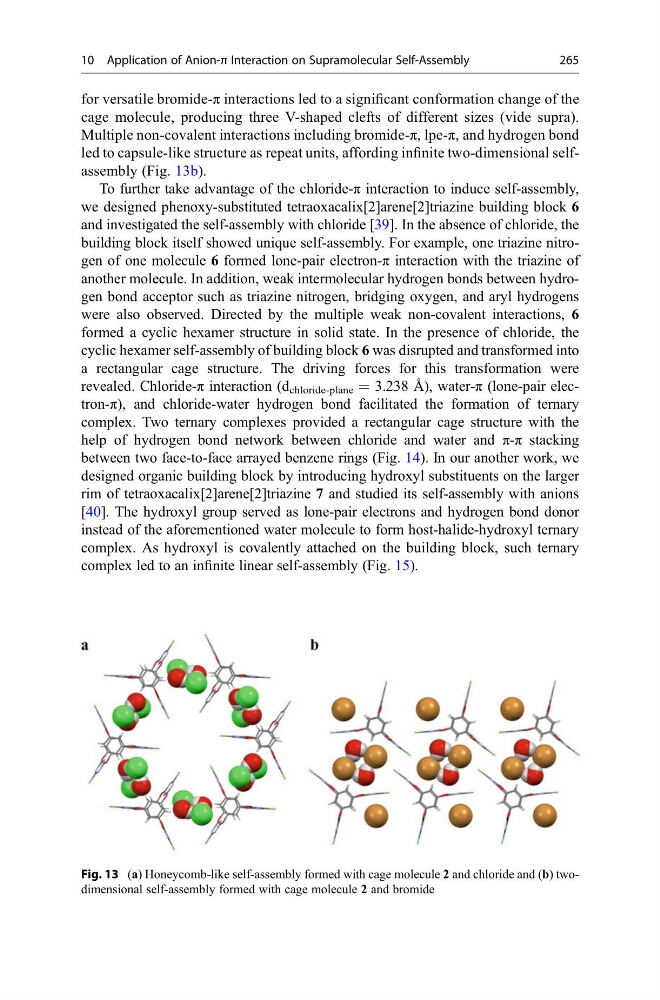
for versatile bromide-π interactions led to a significant conformation change of the
cage molecule, producing three V-shaped clefts of different sizes (vide supra).
Multiple non-covalent interactions including bromide-π, lpe-π, and hydrogen bond
led to capsule-like structure as repeat units, affording infinite two-dimensional selfassembly (Fig. 13b).
To further take advantage of the chloride-π interaction to induce self-assembly,
we designed phenoxy-substituted tetraoxacalix[2]arene[2]triazine building block 6
and investigated the self-assembly with chloride [39]. In the absence of chloride, the
building block itself showed unique self-assembly. For example, one triazine nitrogen of one molecule 6 formed lone-pair electron-π interaction with the triazine of
another molecule. In addition, weak intermolecular hydrogen bonds between hydrogen bond acceptor such as triazine nitrogen, bridging oxygen, and aryl hydrogens
were also observed. Directed by the multiple weak non-covalent interactions, 6
formed a cyclic hexamer structure in solid state. In the presence of chloride, the
cyclic hexamer self-assembly of building block 6 was disrupted and transformed into
a rectangular cage structure. The driving forces for this transformation were
revealed. Chloride-π interaction (d chloride-plane = 3.238 Å), water-π (lone-pair electron-π), and chloride-water hydrogen bond facilitated the formation of ternary
complex. Two ternary complexes provided a rectangular cage structure with the
help of hydrogen bond network between chloride and water and π-π stacking
between two face-to-face arrayed benzene rings (Fig. 14). In our another work, we
designed organic building block by introducing hydroxyl substituents on the larger
rim of tetraoxacalix[2]arene[2]triazine 7 and studied its self-assembly with anions
[40]. The hydroxyl group served as lone-pair electrons and hydrogen bond donor
instead of the aforementioned water molecule to form host-halide-hydroxyl ternary
complex. As hydroxyl is covalently attached on the building block, such ternary
complex led to an infinite linear self-assembly (Fig. 15).
Fig. 13 (a) Honeycomb-like self-assembly formed with cage molecule 2 and chloride and (b) twodimensional self-assembly formed with cage molecule 2 and bromide
10 Application of Anion-π Interaction on Supramolecular Self-Assembly
265
cage molecule, producing three V-shaped clefts of different sizes (vide supra).
Multiple non-covalent interactions including bromide-π, lpe-π, and hydrogen bond
led to capsule-like structure as repeat units, affording infinite two-dimensional selfassembly (Fig. 13b).
To further take advantage of the chloride-π interaction to induce self-assembly,
we designed phenoxy-substituted tetraoxacalix[2]arene[2]triazine building block 6
and investigated the self-assembly with chloride [39]. In the absence of chloride, the
building block itself showed unique self-assembly. For example, one triazine nitrogen of one molecule 6 formed lone-pair electron-π interaction with the triazine of
another molecule. In addition, weak intermolecular hydrogen bonds between hydrogen bond acceptor such as triazine nitrogen, bridging oxygen, and aryl hydrogens
were also observed. Directed by the multiple weak non-covalent interactions, 6
formed a cyclic hexamer structure in solid state. In the presence of chloride, the
cyclic hexamer self-assembly of building block 6 was disrupted and transformed into
a rectangular cage structure. The driving forces for this transformation were
revealed. Chloride-π interaction (d chloride-plane = 3.238 Å), water-π (lone-pair electron-π), and chloride-water hydrogen bond facilitated the formation of ternary
complex. Two ternary complexes provided a rectangular cage structure with the
help of hydrogen bond network between chloride and water and π-π stacking
between two face-to-face arrayed benzene rings (Fig. 14). In our another work, we
designed organic building block by introducing hydroxyl substituents on the larger
rim of tetraoxacalix[2]arene[2]triazine 7 and studied its self-assembly with anions
[40]. The hydroxyl group served as lone-pair electrons and hydrogen bond donor
instead of the aforementioned water molecule to form host-halide-hydroxyl ternary
complex. As hydroxyl is covalently attached on the building block, such ternary
complex led to an infinite linear self-assembly (Fig. 15).
Fig. 13 (a) Honeycomb-like self-assembly formed with cage molecule 2 and chloride and (b) twodimensional self-assembly formed with cage molecule 2 and bromide
10 Application of Anion-π Interaction on Supramolecular Self-Assembly
265