

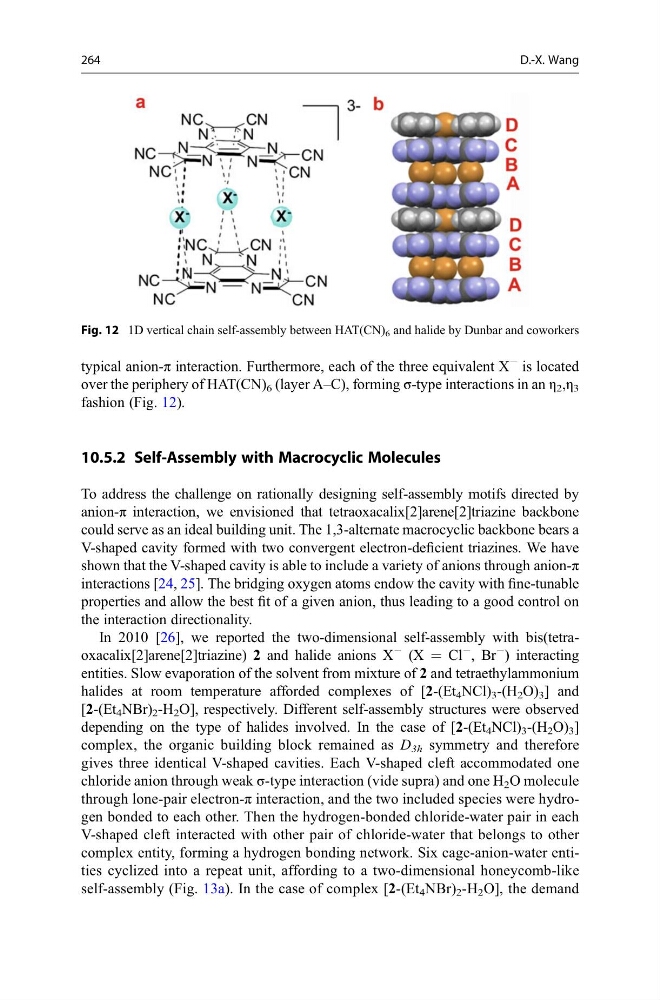
typical anion-π interaction. Furthermore, each of the three equivalent X
À is located
over the periphery of HAT(CN) 6 (layer A–C), forming σ-type interactions in an η 2 ,η 3
fashion (Fig. 12).
10.5.2 Self-Assembly with Macrocyclic Molecules
To address the challenge on rationally designing self-assembly motifs directed by
anion-π interaction, we envisioned that tetraoxacalix[2]arene[2]triazine backbone
could serve as an ideal building unit. The 1,3-alternate macrocyclic backbone bears a
V-shaped cavity formed with two convergent electron-deficient triazines. We have
shown that the V-shaped cavity is able to include a variety of anions through anion-π
interactions [24, 25]. The bridging oxygen atoms endow the cavity with fine-tunable
properties and allow the best fit of a given anion, thus leading to a good control on
the interaction directionality.
In 2010 [26], we reported the two-dimensional self-assembly with bis(tetraoxacalix[2]arene[2]triazine) 2 and halide anions X
À (X = Cl
À , Br
À ) interacting
entities. Slow evaporation of the solvent from mixture of 2 and tetraethylammonium
halides at room temperature afforded complexes of [2-(Et 4 NCl) 3 -(H 2 O) 3 ] and
[2-(Et 4 NBr) 2 -H 2 O], respectively. Different self-assembly structures were observed
depending on the type of halides involved. In the case of [2-(Et 4 NCl) 3 -(H 2 O) 3 ]
complex, the organic building block remained as D 3h symmetry and therefore
gives three identical V-shaped cavities. Each V-shaped cleft accommodated one
chloride anion through weak σ-type interaction (vide supra) and one H 2 O molecule
through lone-pair electron-π interaction, and the two included species were hydrogen bonded to each other. Then the hydrogen-bonded chloride-water pair in each
V-shaped cleft interacted with other pair of chloride-water that belongs to other
complex entity, forming a hydrogen bonding network. Six cage-anion-water entities cyclized into a repeat unit, affording to a two-dimensional honeycomb-like
self-assembly (Fig. 13a). In the case of complex [2-(Et 4 NBr) 2 -H 2 O], the demand
Fig. 12 1D vertical chain self-assembly between HAT(CN) 6 and halide by Dunbar and coworkers
264
D.-X. Wang
À is located
over the periphery of HAT(CN) 6 (layer A–C), forming σ-type interactions in an η 2 ,η 3
fashion (Fig. 12).
10.5.2 Self-Assembly with Macrocyclic Molecules
To address the challenge on rationally designing self-assembly motifs directed by
anion-π interaction, we envisioned that tetraoxacalix[2]arene[2]triazine backbone
could serve as an ideal building unit. The 1,3-alternate macrocyclic backbone bears a
V-shaped cavity formed with two convergent electron-deficient triazines. We have
shown that the V-shaped cavity is able to include a variety of anions through anion-π
interactions [24, 25]. The bridging oxygen atoms endow the cavity with fine-tunable
properties and allow the best fit of a given anion, thus leading to a good control on
the interaction directionality.
In 2010 [26], we reported the two-dimensional self-assembly with bis(tetraoxacalix[2]arene[2]triazine) 2 and halide anions X
À (X = Cl
À , Br
À ) interacting
entities. Slow evaporation of the solvent from mixture of 2 and tetraethylammonium
halides at room temperature afforded complexes of [2-(Et 4 NCl) 3 -(H 2 O) 3 ] and
[2-(Et 4 NBr) 2 -H 2 O], respectively. Different self-assembly structures were observed
depending on the type of halides involved. In the case of [2-(Et 4 NCl) 3 -(H 2 O) 3 ]
complex, the organic building block remained as D 3h symmetry and therefore
gives three identical V-shaped cavities. Each V-shaped cleft accommodated one
chloride anion through weak σ-type interaction (vide supra) and one H 2 O molecule
through lone-pair electron-π interaction, and the two included species were hydrogen bonded to each other. Then the hydrogen-bonded chloride-water pair in each
V-shaped cleft interacted with other pair of chloride-water that belongs to other
complex entity, forming a hydrogen bonding network. Six cage-anion-water entities cyclized into a repeat unit, affording to a two-dimensional honeycomb-like
self-assembly (Fig. 13a). In the case of complex [2-(Et 4 NBr) 2 -H 2 O], the demand
Fig. 12 1D vertical chain self-assembly between HAT(CN) 6 and halide by Dunbar and coworkers
264
D.-X. Wang