

over the π-acid showed subtly different details depending on the specific geometry of
anions. Consequently, the atom-to-atom distances for the σ-type interactions were in
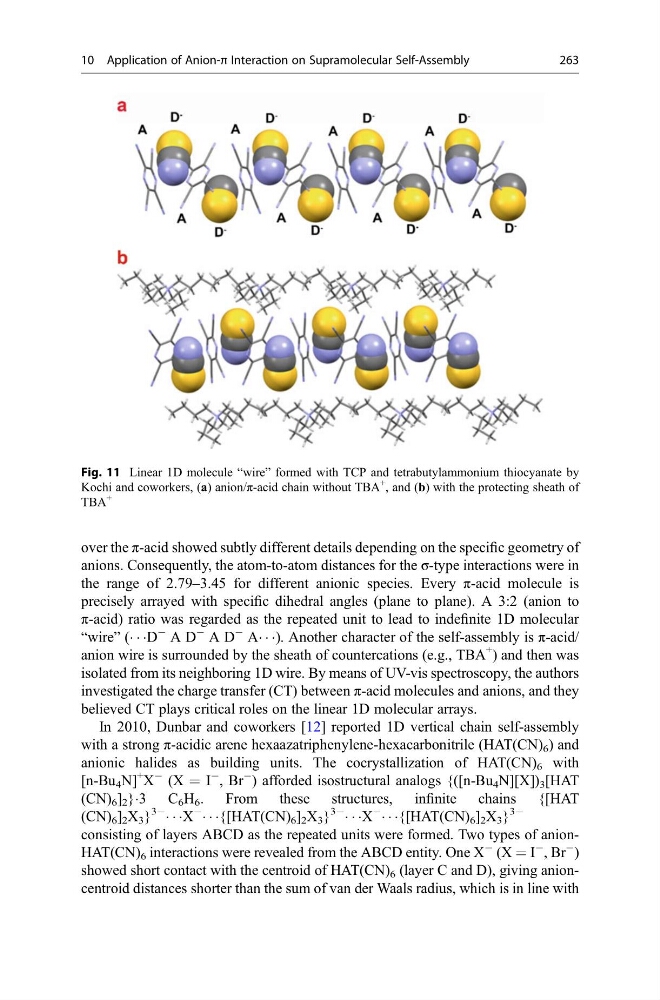
the range of 2.79–3.45 for different anionic species. Every π-acid molecule is
precisely arrayed with specific dihedral angles (plane to plane). A 3:2 (anion to
π-acid) ratio was regarded as the repeated unit to lead to indefinite 1D molecular
“wire” (Á Á ÁD
À A D
À A D
À AÁ Á Á). Another character of the self-assembly is π-acid/
anion wire is surrounded by the sheath of countercations (e.g., TBA
+ ) and then was
isolated from its neighboring 1D wire. By means of UV-vis spectroscopy, the authors
investigated the charge transfer (CT) between π-acid molecules and anions, and they
believed CT plays critical roles on the linear 1D molecular arrays.
In 2010, Dunbar and coworkers [12] reported 1D vertical chain self-assembly
with a strong π-acidic arene hexaazatriphenylene-hexacarbonitrile (HAT(CN) 6 ) and
anionic halides as building units. The cocrystallization of HAT(CN) 6 with
[n-Bu 4 N]
+
X
À (X = I
À , Br
À ) afforded isostructural analogs {([n-Bu 4 N][X]) 3 [HAT
(CN) 6 ] 2 }Á3 C 6 H 6 . From these structures, infinite chains {[HAT
(CN) 6 ] 2 X 3 }
3À
Á Á ÁX
À
Á Á Á{[HAT(CN) 6 ] 2 X 3 }
3À
Á Á ÁX
À
Á Á Á{[HAT(CN) 6 ] 2 X 3 }
3À
consisting of layers ABCD as the repeated units were formed. Two types of anionHAT(CN) 6 interactions were revealed from the ABCD entity. One X
À (X = I
À
, Br
À )
showed short contact with the centroid of HAT(CN) 6 (layer C and D), giving anioncentroid distances shorter than the sum of van der Waals radius, which is in line with
Fig. 11 Linear 1D molecule “wire” formed with TCP and tetrabutylammonium thiocyanate by
Kochi and coworkers, (a) anion/π-acid chain without TBA
+ , and (b) with the protecting sheath of
TBA
+
10 Application of Anion-π Interaction on Supramolecular Self-Assembly
263
anions. Consequently, the atom-to-atom distances for the σ-type interactions were in
the range of 2.79–3.45 for different anionic species. Every π-acid molecule is
precisely arrayed with specific dihedral angles (plane to plane). A 3:2 (anion to
π-acid) ratio was regarded as the repeated unit to lead to indefinite 1D molecular
“wire” (Á Á ÁD
À A D
À A D
À AÁ Á Á). Another character of the self-assembly is π-acid/
anion wire is surrounded by the sheath of countercations (e.g., TBA
+ ) and then was
isolated from its neighboring 1D wire. By means of UV-vis spectroscopy, the authors
investigated the charge transfer (CT) between π-acid molecules and anions, and they
believed CT plays critical roles on the linear 1D molecular arrays.
In 2010, Dunbar and coworkers [12] reported 1D vertical chain self-assembly
with a strong π-acidic arene hexaazatriphenylene-hexacarbonitrile (HAT(CN) 6 ) and
anionic halides as building units. The cocrystallization of HAT(CN) 6 with
[n-Bu 4 N]
+
X
À (X = I
À , Br
À ) afforded isostructural analogs {([n-Bu 4 N][X]) 3 [HAT
(CN) 6 ] 2 }Á3 C 6 H 6 . From these structures, infinite chains {[HAT
(CN) 6 ] 2 X 3 }
3À
Á Á ÁX
À
Á Á Á{[HAT(CN) 6 ] 2 X 3 }
3À
Á Á ÁX
À
Á Á Á{[HAT(CN) 6 ] 2 X 3 }
3À
consisting of layers ABCD as the repeated units were formed. Two types of anionHAT(CN) 6 interactions were revealed from the ABCD entity. One X
À (X = I
À
, Br
À )
showed short contact with the centroid of HAT(CN) 6 (layer C and D), giving anioncentroid distances shorter than the sum of van der Waals radius, which is in line with
Fig. 11 Linear 1D molecule “wire” formed with TCP and tetrabutylammonium thiocyanate by
Kochi and coworkers, (a) anion/π-acid chain without TBA
+ , and (b) with the protecting sheath of
TBA
+
10 Application of Anion-π Interaction on Supramolecular Self-Assembly
263