

3,4,5,6-tetrachlorocyclohexa-3,5-diene-1,2-dione
(o-CA),
and
1,1,2,2-tetracyanoethene (TCNE). From the crystal structure of the complexes formed with halides
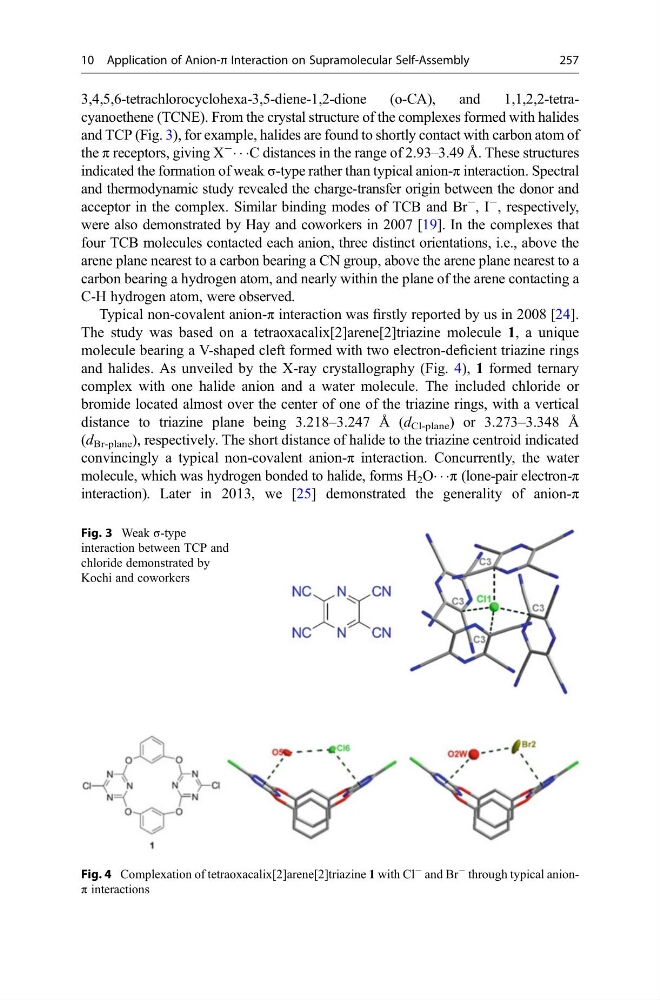
and TCP (Fig. 3), for example, halides are found to shortly contact with carbon atom of
the π receptors, giving X
À
Á Á ÁC distances in the range of 2.93–3.49 Å. These structures
indicated the formation of weak σ-type rather than typical anion-π interaction. Spectral
and thermodynamic study revealed the charge-transfer origin between the donor and
acceptor in the complex. Similar binding modes of TCB and Br
À
, I
À
, respectively,
were also demonstrated by Hay and coworkers in 2007 [19]. In the complexes that
four TCB molecules contacted each anion, three distinct orientations, i.e., above the
arene plane nearest to a carbon bearing a CN group, above the arene plane nearest to a
carbon bearing a hydrogen atom, and nearly within the plane of the arene contacting a
C-H hydrogen atom, were observed.
Typical non-covalent anion-π interaction was firstly reported by us in 2008 [24].
The study was based on a tetraoxacalix[2]arene[2]triazine molecule 1, a unique
molecule bearing a V-shaped cleft formed with two electron-deficient triazine rings
and halides. As unveiled by the X-ray crystallography (Fig. 4), 1 formed ternary
complex with one halide anion and a water molecule. The included chloride or
bromide located almost over the center of one of the triazine rings, with a vertical
distance to triazine plane being 3.218–3.247 Å (d Cl-plane ) or 3.273–3.348 Å
(d Br-plane ), respectively. The short distance of halide to the triazine centroid indicated
convincingly a typical non-covalent anion-π interaction. Concurrently, the water
molecule, which was hydrogen bonded to halide, forms H 2 OÁ Á Áπ (lone-pair electron-π
interaction). Later in 2013, we [25] demonstrated the generality of anion-π
Fig. 3 Weak σ-type
interaction between TCP and
chloride demonstrated by
Kochi and coworkers
Fig. 4 Complexation of tetraoxacalix[2]arene[2]triazine 1 with Cl
À and Br
À through typical anionπ interactions
10 Application of Anion-π Interaction on Supramolecular Self-Assembly
257
(o-CA),
and
1,1,2,2-tetracyanoethene (TCNE). From the crystal structure of the complexes formed with halides
and TCP (Fig. 3), for example, halides are found to shortly contact with carbon atom of
the π receptors, giving X
À
Á Á ÁC distances in the range of 2.93–3.49 Å. These structures
indicated the formation of weak σ-type rather than typical anion-π interaction. Spectral
and thermodynamic study revealed the charge-transfer origin between the donor and
acceptor in the complex. Similar binding modes of TCB and Br
À
, I
À
, respectively,
were also demonstrated by Hay and coworkers in 2007 [19]. In the complexes that
four TCB molecules contacted each anion, three distinct orientations, i.e., above the
arene plane nearest to a carbon bearing a CN group, above the arene plane nearest to a
carbon bearing a hydrogen atom, and nearly within the plane of the arene contacting a
C-H hydrogen atom, were observed.
Typical non-covalent anion-π interaction was firstly reported by us in 2008 [24].
The study was based on a tetraoxacalix[2]arene[2]triazine molecule 1, a unique
molecule bearing a V-shaped cleft formed with two electron-deficient triazine rings
and halides. As unveiled by the X-ray crystallography (Fig. 4), 1 formed ternary
complex with one halide anion and a water molecule. The included chloride or
bromide located almost over the center of one of the triazine rings, with a vertical
distance to triazine plane being 3.218–3.247 Å (d Cl-plane ) or 3.273–3.348 Å
(d Br-plane ), respectively. The short distance of halide to the triazine centroid indicated
convincingly a typical non-covalent anion-π interaction. Concurrently, the water
molecule, which was hydrogen bonded to halide, forms H 2 OÁ Á Áπ (lone-pair electron-π
interaction). Later in 2013, we [25] demonstrated the generality of anion-π
Fig. 3 Weak σ-type
interaction between TCP and
chloride demonstrated by
Kochi and coworkers
Fig. 4 Complexation of tetraoxacalix[2]arene[2]triazine 1 with Cl
À and Br
À through typical anionπ interactions
10 Application of Anion-π Interaction on Supramolecular Self-Assembly
257