

10.3 Representative Experimental Evidences of Anion-p
Interactions
At the early stage after the theoretical predictions on anion-π interactions, many
endeavors have been made to exemplify such non-covalent interaction from experiment. Here we gave some representative examples that have single crystal structures
to definitely support anion-π interaction. In 2004, Meyer and coworkers prepared
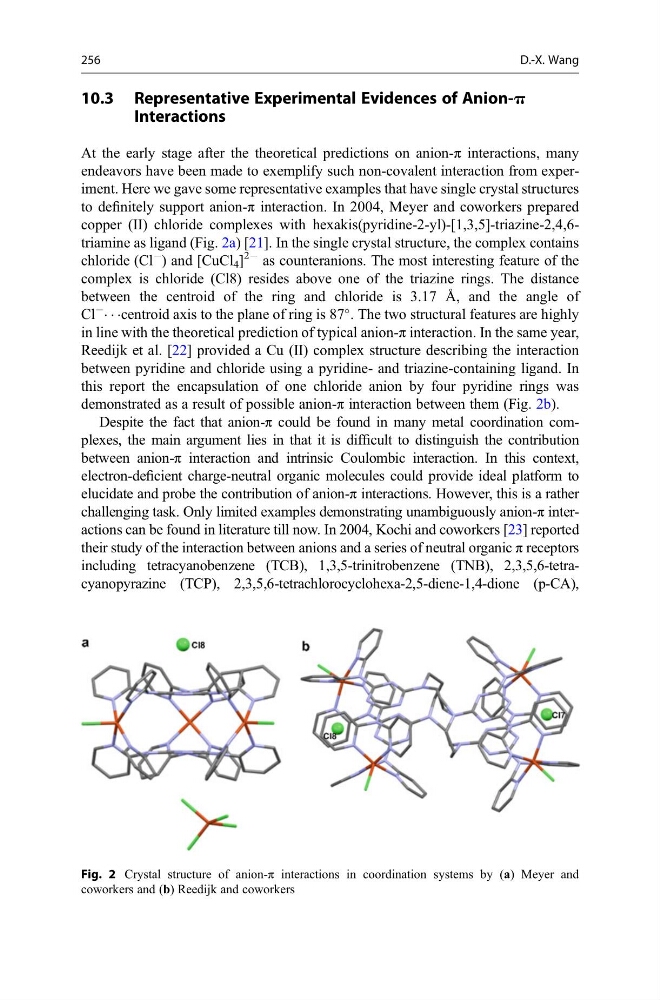
copper (II) chloride complexes with hexakis(pyridine-2-yl)-[1,3,5]-triazine-2,4,6triamine as ligand (Fig. 2a) [21]. In the single crystal structure, the complex contains
chloride (Cl
À
) and [CuCl 4 ]
2À as counteranions. The most interesting feature of the
complex is chloride (Cl8) resides above one of the triazine rings. The distance
between the centroid of the ring and chloride is 3.17 Å, and the angle of
Cl
À Á Á Ácentroid axis to the plane of ring is 87
. The two structural features are highly
in line with the theoretical prediction of typical anion-π interaction. In the same year,
Reedijk et al. [22] provided a Cu (II) complex structure describing the interaction
between pyridine and chloride using a pyridine- and triazine-containing ligand. In
this report the encapsulation of one chloride anion by four pyridine rings was
demonstrated as a result of possible anion-π interaction between them (Fig. 2b).
Despite the fact that anion-π could be found in many metal coordination complexes, the main argument lies in that it is difficult to distinguish the contribution
between anion-π interaction and intrinsic Coulombic interaction. In this context,
electron-deficient charge-neutral organic molecules could provide ideal platform to
elucidate and probe the contribution of anion-π interactions. However, this is a rather
challenging task. Only limited examples demonstrating unambiguously anion-π interactions can be found in literature till now. In 2004, Kochi and coworkers [23] reported
their study of the interaction between anions and a series of neutral organic π receptors
including tetracyanobenzene (TCB), 1,3,5-trinitrobenzene (TNB), 2,3,5,6-tetracyanopyrazine (TCP), 2,3,5,6-tetrachlorocyclohexa-2,5-diene-1,4-dione (p-CA),
Fig. 2 Crystal structure of anion-π interactions in coordination systems by (a) Meyer and
coworkers and (b) Reedijk and coworkers
256
D.-X. Wang
Interactions
At the early stage after the theoretical predictions on anion-π interactions, many
endeavors have been made to exemplify such non-covalent interaction from experiment. Here we gave some representative examples that have single crystal structures
to definitely support anion-π interaction. In 2004, Meyer and coworkers prepared
copper (II) chloride complexes with hexakis(pyridine-2-yl)-[1,3,5]-triazine-2,4,6triamine as ligand (Fig. 2a) [21]. In the single crystal structure, the complex contains
chloride (Cl
À
) and [CuCl 4 ]
2À as counteranions. The most interesting feature of the
complex is chloride (Cl8) resides above one of the triazine rings. The distance
between the centroid of the ring and chloride is 3.17 Å, and the angle of
Cl
À Á Á Ácentroid axis to the plane of ring is 87
. The two structural features are highly
in line with the theoretical prediction of typical anion-π interaction. In the same year,
Reedijk et al. [22] provided a Cu (II) complex structure describing the interaction
between pyridine and chloride using a pyridine- and triazine-containing ligand. In
this report the encapsulation of one chloride anion by four pyridine rings was
demonstrated as a result of possible anion-π interaction between them (Fig. 2b).
Despite the fact that anion-π could be found in many metal coordination complexes, the main argument lies in that it is difficult to distinguish the contribution
between anion-π interaction and intrinsic Coulombic interaction. In this context,
electron-deficient charge-neutral organic molecules could provide ideal platform to
elucidate and probe the contribution of anion-π interactions. However, this is a rather
challenging task. Only limited examples demonstrating unambiguously anion-π interactions can be found in literature till now. In 2004, Kochi and coworkers [23] reported
their study of the interaction between anions and a series of neutral organic π receptors
including tetracyanobenzene (TCB), 1,3,5-trinitrobenzene (TNB), 2,3,5,6-tetracyanopyrazine (TCP), 2,3,5,6-tetrachlorocyclohexa-2,5-diene-1,4-dione (p-CA),
Fig. 2 Crystal structure of anion-π interactions in coordination systems by (a) Meyer and
coworkers and (b) Reedijk and coworkers
256
D.-X. Wang