

interactions with the same host and anions of varied geometry including linear
thiocyanate (SCN
À ), triangular nitrate (NO 3
À
), tetrahedral tetrafluoroborate
(BF 4
À ), and octahedral hexafluorophosphate (PF 6
À
). The complexations as revealed
by X-ray crystallography showed clearly that anions despite their various geometries
form 1:1 complexes with 1. Typical anion-π interaction was ubiquitously observed in
all complexes; besides, concurrent σ-type interaction was also found depending on
the specific geometry of the anion (e.g., in [1ÁNO 3 ]
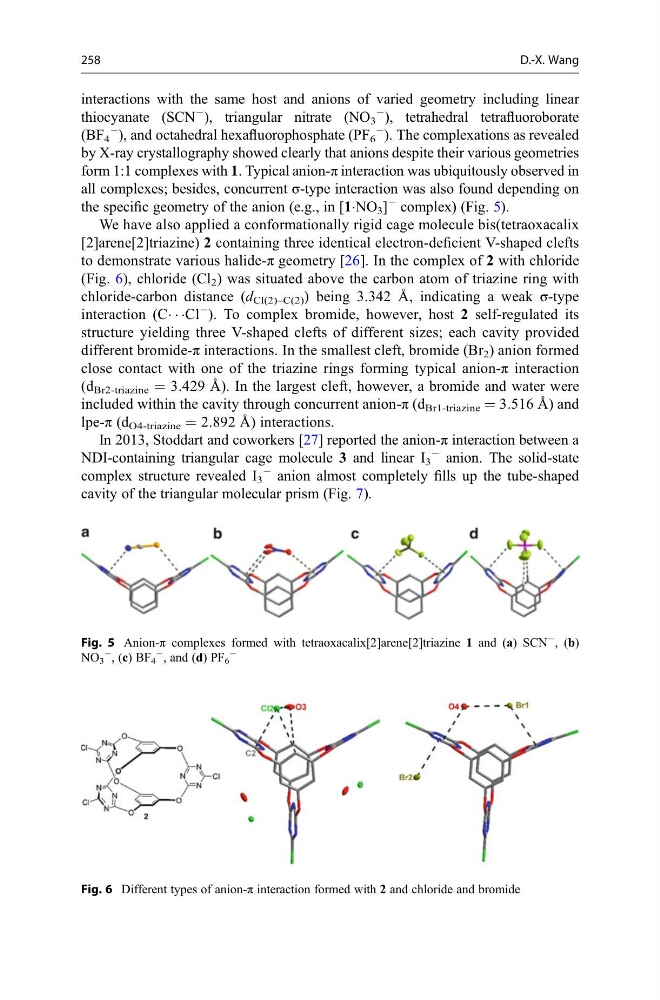
À complex) (Fig. 5).
We have also applied a conformationally rigid cage molecule bis(tetraoxacalix
[2]arene[2]triazine) 2 containing three identical electron-deficient V-shaped clefts
to demonstrate various halide-π geometry [26]. In the complex of 2 with chloride
(Fig. 6), chloride (Cl 2 ) was situated above the carbon atom of triazine ring with
chloride-carbon distance (d Cl(2)–C(2) ) being 3.342 Å, indicating a weak σ-type
interaction (CÁ Á ÁCl
À
). To complex bromide, however, host 2 self-regulated its
structure yielding three V-shaped clefts of different sizes; each cavity provided
different bromide-π interactions. In the smallest cleft, bromide (Br 2 ) anion formed
close contact with one of the triazine rings forming typical anion-π interaction
(d Br2-triazine = 3.429 Å). In the largest cleft, however, a bromide and water were
included within the cavity through concurrent anion-π (d Br1-triazine = 3.516 Å) and
lpe-π (d O4-triazine = 2.892 Å) interactions.
In 2013, Stoddart and coworkers [27] reported the anion-π interaction between a
NDI-containing triangular cage molecule 3 and linear I 3
À anion. The solid-state
complex structure revealed I 3
À anion almost completely fills up the tube-shaped
cavity of the triangular molecular prism (Fig. 7).
Fig. 5 Anion-π complexes formed with tetraoxacalix[2]arene[2]triazine 1 and (a) SCN
À
, (b)
NO 3
À
, (c) BF 4
À
, and (d) PF 6
À
Fig. 6 Different types of anion-π interaction formed with 2 and chloride and bromide
258
D.-X. Wang
thiocyanate (SCN
À ), triangular nitrate (NO 3
À
), tetrahedral tetrafluoroborate
(BF 4
À ), and octahedral hexafluorophosphate (PF 6
À
). The complexations as revealed
by X-ray crystallography showed clearly that anions despite their various geometries
form 1:1 complexes with 1. Typical anion-π interaction was ubiquitously observed in
all complexes; besides, concurrent σ-type interaction was also found depending on
the specific geometry of the anion (e.g., in [1ÁNO 3 ]
À complex) (Fig. 5).
We have also applied a conformationally rigid cage molecule bis(tetraoxacalix
[2]arene[2]triazine) 2 containing three identical electron-deficient V-shaped clefts
to demonstrate various halide-π geometry [26]. In the complex of 2 with chloride
(Fig. 6), chloride (Cl 2 ) was situated above the carbon atom of triazine ring with
chloride-carbon distance (d Cl(2)–C(2) ) being 3.342 Å, indicating a weak σ-type
interaction (CÁ Á ÁCl
À
). To complex bromide, however, host 2 self-regulated its
structure yielding three V-shaped clefts of different sizes; each cavity provided
different bromide-π interactions. In the smallest cleft, bromide (Br 2 ) anion formed
close contact with one of the triazine rings forming typical anion-π interaction
(d Br2-triazine = 3.429 Å). In the largest cleft, however, a bromide and water were
included within the cavity through concurrent anion-π (d Br1-triazine = 3.516 Å) and
lpe-π (d O4-triazine = 2.892 Å) interactions.
In 2013, Stoddart and coworkers [27] reported the anion-π interaction between a
NDI-containing triangular cage molecule 3 and linear I 3
À anion. The solid-state
complex structure revealed I 3
À anion almost completely fills up the tube-shaped
cavity of the triangular molecular prism (Fig. 7).
Fig. 5 Anion-π complexes formed with tetraoxacalix[2]arene[2]triazine 1 and (a) SCN
À
, (b)
NO 3
À
, (c) BF 4
À
, and (d) PF 6
À
Fig. 6 Different types of anion-π interaction formed with 2 and chloride and bromide
258
D.-X. Wang