

“off-on” system usually originates from one kind of redox probe, the environmental
variations, such as solution pH and concentration, may give rise to the positive or
negative false signal. Ratiometric electrochemical assays have attracted more and
more research interests recently due to the removal of most errors via the normalization of environmental variations [56, 57]. Considering the advantages of
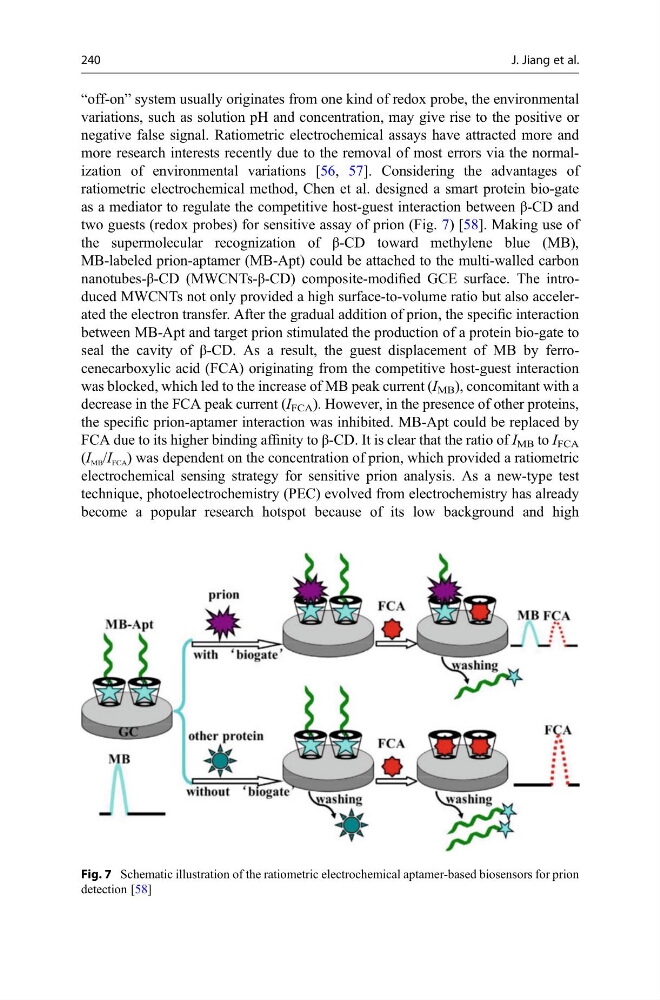
ratiometric electrochemical method, Chen et al. designed a smart protein bio-gate
as a mediator to regulate the competitive host-guest interaction between β-CD and
two guests (redox probes) for sensitive assay of prion (Fig. 7) [58]. Making use of
the supermolecular recognization of β-CD toward methylene blue (MB),
MB-labeled prion-aptamer (MB-Apt) could be attached to the multi-walled carbon
nanotubes-β-CD (MWCNTs-β-CD) composite-modified GCE surface. The introduced MWCNTs not only provided a high surface-to-volume ratio but also accelerated the electron transfer. After the gradual addition of prion, the specific interaction
between MB-Apt and target prion stimulated the production of a protein bio-gate to
seal the cavity of β-CD. As a result, the guest displacement of MB by ferrocenecarboxylic acid (FCA) originating from the competitive host-guest interaction
was blocked, which led to the increase of MB peak current (I MB ), concomitant with a
decrease in the FCA peak current (I FCA ). However, in the presence of other proteins,
the specific prion-aptamer interaction was inhibited. MB-Apt could be replaced by
FCA due to its higher binding affinity to β-CD. It is clear that the ratio of I MB to I FCA
(I MB /I FCA ) was dependent on the concentration of prion, which provided a ratiometric
electrochemical sensing strategy for sensitive prion analysis. As a new-type test
technique, photoelectrochemistry (PEC) evolved from electrochemistry has already
become a popular research hotspot because of its low background and high
Fig. 7 Schematic illustration of the ratiometric electrochemical aptamer-based biosensors for prion
detection [58]
240
J. Jiang et al.
variations, such as solution pH and concentration, may give rise to the positive or
negative false signal. Ratiometric electrochemical assays have attracted more and
more research interests recently due to the removal of most errors via the normalization of environmental variations [56, 57]. Considering the advantages of
ratiometric electrochemical method, Chen et al. designed a smart protein bio-gate
as a mediator to regulate the competitive host-guest interaction between β-CD and
two guests (redox probes) for sensitive assay of prion (Fig. 7) [58]. Making use of
the supermolecular recognization of β-CD toward methylene blue (MB),
MB-labeled prion-aptamer (MB-Apt) could be attached to the multi-walled carbon
nanotubes-β-CD (MWCNTs-β-CD) composite-modified GCE surface. The introduced MWCNTs not only provided a high surface-to-volume ratio but also accelerated the electron transfer. After the gradual addition of prion, the specific interaction
between MB-Apt and target prion stimulated the production of a protein bio-gate to
seal the cavity of β-CD. As a result, the guest displacement of MB by ferrocenecarboxylic acid (FCA) originating from the competitive host-guest interaction
was blocked, which led to the increase of MB peak current (I MB ), concomitant with a
decrease in the FCA peak current (I FCA ). However, in the presence of other proteins,
the specific prion-aptamer interaction was inhibited. MB-Apt could be replaced by
FCA due to its higher binding affinity to β-CD. It is clear that the ratio of I MB to I FCA
(I MB /I FCA ) was dependent on the concentration of prion, which provided a ratiometric
electrochemical sensing strategy for sensitive prion analysis. As a new-type test
technique, photoelectrochemistry (PEC) evolved from electrochemistry has already
become a popular research hotspot because of its low background and high
Fig. 7 Schematic illustration of the ratiometric electrochemical aptamer-based biosensors for prion
detection [58]
240
J. Jiang et al.