

firstly design a general electrochemical signal readout strategy to assay protein by
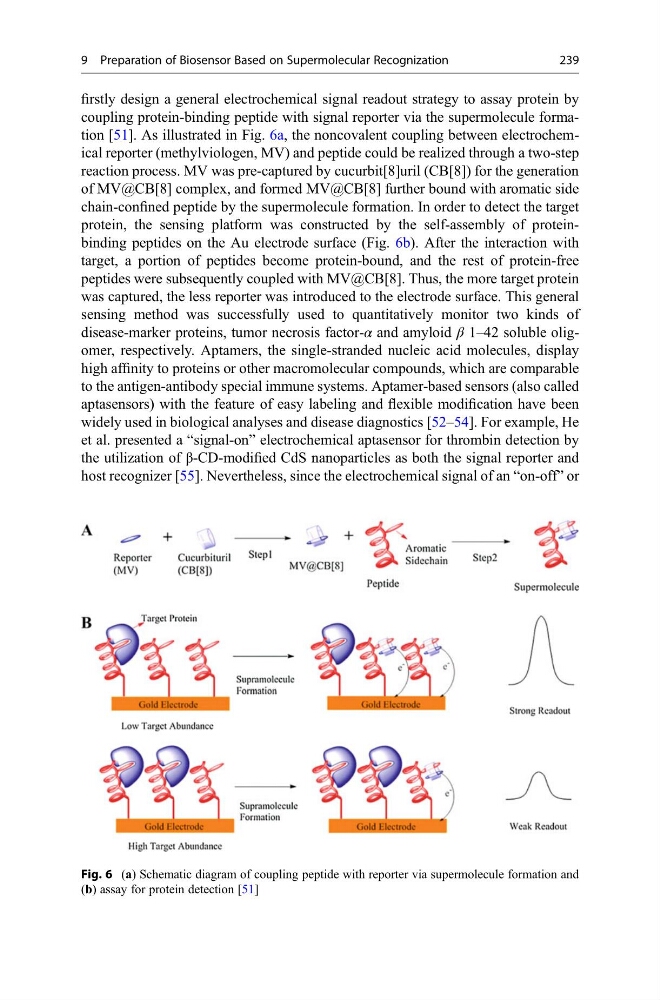
coupling protein-binding peptide with signal reporter via the supermolecule formation [51]. As illustrated in Fig. 6a, the noncovalent coupling between electrochemical reporter (methylviologen, MV) and peptide could be realized through a two-step
reaction process. MV was pre-captured by cucurbit[8]uril (CB[8]) for the generation
of MV@CB[8] complex, and formed MV@CB[8] further bound with aromatic side
chain-confined peptide by the supermolecule formation. In order to detect the target
protein, the sensing platform was constructed by the self-assembly of proteinbinding peptides on the Au electrode surface (Fig. 6b). After the interaction with
target, a portion of peptides become protein-bound, and the rest of protein-free
peptides were subsequently coupled with MV@CB[8]. Thus, the more target protein
was captured, the less reporter was introduced to the electrode surface. This general
sensing method was successfully used to quantitatively monitor two kinds of
disease-marker proteins, tumor necrosis factor-α and amyloid β 1–42 soluble oligomer, respectively. Aptamers, the single-stranded nucleic acid molecules, display
high affinity to proteins or other macromolecular compounds, which are comparable
to the antigen-antibody special immune systems. Aptamer-based sensors (also called
aptasensors) with the feature of easy labeling and flexible modification have been
widely used in biological analyses and disease diagnostics [52–54]. For example, He
et al. presented a “signal-on” electrochemical aptasensor for thrombin detection by
the utilization of β-CD-modified CdS nanoparticles as both the signal reporter and
host recognizer [55]. Nevertheless, since the electrochemical signal of an “on-off” or
Fig. 6 (a) Schematic diagram of coupling peptide with reporter via supermolecule formation and
(b) assay for protein detection [51]
9 Preparation of Biosensor Based on Supermolecular Recognization
239
coupling protein-binding peptide with signal reporter via the supermolecule formation [51]. As illustrated in Fig. 6a, the noncovalent coupling between electrochemical reporter (methylviologen, MV) and peptide could be realized through a two-step
reaction process. MV was pre-captured by cucurbit[8]uril (CB[8]) for the generation
of MV@CB[8] complex, and formed MV@CB[8] further bound with aromatic side
chain-confined peptide by the supermolecule formation. In order to detect the target
protein, the sensing platform was constructed by the self-assembly of proteinbinding peptides on the Au electrode surface (Fig. 6b). After the interaction with
target, a portion of peptides become protein-bound, and the rest of protein-free
peptides were subsequently coupled with MV@CB[8]. Thus, the more target protein
was captured, the less reporter was introduced to the electrode surface. This general
sensing method was successfully used to quantitatively monitor two kinds of
disease-marker proteins, tumor necrosis factor-α and amyloid β 1–42 soluble oligomer, respectively. Aptamers, the single-stranded nucleic acid molecules, display
high affinity to proteins or other macromolecular compounds, which are comparable
to the antigen-antibody special immune systems. Aptamer-based sensors (also called
aptasensors) with the feature of easy labeling and flexible modification have been
widely used in biological analyses and disease diagnostics [52–54]. For example, He
et al. presented a “signal-on” electrochemical aptasensor for thrombin detection by
the utilization of β-CD-modified CdS nanoparticles as both the signal reporter and
host recognizer [55]. Nevertheless, since the electrochemical signal of an “on-off” or
Fig. 6 (a) Schematic diagram of coupling peptide with reporter via supermolecule formation and
(b) assay for protein detection [51]
9 Preparation of Biosensor Based on Supermolecular Recognization
239