

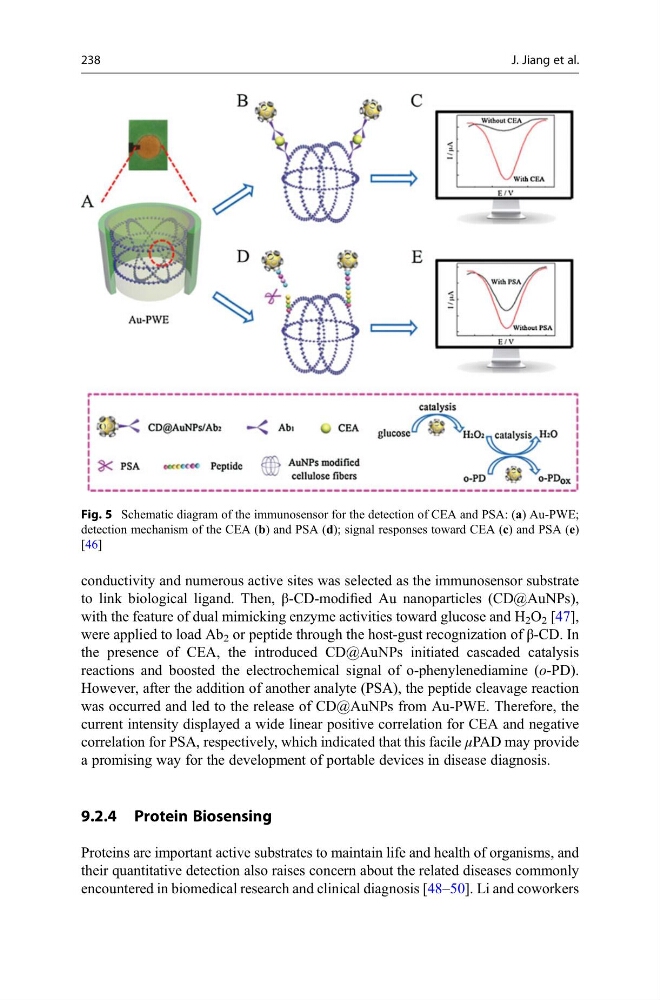
conductivity and numerous active sites was selected as the immunosensor substrate
to link biological ligand. Then, β-CD-modified Au nanoparticles (CD@AuNPs),
with the feature of dual mimicking enzyme activities toward glucose and H 2 O 2 [47],
were applied to load Ab 2 or peptide through the host-gust recognization of β-CD. In
the presence of CEA, the introduced CD@AuNPs initiated cascaded catalysis
reactions and boosted the electrochemical signal of o-phenylenediamine (o-PD).
However, after the addition of another analyte (PSA), the peptide cleavage reaction
was occurred and led to the release of CD@AuNPs from Au-PWE. Therefore, the
current intensity displayed a wide linear positive correlation for CEA and negative
correlation for PSA, respectively, which indicated that this facile μPAD may provide
a promising way for the development of portable devices in disease diagnosis.
9.2.4 Protein Biosensing
Proteins are important active substrates to maintain life and health of organisms, and
their quantitative detection also raises concern about the related diseases commonly
encountered in biomedical research and clinical diagnosis [48–50]. Li and coworkers
Fig. 5 Schematic diagram of the immunosensor for the detection of CEA and PSA: (a) Au-PWE;
detection mechanism of the CEA (b) and PSA (d); signal responses toward CEA (c) and PSA (e)
[46]
238
J. Jiang et al.
to link biological ligand. Then, β-CD-modified Au nanoparticles (CD@AuNPs),
with the feature of dual mimicking enzyme activities toward glucose and H 2 O 2 [47],
were applied to load Ab 2 or peptide through the host-gust recognization of β-CD. In
the presence of CEA, the introduced CD@AuNPs initiated cascaded catalysis
reactions and boosted the electrochemical signal of o-phenylenediamine (o-PD).
However, after the addition of another analyte (PSA), the peptide cleavage reaction
was occurred and led to the release of CD@AuNPs from Au-PWE. Therefore, the
current intensity displayed a wide linear positive correlation for CEA and negative
correlation for PSA, respectively, which indicated that this facile μPAD may provide
a promising way for the development of portable devices in disease diagnosis.
9.2.4 Protein Biosensing
Proteins are important active substrates to maintain life and health of organisms, and
their quantitative detection also raises concern about the related diseases commonly
encountered in biomedical research and clinical diagnosis [48–50]. Li and coworkers
Fig. 5 Schematic diagram of the immunosensor for the detection of CEA and PSA: (a) Au-PWE;
detection mechanism of the CEA (b) and PSA (d); signal responses toward CEA (c) and PSA (e)
[46]
238
J. Jiang et al.