

sensitivity [59, 60]. Photoelectrochemical process usually involves in the photon-toelectron conversion caused by electron excitation and consequent charge transfer of
photoactive substances (such as inorganic or organic semiconductors) produced
under the light irradiation [61, 62]. In view of the favorable biocompatibility, high
electronic mobility, and desirable chemical stability of titanium dioxide (TiO 2 ), a
simple prion PEC aptasensor with a low detection limit of 50.9 fM was constructed
by the integration of the enhanced photoelectric property of Au-TiO 2 composites and
good host-guest interaction between thiol-β-CD (SH-β-CD) and rhodamine B
(RhB) [63].
The precise monitoring of enzyme activity is of great practical significance for
further understanding their functions, developing early diagnoses, and discovering
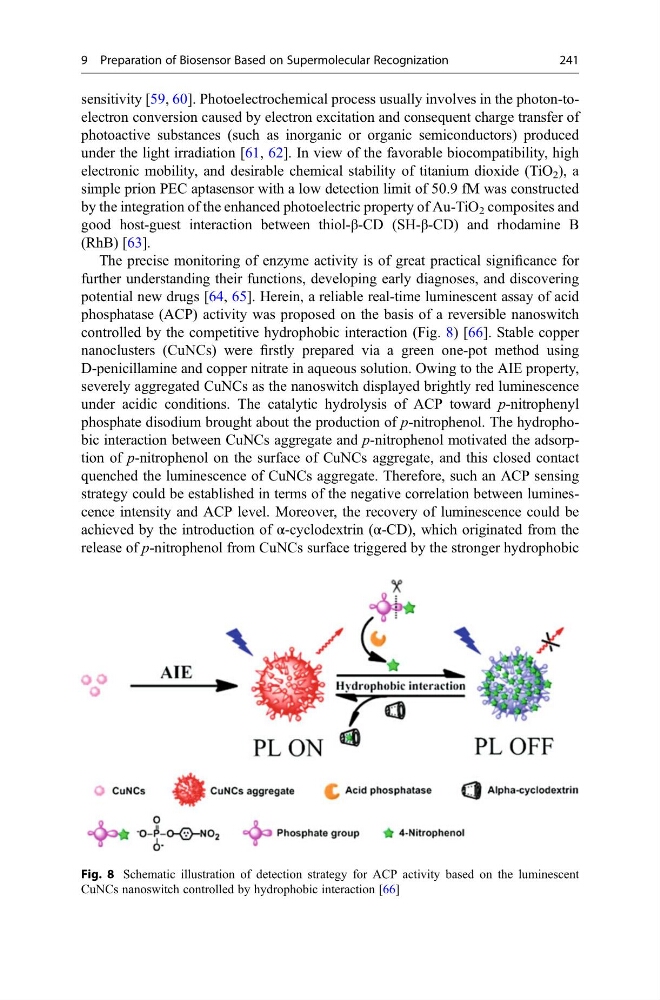
potential new drugs [64, 65]. Herein, a reliable real-time luminescent assay of acid
phosphatase (ACP) activity was proposed on the basis of a reversible nanoswitch
controlled by the competitive hydrophobic interaction (Fig. 8) [66]. Stable copper
nanoclusters (CuNCs) were firstly prepared via a green one-pot method using
D-penicillamine and copper nitrate in aqueous solution. Owing to the AIE property,
severely aggregated CuNCs as the nanoswitch displayed brightly red luminescence
under acidic conditions. The catalytic hydrolysis of ACP toward p-nitrophenyl
phosphate disodium brought about the production of p-nitrophenol. The hydrophobic interaction between CuNCs aggregate and p-nitrophenol motivated the adsorption of p-nitrophenol on the surface of CuNCs aggregate, and this closed contact
quenched the luminescence of CuNCs aggregate. Therefore, such an ACP sensing
strategy could be established in terms of the negative correlation between luminescence intensity and ACP level. Moreover, the recovery of luminescence could be
achieved by the introduction of α-cyclodextrin (α-CD), which originated from the
release of p-nitrophenol from CuNCs surface triggered by the stronger hydrophobic
Fig. 8 Schematic illustration of detection strategy for ACP activity based on the luminescent
CuNCs nanoswitch controlled by hydrophobic interaction [66]
9 Preparation of Biosensor Based on Supermolecular Recognization
241
photoactive substances (such as inorganic or organic semiconductors) produced
under the light irradiation [61, 62]. In view of the favorable biocompatibility, high
electronic mobility, and desirable chemical stability of titanium dioxide (TiO 2 ), a
simple prion PEC aptasensor with a low detection limit of 50.9 fM was constructed
by the integration of the enhanced photoelectric property of Au-TiO 2 composites and
good host-guest interaction between thiol-β-CD (SH-β-CD) and rhodamine B
(RhB) [63].
The precise monitoring of enzyme activity is of great practical significance for
further understanding their functions, developing early diagnoses, and discovering
potential new drugs [64, 65]. Herein, a reliable real-time luminescent assay of acid
phosphatase (ACP) activity was proposed on the basis of a reversible nanoswitch
controlled by the competitive hydrophobic interaction (Fig. 8) [66]. Stable copper
nanoclusters (CuNCs) were firstly prepared via a green one-pot method using
D-penicillamine and copper nitrate in aqueous solution. Owing to the AIE property,
severely aggregated CuNCs as the nanoswitch displayed brightly red luminescence
under acidic conditions. The catalytic hydrolysis of ACP toward p-nitrophenyl
phosphate disodium brought about the production of p-nitrophenol. The hydrophobic interaction between CuNCs aggregate and p-nitrophenol motivated the adsorption of p-nitrophenol on the surface of CuNCs aggregate, and this closed contact
quenched the luminescence of CuNCs aggregate. Therefore, such an ACP sensing
strategy could be established in terms of the negative correlation between luminescence intensity and ACP level. Moreover, the recovery of luminescence could be
achieved by the introduction of α-cyclodextrin (α-CD), which originated from the
release of p-nitrophenol from CuNCs surface triggered by the stronger hydrophobic
Fig. 8 Schematic illustration of detection strategy for ACP activity based on the luminescent
CuNCs nanoswitch controlled by hydrophobic interaction [66]
9 Preparation of Biosensor Based on Supermolecular Recognization
241