

MB in signal probe as the efficient electron transfer mediator [27]. Furthermore, this
sensing platform showed favorable recyclability after a simple washing treatment
with hot acetonitrile to dissociate the inclusion complex. On the basis of the toeholdtriggered strand displacement reaction and host-guest recognization of
Fe 3 O 4 @SiO 2 @βÀCD nanocomposites, Diao’s group realized a facile homogeneous
electrochemical analytical method for sensitive target DNA assay, and the fabricated
biosensor was successfully used to work in complex biological systems [28].
Some previous researches have verified that epichlorohydrin cross-linked
β-cyclodextrin polymer (β-CDP) possessed stronger recognization capability toward
guest molecules in comparison with the β-CD monomer [29, 30]. Based on this, a
polymerase and λ exonuclease-assisted multiple amplification fluorescence method
was reported for sensitive miRNA-21 detection in combination of a significant
fluorescence enhancement effect of β-CDP for pyrene, which could be ascribed to
the high molecular recognization of β-CDP [31]. Therefore, the proposed biosensor
was successfully applied for the quantitative monitoring of miRNA-21 in a dynamic
range of 1–5000 pM with a detection limit down to 0.3 pM and displayed high
selectivity in discriminating base-mismatched sequences. Analogously, selecting
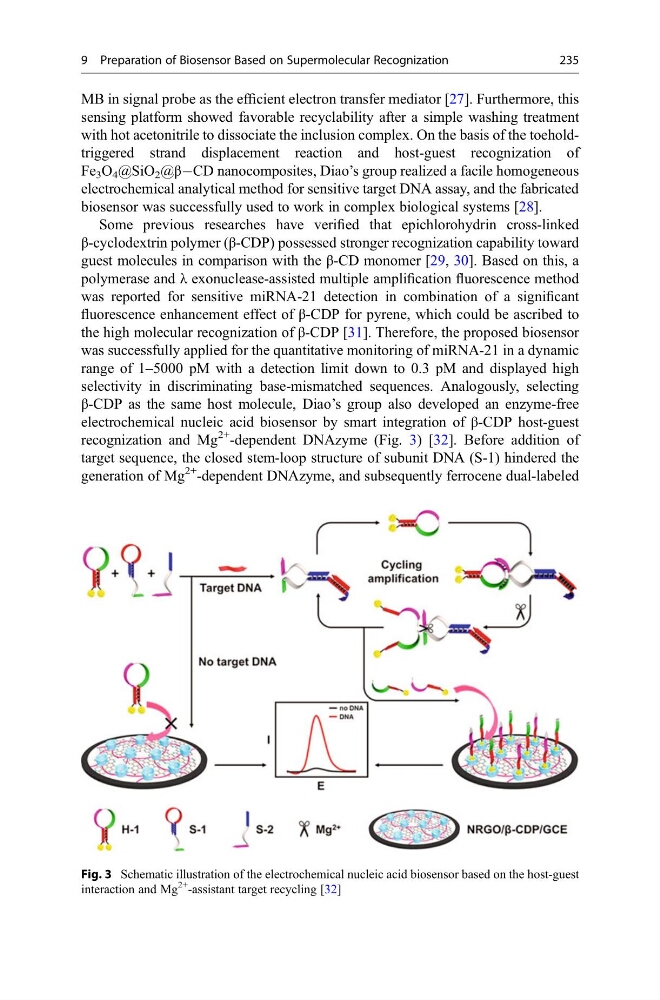
β-CDP as the same host molecule, Diao’s group also developed an enzyme-free
electrochemical nucleic acid biosensor by smart integration of β-CDP host-guest
recognization and Mg
2+ -dependent DNAzyme (Fig. 3) [32]. Before addition of
target sequence, the closed stem-loop structure of subunit DNA (S-1) hindered the
generation of Mg
2+ -dependent DNAzyme, and subsequently ferrocene dual-labeled
Fig. 3 Schematic illustration of the electrochemical nucleic acid biosensor based on the host-guest
interaction and Mg
2+ -assistant target recycling [32]
9 Preparation of Biosensor Based on Supermolecular Recognization
235
sensing platform showed favorable recyclability after a simple washing treatment
with hot acetonitrile to dissociate the inclusion complex. On the basis of the toeholdtriggered strand displacement reaction and host-guest recognization of
Fe 3 O 4 @SiO 2 @βÀCD nanocomposites, Diao’s group realized a facile homogeneous
electrochemical analytical method for sensitive target DNA assay, and the fabricated
biosensor was successfully used to work in complex biological systems [28].
Some previous researches have verified that epichlorohydrin cross-linked
β-cyclodextrin polymer (β-CDP) possessed stronger recognization capability toward
guest molecules in comparison with the β-CD monomer [29, 30]. Based on this, a
polymerase and λ exonuclease-assisted multiple amplification fluorescence method
was reported for sensitive miRNA-21 detection in combination of a significant
fluorescence enhancement effect of β-CDP for pyrene, which could be ascribed to
the high molecular recognization of β-CDP [31]. Therefore, the proposed biosensor
was successfully applied for the quantitative monitoring of miRNA-21 in a dynamic
range of 1–5000 pM with a detection limit down to 0.3 pM and displayed high
selectivity in discriminating base-mismatched sequences. Analogously, selecting
β-CDP as the same host molecule, Diao’s group also developed an enzyme-free
electrochemical nucleic acid biosensor by smart integration of β-CDP host-guest
recognization and Mg
2+ -dependent DNAzyme (Fig. 3) [32]. Before addition of
target sequence, the closed stem-loop structure of subunit DNA (S-1) hindered the
generation of Mg
2+ -dependent DNAzyme, and subsequently ferrocene dual-labeled
Fig. 3 Schematic illustration of the electrochemical nucleic acid biosensor based on the host-guest
interaction and Mg
2+ -assistant target recycling [32]
9 Preparation of Biosensor Based on Supermolecular Recognization
235