

hairpin probe (H-1) could not be accumulated on the surface of nitrogen-doped
reduced graphene oxide (NRGO)/β-CDP nanocomposite-modified electrode owing
to the principle of dimension matching. After addition of target molecule, the stemloop structure of S-1 was opened, producing the active DNAzyme to catalyze the
cyclic cleavage of numerous H-1 in the presence of cofactor Mg
2+ . The cleaved H-1
allowed ferrocene molecule to enter the cavity of β-CDP and caused an obvious
increase of response current. By means of the superior recognization capability of
β-CDP and DNAzyme-based enzyme-free amplification technique, the designed
biosensor showed prominent performances for DNA and miRNA assays with low
detection limits of 3.2 and 18 fM, respectively, which may provide a universal
nucleic acid detection approach in the field of bioanalysis.
9.2.3 Immunoassay
As a fascinating recognization technique, supermolecular recognization-based
immunoassays have become the attractive sensing method with improved detection
characteristics [33–35]. A supermolecular immunosensor based on polypyrrolecyclodextrin-modified electrode surfaces for the immobilization of adamantaneand gliadin-bifunctionalized polysaccharide was constructed for the monitoring of
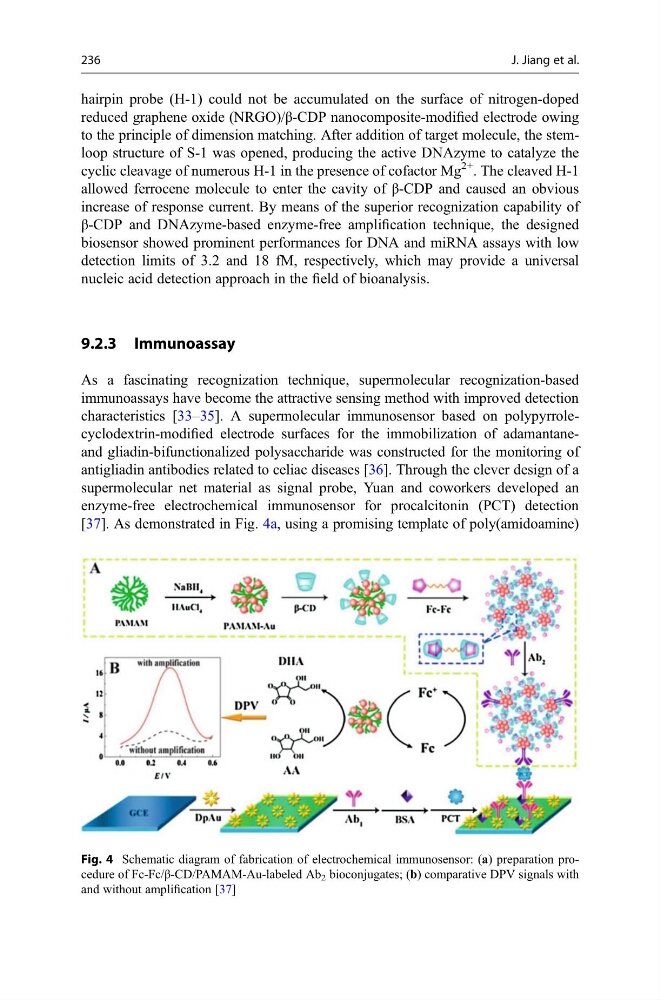
antigliadin antibodies related to celiac diseases [36]. Through the clever design of a
supermolecular net material as signal probe, Yuan and coworkers developed an
enzyme-free electrochemical immunosensor for procalcitonin (PCT) detection
[37]. As demonstrated in Fig. 4a, using a promising template of poly(amidoamine)
Fig. 4 Schematic diagram of fabrication of electrochemical immunosensor: (a) preparation procedure of Fc-Fc/β-CD/PAMAM-Au-labeled Ab 2 bioconjugates; (b) comparative DPV signals with
and without amplification [37]
236
J. Jiang et al.
reduced graphene oxide (NRGO)/β-CDP nanocomposite-modified electrode owing
to the principle of dimension matching. After addition of target molecule, the stemloop structure of S-1 was opened, producing the active DNAzyme to catalyze the
cyclic cleavage of numerous H-1 in the presence of cofactor Mg
2+ . The cleaved H-1
allowed ferrocene molecule to enter the cavity of β-CDP and caused an obvious
increase of response current. By means of the superior recognization capability of
β-CDP and DNAzyme-based enzyme-free amplification technique, the designed
biosensor showed prominent performances for DNA and miRNA assays with low
detection limits of 3.2 and 18 fM, respectively, which may provide a universal
nucleic acid detection approach in the field of bioanalysis.
9.2.3 Immunoassay
As a fascinating recognization technique, supermolecular recognization-based
immunoassays have become the attractive sensing method with improved detection
characteristics [33–35]. A supermolecular immunosensor based on polypyrrolecyclodextrin-modified electrode surfaces for the immobilization of adamantaneand gliadin-bifunctionalized polysaccharide was constructed for the monitoring of
antigliadin antibodies related to celiac diseases [36]. Through the clever design of a
supermolecular net material as signal probe, Yuan and coworkers developed an
enzyme-free electrochemical immunosensor for procalcitonin (PCT) detection
[37]. As demonstrated in Fig. 4a, using a promising template of poly(amidoamine)
Fig. 4 Schematic diagram of fabrication of electrochemical immunosensor: (a) preparation procedure of Fc-Fc/β-CD/PAMAM-Au-labeled Ab 2 bioconjugates; (b) comparative DPV signals with
and without amplification [37]
236
J. Jiang et al.