

selective determination of ultra-trace Tb
3+ [22]. When Tb
3+ -ethylenediaminetetraacetic acid (Tb-EDTA) complex incorporated into the hydrophobic cavity of
β-CD, a dual-signal amplification mechanism by the combination of ECL resonance
energy transfer between β-CD/Tb-EDTA (donor) and Ru(bpy)
3 2+ (acceptor) and the
coreactant system of Ru(bpy) 3
2+ /Tb-EDTA was realized. As a result, the detection
limit of 0.39 pM was dramatically reduced by three orders of magnitudes in
comparison with other Tb
3+ sensors without the supermolecular recognization.
9.2.2 Nucleic Acid Analysis
Accurate and ultrasensitive detection of trace nucleic acid sequences acts as a
significant role in the quantitative analyses of biological markers for various disease
diagnoses [23]. Taking advantage of the novel pillararene derivative
(trithiocarbonate-substituted pillar[5]arene, P5A-CTA), He and coworkers
constructed a recyclable and immobilization-free electrochemical biosensor to detect
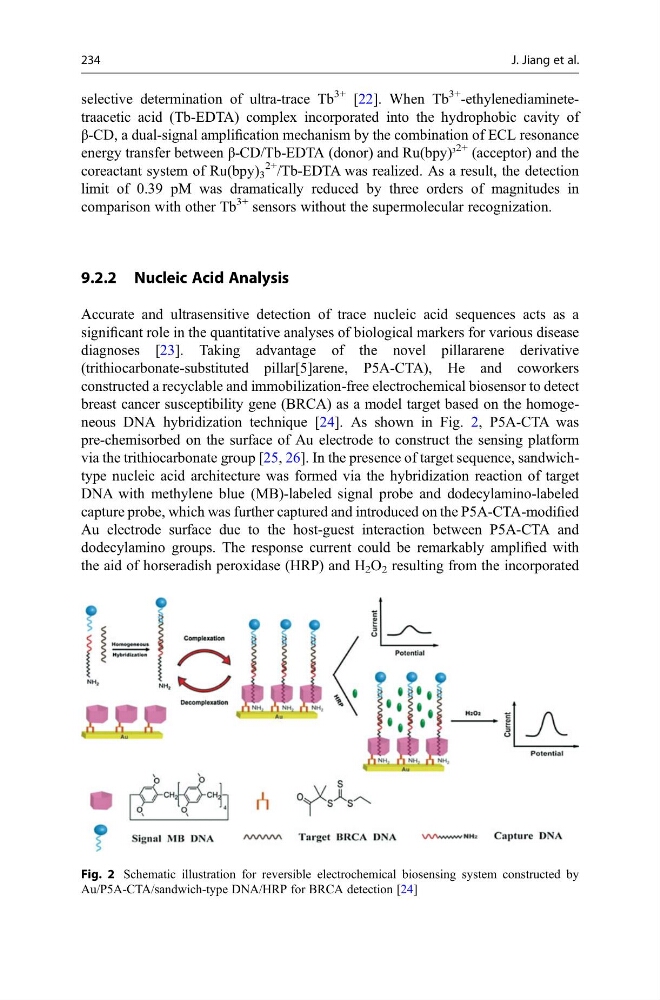
breast cancer susceptibility gene (BRCA) as a model target based on the homogeneous DNA hybridization technique [24]. As shown in Fig. 2, P5A-CTA was
pre-chemisorbed on the surface of Au electrode to construct the sensing platform
via the trithiocarbonate group [25, 26]. In the presence of target sequence, sandwichtype nucleic acid architecture was formed via the hybridization reaction of target
DNA with methylene blue (MB)-labeled signal probe and dodecylamino-labeled
capture probe, which was further captured and introduced on the P5A-CTA-modified
Au electrode surface due to the host-guest interaction between P5A-CTA and
dodecylamino groups. The response current could be remarkably amplified with
the aid of horseradish peroxidase (HRP) and H 2 O 2 resulting from the incorporated
Fig. 2 Schematic illustration for reversible electrochemical biosensing system constructed by
Au/P5A-CTA/sandwich-type DNA/HRP for BRCA detection [24]
234
J. Jiang et al.
3+ [22]. When Tb
3+ -ethylenediaminetetraacetic acid (Tb-EDTA) complex incorporated into the hydrophobic cavity of
β-CD, a dual-signal amplification mechanism by the combination of ECL resonance
energy transfer between β-CD/Tb-EDTA (donor) and Ru(bpy)
3 2+ (acceptor) and the
coreactant system of Ru(bpy) 3
2+ /Tb-EDTA was realized. As a result, the detection
limit of 0.39 pM was dramatically reduced by three orders of magnitudes in
comparison with other Tb
3+ sensors without the supermolecular recognization.
9.2.2 Nucleic Acid Analysis
Accurate and ultrasensitive detection of trace nucleic acid sequences acts as a
significant role in the quantitative analyses of biological markers for various disease
diagnoses [23]. Taking advantage of the novel pillararene derivative
(trithiocarbonate-substituted pillar[5]arene, P5A-CTA), He and coworkers
constructed a recyclable and immobilization-free electrochemical biosensor to detect
breast cancer susceptibility gene (BRCA) as a model target based on the homogeneous DNA hybridization technique [24]. As shown in Fig. 2, P5A-CTA was
pre-chemisorbed on the surface of Au electrode to construct the sensing platform
via the trithiocarbonate group [25, 26]. In the presence of target sequence, sandwichtype nucleic acid architecture was formed via the hybridization reaction of target
DNA with methylene blue (MB)-labeled signal probe and dodecylamino-labeled
capture probe, which was further captured and introduced on the P5A-CTA-modified
Au electrode surface due to the host-guest interaction between P5A-CTA and
dodecylamino groups. The response current could be remarkably amplified with
the aid of horseradish peroxidase (HRP) and H 2 O 2 resulting from the incorporated
Fig. 2 Schematic illustration for reversible electrochemical biosensing system constructed by
Au/P5A-CTA/sandwich-type DNA/HRP for BRCA detection [24]
234
J. Jiang et al.