

(β-CD-PEI/AD-PAA) multilayer coatings, and the fluorescence signal of MoS 2 was
obviously decreased after the adsorption of Co
2+ . However, the self-healing capability of MoS 2 /(β-CD-PEI/AD-PAA) 15 coatings was not affected by Co
2+ accumulation, which could be attributed to the satisfactory host-guest interaction between
β-CD-PEI and AD-PAA. With the help of Hg
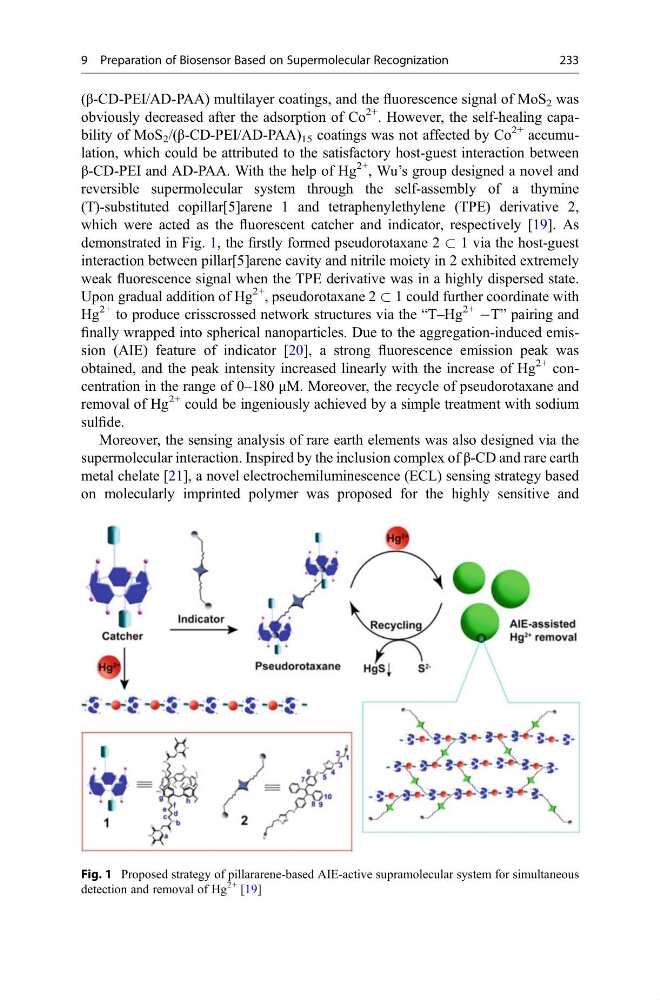
2+ , Wu’s group designed a novel and
reversible supermolecular system through the self-assembly of a thymine
(T)-substituted copillar[5]arene 1 and tetraphenylethylene (TPE) derivative 2,
which were acted as the fluorescent catcher and indicator, respectively [19]. As
demonstrated in Fig. 1, the firstly formed pseudorotaxane 2 & 1 via the host-guest
interaction between pillar[5]arene cavity and nitrile moiety in 2 exhibited extremely
weak fluorescence signal when the TPE derivative was in a highly dispersed state.
Upon gradual addition of Hg
2+ , pseudorotaxane 2 & 1 could further coordinate with
Hg
2+ to produce crisscrossed network structures via the “T–Hg
2+
ÀT” pairing and
finally wrapped into spherical nanoparticles. Due to the aggregation-induced emission (AIE) feature of indicator [20], a strong fluorescence emission peak was
obtained, and the peak intensity increased linearly with the increase of Hg
2+ concentration in the range of 0–180 μM. Moreover, the recycle of pseudorotaxane and
removal of Hg
2+ could be ingeniously achieved by a simple treatment with sodium
sulfide.
Moreover, the sensing analysis of rare earth elements was also designed via the
supermolecular interaction. Inspired by the inclusion complex of β-CD and rare earth
metal chelate [21], a novel electrochemiluminescence (ECL) sensing strategy based
on molecularly imprinted polymer was proposed for the highly sensitive and
Fig. 1 Proposed strategy of pillararene-based AIE-active supramolecular system for simultaneous
detection and removal of Hg
2+ [19]
9 Preparation of Biosensor Based on Supermolecular Recognization
233
obviously decreased after the adsorption of Co
2+ . However, the self-healing capability of MoS 2 /(β-CD-PEI/AD-PAA) 15 coatings was not affected by Co
2+ accumulation, which could be attributed to the satisfactory host-guest interaction between
β-CD-PEI and AD-PAA. With the help of Hg
2+ , Wu’s group designed a novel and
reversible supermolecular system through the self-assembly of a thymine
(T)-substituted copillar[5]arene 1 and tetraphenylethylene (TPE) derivative 2,
which were acted as the fluorescent catcher and indicator, respectively [19]. As
demonstrated in Fig. 1, the firstly formed pseudorotaxane 2 & 1 via the host-guest
interaction between pillar[5]arene cavity and nitrile moiety in 2 exhibited extremely
weak fluorescence signal when the TPE derivative was in a highly dispersed state.
Upon gradual addition of Hg
2+ , pseudorotaxane 2 & 1 could further coordinate with
Hg
2+ to produce crisscrossed network structures via the “T–Hg
2+
ÀT” pairing and
finally wrapped into spherical nanoparticles. Due to the aggregation-induced emission (AIE) feature of indicator [20], a strong fluorescence emission peak was
obtained, and the peak intensity increased linearly with the increase of Hg
2+ concentration in the range of 0–180 μM. Moreover, the recycle of pseudorotaxane and
removal of Hg
2+ could be ingeniously achieved by a simple treatment with sodium
sulfide.
Moreover, the sensing analysis of rare earth elements was also designed via the
supermolecular interaction. Inspired by the inclusion complex of β-CD and rare earth
metal chelate [21], a novel electrochemiluminescence (ECL) sensing strategy based
on molecularly imprinted polymer was proposed for the highly sensitive and
Fig. 1 Proposed strategy of pillararene-based AIE-active supramolecular system for simultaneous
detection and removal of Hg
2+ [19]
9 Preparation of Biosensor Based on Supermolecular Recognization
233