

7.3.7 Pillar[4]pyridinium
A highly symmetric and quadrupled positively charged macrocycle, namely, pillar
[4]pyridinium (56), was introduced by Sashuk, Szumna, and coworkers in 2017
[68]. 56 could be produced by condensation of 4-(bromomethyl) pyridine
hydrobromide with equimolar amounts of NaHCO 3 and NH 4 PF 6 in acetonitrile
(Fig. 10a), giving the target product in a good yield of 50%. Significantly, similar
to calix[n]imidazolium as aforementioned, 56 could also serve as an effective
fluoride receptor in aqueous solution. In a word, taking advantage of the electronrich feature, pillar[4]pyridinium will find a wide range of applications in the field of
ion sensing.
7.3.8 Leaning Pillar[6]arenes
Very recently, a new version of pillar[6]arenes with desirable cavity adaptability
and enhanced guest-binding capability, namely, leaning pillar[6]arenes (or leaning
towerarenes), was first reported by our group [69–71]. The synthesis of leaning
pillar[6]arenes was accomplished by a facile two-step synthetic approach including
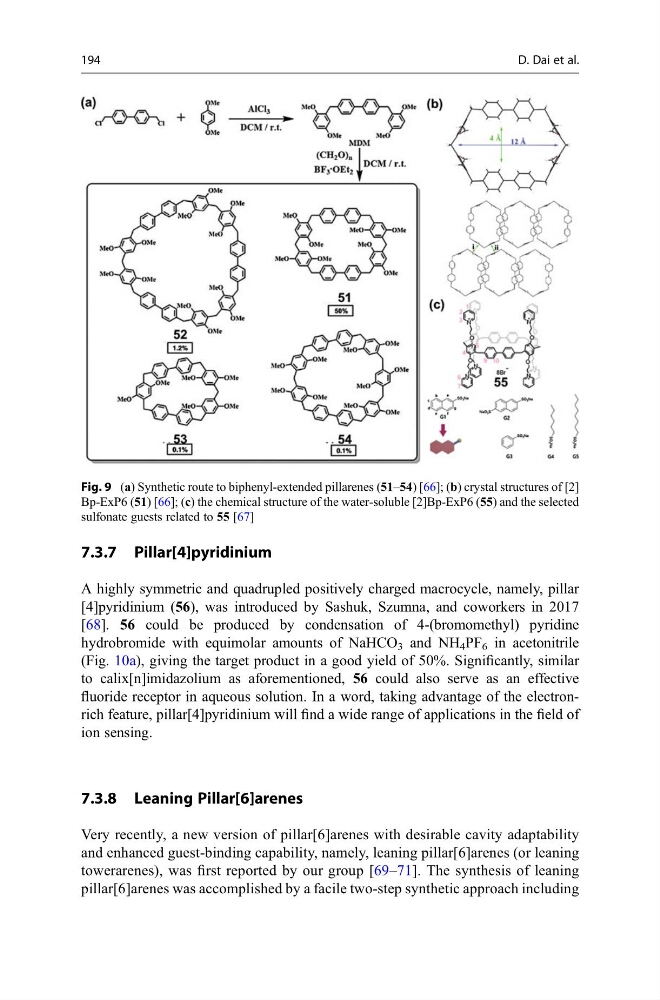
Fig. 9 (a) Synthetic route to biphenyl-extended pillarenes (51–54) [66]; (b) crystal structures of [2]
Bp-ExP6 (51) [66]; (c) the chemical structure of the water-soluble [2]Bp-ExP6 (55) and the selected
sulfonate guests related to 55 [67]
194
D. Dai et al.
A highly symmetric and quadrupled positively charged macrocycle, namely, pillar
[4]pyridinium (56), was introduced by Sashuk, Szumna, and coworkers in 2017
[68]. 56 could be produced by condensation of 4-(bromomethyl) pyridine
hydrobromide with equimolar amounts of NaHCO 3 and NH 4 PF 6 in acetonitrile
(Fig. 10a), giving the target product in a good yield of 50%. Significantly, similar
to calix[n]imidazolium as aforementioned, 56 could also serve as an effective
fluoride receptor in aqueous solution. In a word, taking advantage of the electronrich feature, pillar[4]pyridinium will find a wide range of applications in the field of
ion sensing.
7.3.8 Leaning Pillar[6]arenes
Very recently, a new version of pillar[6]arenes with desirable cavity adaptability
and enhanced guest-binding capability, namely, leaning pillar[6]arenes (or leaning
towerarenes), was first reported by our group [69–71]. The synthesis of leaning
pillar[6]arenes was accomplished by a facile two-step synthetic approach including
Fig. 9 (a) Synthetic route to biphenyl-extended pillarenes (51–54) [66]; (b) crystal structures of [2]
Bp-ExP6 (51) [66]; (c) the chemical structure of the water-soluble [2]Bp-ExP6 (55) and the selected
sulfonate guests related to 55 [67]
194
D. Dai et al.