

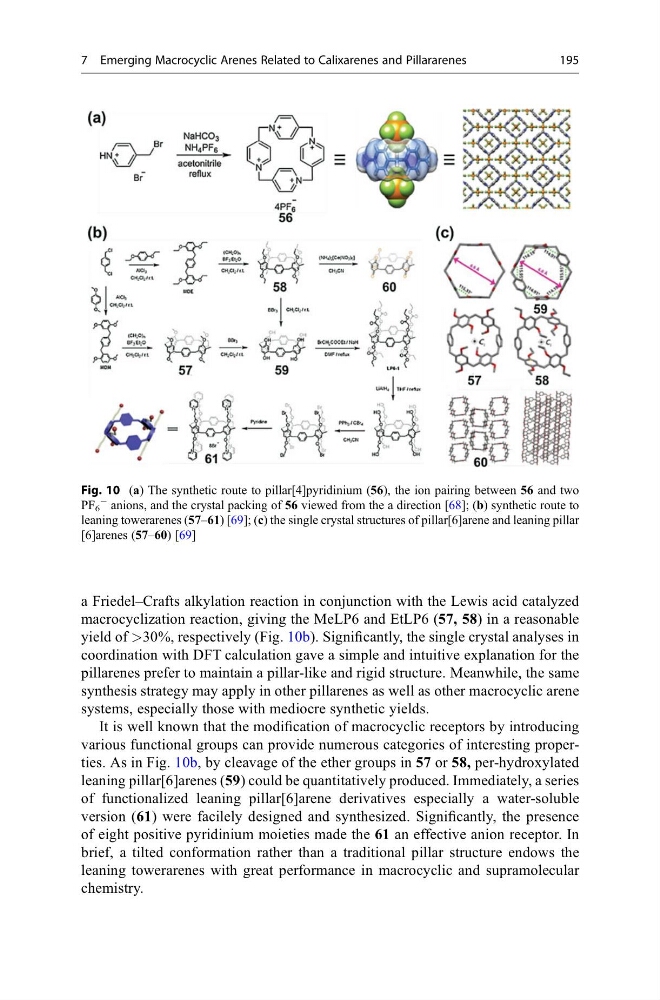
a Friedel–Crafts alkylation reaction in conjunction with the Lewis acid catalyzed
macrocyclization reaction, giving the MeLP6 and EtLP6 (57, 58) in a reasonable
yield of >30%, respectively (Fig. 10b). Significantly, the single crystal analyses in
coordination with DFT calculation gave a simple and intuitive explanation for the
pillarenes prefer to maintain a pillar-like and rigid structure. Meanwhile, the same
synthesis strategy may apply in other pillarenes as well as other macrocyclic arene
systems, especially those with mediocre synthetic yields.
It is well known that the modification of macrocyclic receptors by introducing
various functional groups can provide numerous categories of interesting properties. As in Fig. 10b, by cleavage of the ether groups in 57 or 58, per-hydroxylated
leaning pillar[6]arenes (59) could be quantitatively produced. Immediately, a series
of functionalized leaning pillar[6]arene derivatives especially a water-soluble
version (61) were facilely designed and synthesized. Significantly, the presence
of eight positive pyridinium moieties made the 61 an effective anion receptor. In
brief, a tilted conformation rather than a traditional pillar structure endows the
leaning towerarenes with great performance in macrocyclic and supramolecular
chemistry.
Fig. 10 (a) The synthetic route to pillar[4]pyridinium (56), the ion pairing between 56 and two
PF 6
À anions, and the crystal packing of 56 viewed from the a direction [68]; (b) synthetic route to
leaning towerarenes (57–61) [69]; (c) the single crystal structures of pillar[6]arene and leaning pillar
[6]arenes (57–60) [69]
7 Emerging Macrocyclic Arenes Related to Calixarenes and Pillararenes
195
macrocyclization reaction, giving the MeLP6 and EtLP6 (57, 58) in a reasonable
yield of >30%, respectively (Fig. 10b). Significantly, the single crystal analyses in
coordination with DFT calculation gave a simple and intuitive explanation for the
pillarenes prefer to maintain a pillar-like and rigid structure. Meanwhile, the same
synthesis strategy may apply in other pillarenes as well as other macrocyclic arene
systems, especially those with mediocre synthetic yields.
It is well known that the modification of macrocyclic receptors by introducing
various functional groups can provide numerous categories of interesting properties. As in Fig. 10b, by cleavage of the ether groups in 57 or 58, per-hydroxylated
leaning pillar[6]arenes (59) could be quantitatively produced. Immediately, a series
of functionalized leaning pillar[6]arene derivatives especially a water-soluble
version (61) were facilely designed and synthesized. Significantly, the presence
of eight positive pyridinium moieties made the 61 an effective anion receptor. In
brief, a tilted conformation rather than a traditional pillar structure endows the
leaning towerarenes with great performance in macrocyclic and supramolecular
chemistry.
Fig. 10 (a) The synthetic route to pillar[4]pyridinium (56), the ion pairing between 56 and two
PF 6
À anions, and the crystal packing of 56 viewed from the a direction [68]; (b) synthetic route to
leaning towerarenes (57–61) [69]; (c) the single crystal structures of pillar[6]arene and leaning pillar
[6]arenes (57–60) [69]
7 Emerging Macrocyclic Arenes Related to Calixarenes and Pillararenes
195