

1,4-dimethoxybenzene with diphenyl under Friedel-Crafts alkylation reaction gave
the intermediate product (MDM) in a good yield of 50%. Secondly, via the direct
condensation of MDM with paraformaldehyde in the presence of BF 3 ÁO(Et) 2 , [2]
Bp-ExP6 (51), [3]Bp-ExP9 (52), [2]Bp-ExP5 (53), and [2]Bp-ExP7 (54) could be
successfully synthesized and separated with yields of 50%, 1.2%, 0.1%, and 0.1%,
respectively (Fig. 9a). The main product [2]Bp-ExP6 (51) could be considered as
an extended version of traditional pillar[6]arene with the replacement of two
opposite 1,4-dimethoxybenzene units by biphenyl units; both the synthetic yield
and cavity size are enhanced evidently. Importantly, the single crystal structures of
51 bearing toluene or m-xylene molecule impart 51 with promising potentials in
petrochemical field. Very recently, the first water-soluble [2]Bp-ExP6 (55) bearing
eight pyridinium moieties was successfully designed and synthesized, which
exhibited outstanding binding affinity toward certain sulfonate species in virtue
of its distinctive cavity size and positively charged feature [67]. More importantly,
2,6-naphthalene-disulfonate could be easily captured and separated by 55 from its
aqueous solution in a form of coprecipitation, which endows 55 with unlimited
potentials in the separation and detection of sulfonate species in water (Fig. 9c).
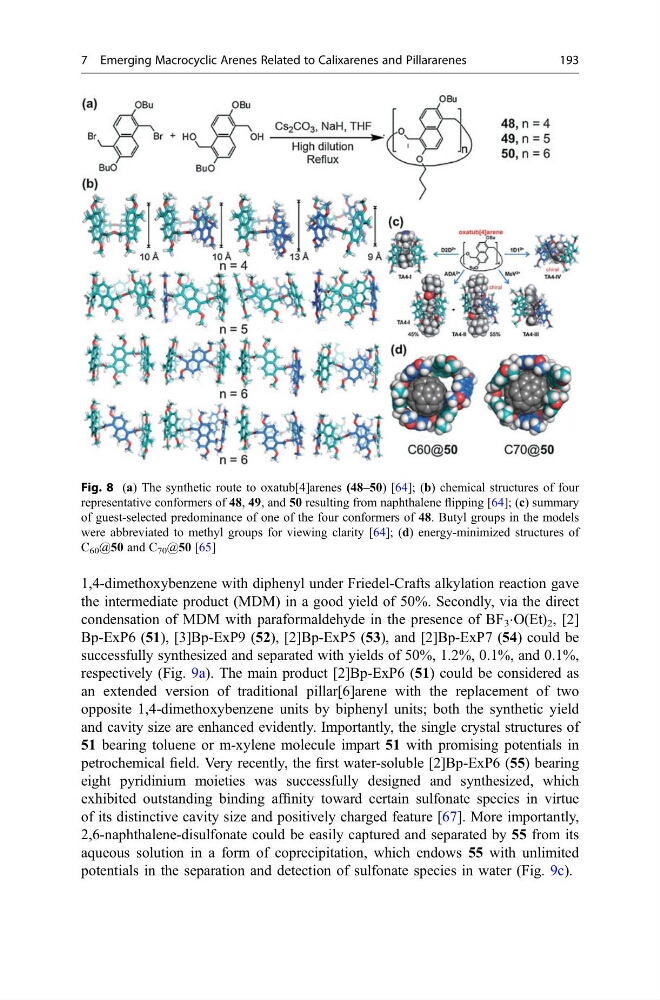
Fig. 8 (a) The synthetic route to oxatub[4]arenes (48–50) [64]; (b) chemical structures of four
representative conformers of 48, 49, and 50 resulting from naphthalene flipping [64]; (c) summary
of guest-selected predominance of one of the four conformers of 48. Butyl groups in the models
were abbreviated to methyl groups for viewing clarity [64]; (d) energy-minimized structures of
C 60 @50 and C 70 @50 [65]
7 Emerging Macrocyclic Arenes Related to Calixarenes and Pillararenes
193
the intermediate product (MDM) in a good yield of 50%. Secondly, via the direct
condensation of MDM with paraformaldehyde in the presence of BF 3 ÁO(Et) 2 , [2]
Bp-ExP6 (51), [3]Bp-ExP9 (52), [2]Bp-ExP5 (53), and [2]Bp-ExP7 (54) could be
successfully synthesized and separated with yields of 50%, 1.2%, 0.1%, and 0.1%,
respectively (Fig. 9a). The main product [2]Bp-ExP6 (51) could be considered as
an extended version of traditional pillar[6]arene with the replacement of two
opposite 1,4-dimethoxybenzene units by biphenyl units; both the synthetic yield
and cavity size are enhanced evidently. Importantly, the single crystal structures of
51 bearing toluene or m-xylene molecule impart 51 with promising potentials in
petrochemical field. Very recently, the first water-soluble [2]Bp-ExP6 (55) bearing
eight pyridinium moieties was successfully designed and synthesized, which
exhibited outstanding binding affinity toward certain sulfonate species in virtue
of its distinctive cavity size and positively charged feature [67]. More importantly,
2,6-naphthalene-disulfonate could be easily captured and separated by 55 from its
aqueous solution in a form of coprecipitation, which endows 55 with unlimited
potentials in the separation and detection of sulfonate species in water (Fig. 9c).
Fig. 8 (a) The synthetic route to oxatub[4]arenes (48–50) [64]; (b) chemical structures of four
representative conformers of 48, 49, and 50 resulting from naphthalene flipping [64]; (c) summary
of guest-selected predominance of one of the four conformers of 48. Butyl groups in the models
were abbreviated to methyl groups for viewing clarity [64]; (d) energy-minimized structures of
C 60 @50 and C 70 @50 [65]
7 Emerging Macrocyclic Arenes Related to Calixarenes and Pillararenes
193