

not only by acid and base stimuli (Fig. 27a) but also by the addition and removal of
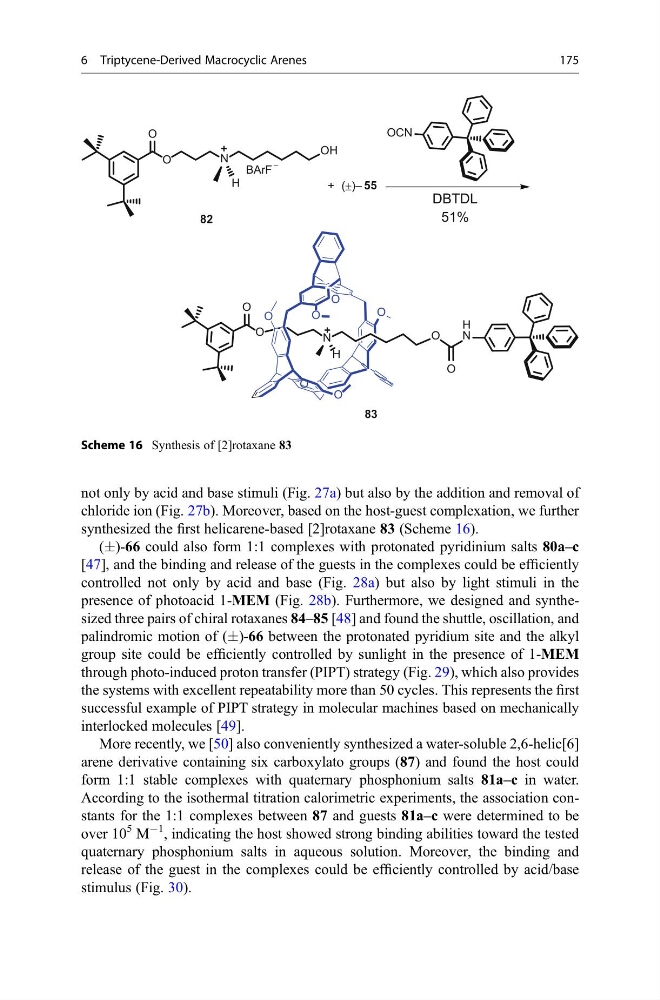
chloride ion (Fig. 27b). Moreover, based on the host-guest complexation, we further
synthesized the first helicarene-based [2]rotaxane 83 (Scheme 16).
(Æ)-66 could also form 1:1 complexes with protonated pyridinium salts 80a–c
[47], and the binding and release of the guests in the complexes could be efficiently
controlled not only by acid and base (Fig. 28a) but also by light stimuli in the
presence of photoacid 1-MEM (Fig. 28b). Furthermore, we designed and synthesized three pairs of chiral rotaxanes 84–85 [48] and found the shuttle, oscillation, and
palindromic motion of (Æ)-66 between the protonated pyridium site and the alkyl
group site could be efficiently controlled by sunlight in the presence of 1-MEM
through photo-induced proton transfer (PIPT) strategy (Fig. 29), which also provides
the systems with excellent repeatability more than 50 cycles. This represents the first
successful example of PIPT strategy in molecular machines based on mechanically
interlocked molecules [49].
More recently, we [50] also conveniently synthesized a water-soluble 2,6-helic[6]
arene derivative containing six carboxylato groups (87) and found the host could
form 1:1 stable complexes with quaternary phosphonium salts 81a–c in water.
According to the isothermal titration calorimetric experiments, the association constants for the 1:1 complexes between 87 and guests 81a–c were determined to be
over 10
5 M
À1 , indicating the host showed strong binding abilities toward the tested
quaternary phosphonium salts in aqueous solution. Moreover, the binding and
release of the guest in the complexes could be efficiently controlled by acid/base
stimulus (Fig. 30).
O
O
N
OH
H
BArF
−
OCN
O
O
N
O
H
H
N
O
O
O
O
O
O
O
82
83
DBTDL
51%
+ (±)– 55
Scheme 16 Synthesis of [2]rotaxane 83
6 Triptycene-Derived Macrocyclic Arenes
175
chloride ion (Fig. 27b). Moreover, based on the host-guest complexation, we further
synthesized the first helicarene-based [2]rotaxane 83 (Scheme 16).
(Æ)-66 could also form 1:1 complexes with protonated pyridinium salts 80a–c
[47], and the binding and release of the guests in the complexes could be efficiently
controlled not only by acid and base (Fig. 28a) but also by light stimuli in the
presence of photoacid 1-MEM (Fig. 28b). Furthermore, we designed and synthesized three pairs of chiral rotaxanes 84–85 [48] and found the shuttle, oscillation, and
palindromic motion of (Æ)-66 between the protonated pyridium site and the alkyl
group site could be efficiently controlled by sunlight in the presence of 1-MEM
through photo-induced proton transfer (PIPT) strategy (Fig. 29), which also provides
the systems with excellent repeatability more than 50 cycles. This represents the first
successful example of PIPT strategy in molecular machines based on mechanically
interlocked molecules [49].
More recently, we [50] also conveniently synthesized a water-soluble 2,6-helic[6]
arene derivative containing six carboxylato groups (87) and found the host could
form 1:1 stable complexes with quaternary phosphonium salts 81a–c in water.
According to the isothermal titration calorimetric experiments, the association constants for the 1:1 complexes between 87 and guests 81a–c were determined to be
over 10
5 M
À1 , indicating the host showed strong binding abilities toward the tested
quaternary phosphonium salts in aqueous solution. Moreover, the binding and
release of the guest in the complexes could be efficiently controlled by acid/base
stimulus (Fig. 30).
O
O
N
OH
H
BArF
−
OCN
O
O
N
O
H
H
N
O
O
O
O
O
O
O
82
83
DBTDL
51%
+ (±)– 55
Scheme 16 Synthesis of [2]rotaxane 83
6 Triptycene-Derived Macrocyclic Arenes
175