

indicated the charge-transfer interactions in the complexes. Especially, the binding
and release of the guest in the complexes could be efficiently controlled by redox
stimulus (Fig. 26), and this responsive process could be visually observed by color
change of the solution. For the complex based on (Æ)-66, the redox-responsive
cycles could be repeated at least 10 times. For the complex from (Æ)-67, similar
phenomenon was also found, and the redox-responsive cycles could be repeated at
least five times [45].
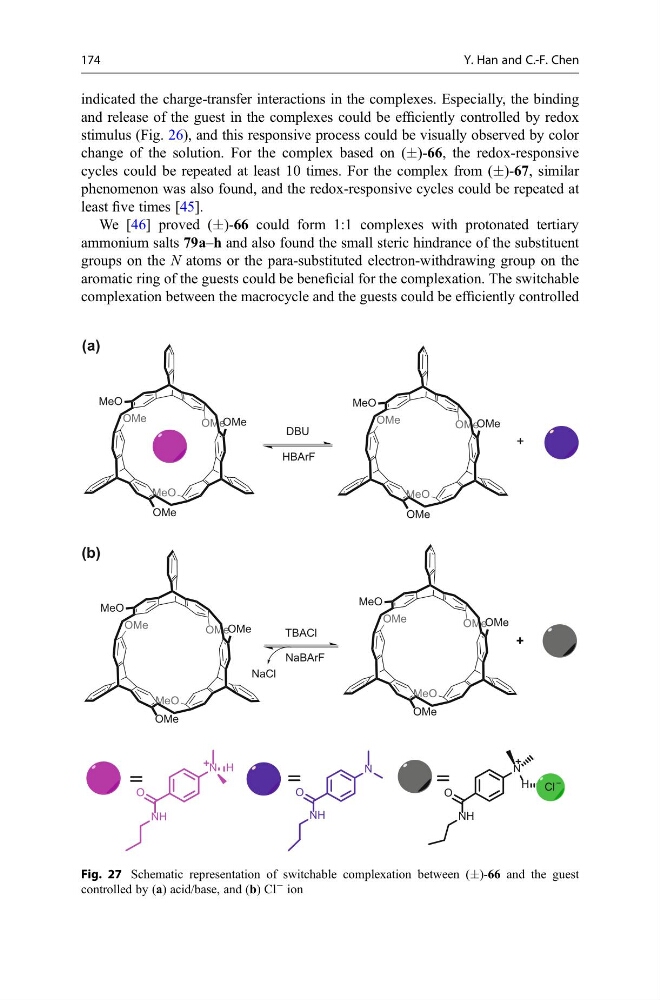
We [46] proved (Æ)-66 could form 1:1 complexes with protonated tertiary
ammonium salts 79a–h and also found the small steric hindrance of the substituent
groups on the N atoms or the para-substituted electron-withdrawing group on the
aromatic ring of the guests could be beneficial for the complexation. The switchable
complexation between the macrocycle and the guests could be efficiently controlled
OMe
OMe
OMe
OMe
MeO
OMe
OMe
OMe
MeO
+
DBU
HBArF
MeO
OMe
OMe
OMe
MeO
N
NH
O
H
N
NH
O
N
O
NH
H Cl
MeO
OMe
OMe
OMe
MeO
NaBArF
TBACl
MeO
OMe
OMe
OMe
MeO
+
NaCl
(a)
(b)
Fig. 27 Schematic representation of switchable complexation between (Æ)-66 and the guest
controlled by (a) acid/base, and (b) Cl
À ion
174
Y. Han and C.-F. Chen
and release of the guest in the complexes could be efficiently controlled by redox
stimulus (Fig. 26), and this responsive process could be visually observed by color
change of the solution. For the complex based on (Æ)-66, the redox-responsive
cycles could be repeated at least 10 times. For the complex from (Æ)-67, similar
phenomenon was also found, and the redox-responsive cycles could be repeated at
least five times [45].
We [46] proved (Æ)-66 could form 1:1 complexes with protonated tertiary
ammonium salts 79a–h and also found the small steric hindrance of the substituent
groups on the N atoms or the para-substituted electron-withdrawing group on the
aromatic ring of the guests could be beneficial for the complexation. The switchable
complexation between the macrocycle and the guests could be efficiently controlled
OMe
OMe
OMe
OMe
MeO
OMe
OMe
OMe
MeO
+
DBU
HBArF
MeO
OMe
OMe
OMe
MeO
N
NH
O
H
N
NH
O
N
O
NH
H Cl
MeO
OMe
OMe
OMe
MeO
NaBArF
TBACl
MeO
OMe
OMe
OMe
MeO
+
NaCl
(a)
(b)
Fig. 27 Schematic representation of switchable complexation between (Æ)-66 and the guest
controlled by (a) acid/base, and (b) Cl
À ion
174
Y. Han and C.-F. Chen