

macrocycles showed obvious enantioselective recognition toward these chiral
guests. Especially, for guest 72, methylated derivative of 1-indamine, the enantioselectivity was considerably high [42].
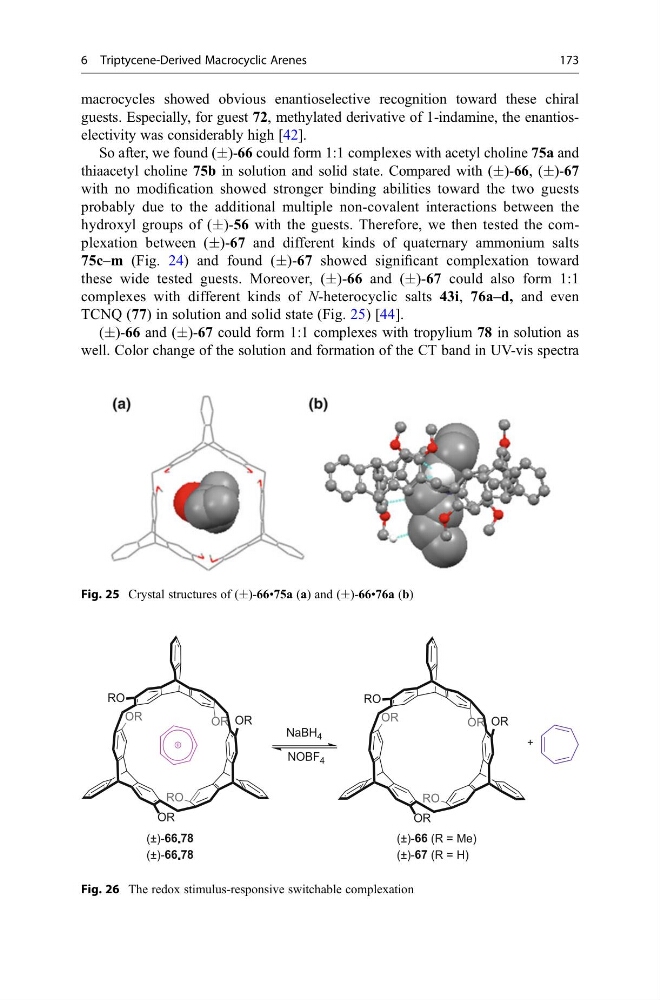
So after, we found (Æ)-66 could form 1:1 complexes with acetyl choline 75a and
thiaacetyl choline 75b in solution and solid state. Compared with (Æ)-66, (Æ)-67
with no modification showed stronger binding abilities toward the two guests
probably due to the additional multiple non-covalent interactions between the
hydroxyl groups of (Æ)-56 with the guests. Therefore, we then tested the complexation between (Æ)-67 and different kinds of quaternary ammonium salts
75c–m (Fig. 24) and found (Æ)-67 showed significant complexation toward
these wide tested guests. Moreover, (Æ)-66 and (Æ)-67 could also form 1:1
complexes with different kinds of N-heterocyclic salts 43i, 76a–d, and even
TCNQ (77) in solution and solid state (Fig. 25) [44].
(Æ)-66 and (Æ)-67 could form 1:1 complexes with tropylium 78 in solution as
well. Color change of the solution and formation of the CT band in UV-vis spectra
Fig. 25 Crystal structures of (Æ)-66•75a (a) and (Æ)-66•76a (b)
RO
OR OR
OR
OR
RO
+
NaBH 4
NOBF 4
RO
OR OR
OR
OR
RO
(±)-66 (R = Me)
(±)-67 (R = H)
(±)-66 78
(±)-66 78
.
.
Fig. 26 The redox stimulus-responsive switchable complexation
6 Triptycene-Derived Macrocyclic Arenes
173
guests. Especially, for guest 72, methylated derivative of 1-indamine, the enantioselectivity was considerably high [42].
So after, we found (Æ)-66 could form 1:1 complexes with acetyl choline 75a and
thiaacetyl choline 75b in solution and solid state. Compared with (Æ)-66, (Æ)-67
with no modification showed stronger binding abilities toward the two guests
probably due to the additional multiple non-covalent interactions between the
hydroxyl groups of (Æ)-56 with the guests. Therefore, we then tested the complexation between (Æ)-67 and different kinds of quaternary ammonium salts
75c–m (Fig. 24) and found (Æ)-67 showed significant complexation toward
these wide tested guests. Moreover, (Æ)-66 and (Æ)-67 could also form 1:1
complexes with different kinds of N-heterocyclic salts 43i, 76a–d, and even
TCNQ (77) in solution and solid state (Fig. 25) [44].
(Æ)-66 and (Æ)-67 could form 1:1 complexes with tropylium 78 in solution as
well. Color change of the solution and formation of the CT band in UV-vis spectra
Fig. 25 Crystal structures of (Æ)-66•75a (a) and (Æ)-66•76a (b)
RO
OR OR
OR
OR
RO
+
NaBH 4
NOBF 4
RO
OR OR
OR
OR
RO
(±)-66 (R = Me)
(±)-67 (R = H)
(±)-66 78
(±)-66 78
.
.
Fig. 26 The redox stimulus-responsive switchable complexation
6 Triptycene-Derived Macrocyclic Arenes
173