

6.4
Conclusion and Perspectives
In summary, it has been proved that triptycene derivatives with unique threedimensional structure could be utilized as useful building blocks for the design
and construction of new kinds of macrocyclic arenes and their analogues. Consequently, a series of triptycene-derived calixarenes, heteracalixarenes, tetralactam macrocycles, and their analogues were conveniently synthesized with
satisfactory yields by one-pot method or two-step fragment-coupling reactions.
Moreover, these triptycene-derived macrocyclic hosts had large enough cavities
and showed fixed conformation in solution. These structural features made them
exhibit not only well molecular recognition toward small organic molecules,
OMe
OMe
MeO
OMe
OMe
MeO
OMe
OMe
MeO
OMe
OMe
MeO
420nm
1-MEH
1-SP
dark
MeO
OMe
OMe
+
MeO
OMe
OMe
N
NH
TfOH
DBU
MeO
OMe
OMe
+
MeO
OMe
OMe
N
1-MEH
1-SP
(a)
(b)
N
O 3 S
HO
N
O 3 S
O
1-MEH
1-SP
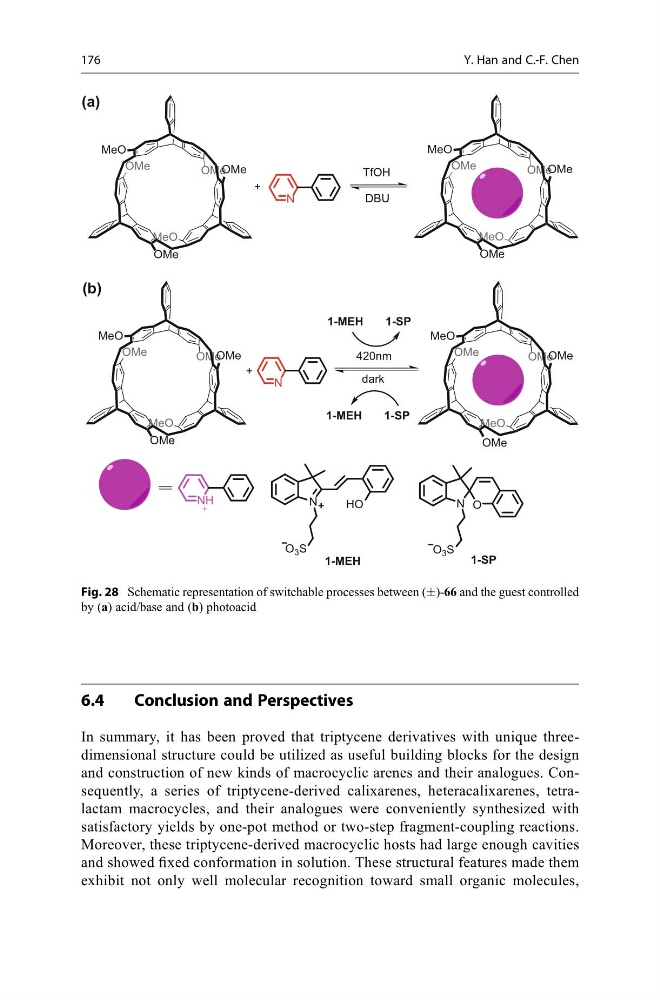
Fig. 28 Schematic representation of switchable processes between (Æ)-66 and the guest controlled
by (a) acid/base and (b) photoacid
176
Y. Han and C.-F. Chen
Conclusion and Perspectives
In summary, it has been proved that triptycene derivatives with unique threedimensional structure could be utilized as useful building blocks for the design
and construction of new kinds of macrocyclic arenes and their analogues. Consequently, a series of triptycene-derived calixarenes, heteracalixarenes, tetralactam macrocycles, and their analogues were conveniently synthesized with
satisfactory yields by one-pot method or two-step fragment-coupling reactions.
Moreover, these triptycene-derived macrocyclic hosts had large enough cavities
and showed fixed conformation in solution. These structural features made them
exhibit not only well molecular recognition toward small organic molecules,
OMe
OMe
MeO
OMe
OMe
MeO
OMe
OMe
MeO
OMe
OMe
MeO
420nm
1-MEH
1-SP
dark
MeO
OMe
OMe
+
MeO
OMe
OMe
N
NH
TfOH
DBU
MeO
OMe
OMe
+
MeO
OMe
OMe
N
1-MEH
1-SP
(a)
(b)
N
O 3 S
HO
N
O 3 S
O
1-MEH
1-SP
Fig. 28 Schematic representation of switchable processes between (Æ)-66 and the guest controlled
by (a) acid/base and (b) photoacid
176
Y. Han and C.-F. Chen