

CÀClÁÁÁπ interactions, in which the aromatic rings acted as the wall and the nitrogen
atoms of the pyridine rings all pointed inward the tube (Fig. 16) [24]. Similarly, with
multiple intermolecular chlorine bonding interactions, oxacalixarenes 36a and 35c
could also assemble into organic tubular structures and further porous architectures.
Based on complexation between 13 and the paraquat derivative, a [2]rotaxanetype assembly was synthesized in 28% yield [20]. Similarly, we synthesized a pair of
isomeric [2]rotaxanes 56a and 56b based on 35d and 36d, respectively, which is the
first example of oxacalixarene to be used as useful wheel for the synthesis of
mechanically interlocked molecules. [2]Rotaxane 56a was further evidenced by its
crystal structure, in which the axle was bent and one stopper group was positioned
close to the 1,8-naphthyridine unit of the wheel with scorpion-like mode (Fig. 17) [26].
Oxacalixarene 35d with an upper semi-cavity encircled by two naphthyridine
moieties and a lower semi-cavity by two triptycene moieties encouraged us to further
investigate the directional complexation between the macrocycle and a nonsymmetric guest. By
1 H NMR spectra and crystal structures, it was unequivocally
shown the bipyridinium guests 57a–b preferred to thread from the triptycene rim and
subsequently gave [2]rotaxanes 58–59a as major products. With 60 as axle, unidirectional threading was achieved to give [2]rotaxane 61 as the sole product. Thus,
the threading direction and the orientation could be finely controlled by adjusting the
electrostatic and steric effect of the guests (Scheme 12) [36].
Moreover, macrocyclic 40d could also form a tubular assembly with the aromatic
rings as the wall and then 3D microporous architecture (Fig. 18) with a pair of
intermolecular complementary CÀHÁÁÁπ interactions between the aromatic proton of
the triptycene moiety of one molecule and the aromatic ring of the triptycene moiety of its
adjacent molecule and another CÀHÁÁÁπ interactions between the proton of the bridging
methylene and the aromatic ring of the p-phenyl moiety of its adjacent molecule [28].
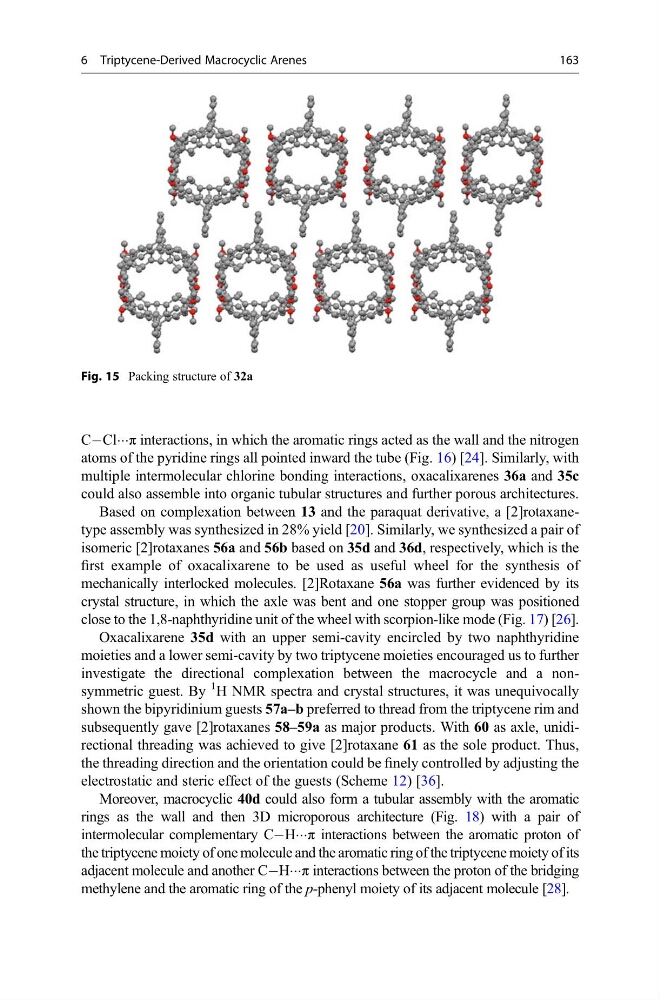
Fig. 15 Packing structure of 32a
6 Triptycene-Derived Macrocyclic Arenes
163
atoms of the pyridine rings all pointed inward the tube (Fig. 16) [24]. Similarly, with
multiple intermolecular chlorine bonding interactions, oxacalixarenes 36a and 35c
could also assemble into organic tubular structures and further porous architectures.
Based on complexation between 13 and the paraquat derivative, a [2]rotaxanetype assembly was synthesized in 28% yield [20]. Similarly, we synthesized a pair of
isomeric [2]rotaxanes 56a and 56b based on 35d and 36d, respectively, which is the
first example of oxacalixarene to be used as useful wheel for the synthesis of
mechanically interlocked molecules. [2]Rotaxane 56a was further evidenced by its
crystal structure, in which the axle was bent and one stopper group was positioned
close to the 1,8-naphthyridine unit of the wheel with scorpion-like mode (Fig. 17) [26].
Oxacalixarene 35d with an upper semi-cavity encircled by two naphthyridine
moieties and a lower semi-cavity by two triptycene moieties encouraged us to further
investigate the directional complexation between the macrocycle and a nonsymmetric guest. By
1 H NMR spectra and crystal structures, it was unequivocally
shown the bipyridinium guests 57a–b preferred to thread from the triptycene rim and
subsequently gave [2]rotaxanes 58–59a as major products. With 60 as axle, unidirectional threading was achieved to give [2]rotaxane 61 as the sole product. Thus,
the threading direction and the orientation could be finely controlled by adjusting the
electrostatic and steric effect of the guests (Scheme 12) [36].
Moreover, macrocyclic 40d could also form a tubular assembly with the aromatic
rings as the wall and then 3D microporous architecture (Fig. 18) with a pair of
intermolecular complementary CÀHÁÁÁπ interactions between the aromatic proton of
the triptycene moiety of one molecule and the aromatic ring of the triptycene moiety of its
adjacent molecule and another CÀHÁÁÁπ interactions between the proton of the bridging
methylene and the aromatic ring of the p-phenyl moiety of its adjacent molecule [28].
Fig. 15 Packing structure of 32a
6 Triptycene-Derived Macrocyclic Arenes
163