

6.2.5 Molecular Self-Assembly
Due to the introduction of rigid triptycene moiety, the novel triptycene-derived
macrocyclic hosts showed the fixed conformations, which also makes the macrocycles as the building blocks for the formation of a variety of supramolecular
structures via self-assembly. Consequently, it was found that both the cis isomer
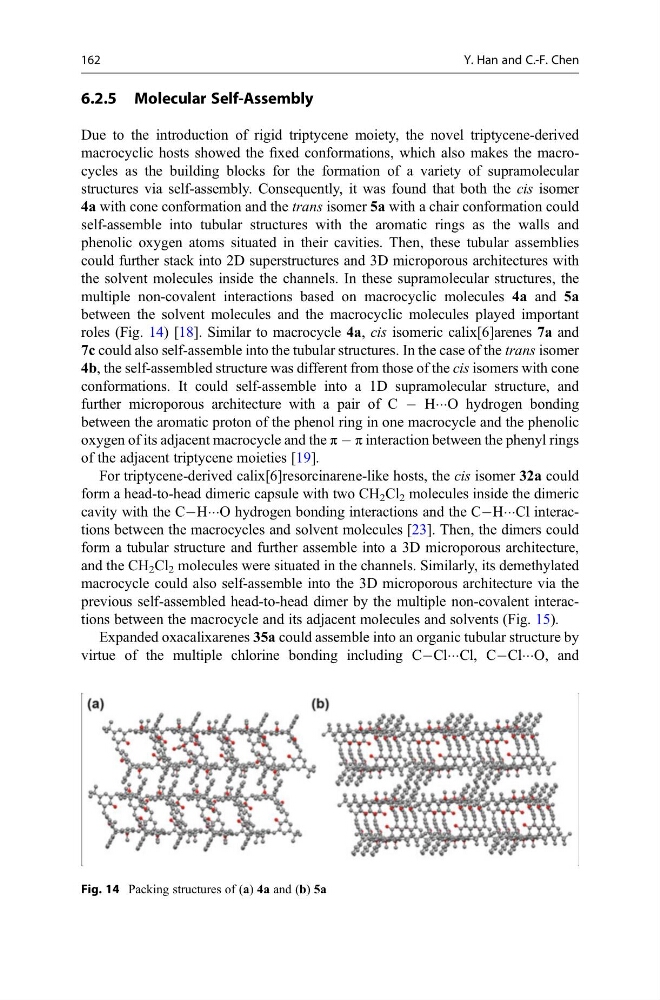
4a with cone conformation and the trans isomer 5a with a chair conformation could
self-assemble into tubular structures with the aromatic rings as the walls and
phenolic oxygen atoms situated in their cavities. Then, these tubular assemblies
could further stack into 2D superstructures and 3D microporous architectures with
the solvent molecules inside the channels. In these supramolecular structures, the
multiple non-covalent interactions based on macrocyclic molecules 4a and 5a
between the solvent molecules and the macrocyclic molecules played important
roles (Fig. 14) [18]. Similar to macrocycle 4a, cis isomeric calix[6]arenes 7a and
7c could also self-assemble into the tubular structures. In the case of the trans isomer
4b, the self-assembled structure was different from those of the cis isomers with cone
conformations. It could self-assemble into a 1D supramolecular structure, and
further microporous architecture with a pair of C À HÁÁÁO hydrogen bonding
between the aromatic proton of the phenol ring in one macrocycle and the phenolic
oxygen of its adjacent macrocycle and the π À π interaction between the phenyl rings
of the adjacent triptycene moieties [19].
For triptycene-derived calix[6]resorcinarene-like hosts, the cis isomer 32a could
form a head-to-head dimeric capsule with two CH 2 Cl 2 molecules inside the dimeric
cavity with the CÀHÁÁÁO hydrogen bonding interactions and the CÀHÁÁÁCl interactions between the macrocycles and solvent molecules [23]. Then, the dimers could
form a tubular structure and further assemble into a 3D microporous architecture,
and the CH 2 Cl 2 molecules were situated in the channels. Similarly, its demethylated
macrocycle could also self-assemble into the 3D microporous architecture via the
previous self-assembled head-to-head dimer by the multiple non-covalent interactions between the macrocycle and its adjacent molecules and solvents (Fig. 15).
Expanded oxacalixarenes 35a could assemble into an organic tubular structure by
virtue of the multiple chlorine bonding including CÀClÁÁÁCl, CÀClÁÁÁO, and
Fig. 14 Packing structures of (a) 4a and (b) 5a
162
Y. Han and C.-F. Chen
Due to the introduction of rigid triptycene moiety, the novel triptycene-derived
macrocyclic hosts showed the fixed conformations, which also makes the macrocycles as the building blocks for the formation of a variety of supramolecular
structures via self-assembly. Consequently, it was found that both the cis isomer
4a with cone conformation and the trans isomer 5a with a chair conformation could
self-assemble into tubular structures with the aromatic rings as the walls and
phenolic oxygen atoms situated in their cavities. Then, these tubular assemblies
could further stack into 2D superstructures and 3D microporous architectures with
the solvent molecules inside the channels. In these supramolecular structures, the
multiple non-covalent interactions based on macrocyclic molecules 4a and 5a
between the solvent molecules and the macrocyclic molecules played important
roles (Fig. 14) [18]. Similar to macrocycle 4a, cis isomeric calix[6]arenes 7a and
7c could also self-assemble into the tubular structures. In the case of the trans isomer
4b, the self-assembled structure was different from those of the cis isomers with cone
conformations. It could self-assemble into a 1D supramolecular structure, and
further microporous architecture with a pair of C À HÁÁÁO hydrogen bonding
between the aromatic proton of the phenol ring in one macrocycle and the phenolic
oxygen of its adjacent macrocycle and the π À π interaction between the phenyl rings
of the adjacent triptycene moieties [19].
For triptycene-derived calix[6]resorcinarene-like hosts, the cis isomer 32a could
form a head-to-head dimeric capsule with two CH 2 Cl 2 molecules inside the dimeric
cavity with the CÀHÁÁÁO hydrogen bonding interactions and the CÀHÁÁÁCl interactions between the macrocycles and solvent molecules [23]. Then, the dimers could
form a tubular structure and further assemble into a 3D microporous architecture,
and the CH 2 Cl 2 molecules were situated in the channels. Similarly, its demethylated
macrocycle could also self-assemble into the 3D microporous architecture via the
previous self-assembled head-to-head dimer by the multiple non-covalent interactions between the macrocycle and its adjacent molecules and solvents (Fig. 15).
Expanded oxacalixarenes 35a could assemble into an organic tubular structure by
virtue of the multiple chlorine bonding including CÀClÁÁÁCl, CÀClÁÁÁO, and
Fig. 14 Packing structures of (a) 4a and (b) 5a
162
Y. Han and C.-F. Chen