

macrocycles 52a–b could show highly efficient complexation with the squaraine to
form a new kind of stable pseudorotaxane-type complexes in solution and in the
solid state. It was noted that the complexation-induced asymmetry of the guest in
the complex between 52a and 56b was also observed owing to the cone conformation of 52a. When the free guest 56b and the complexes 52a•56b and 52b•56b
were dissolved in THF/water solution (4:1). After 4 days, we found that the guest
56b underwent hydrolytic decomposition to turn colorless, whereas the solution of
the complexes retained their blue colors for several weeks. This observation
revealed that the formation of complexes could efficiently protect the squaraine
dyes from polar solvents. Then we further studied on the complexation of the
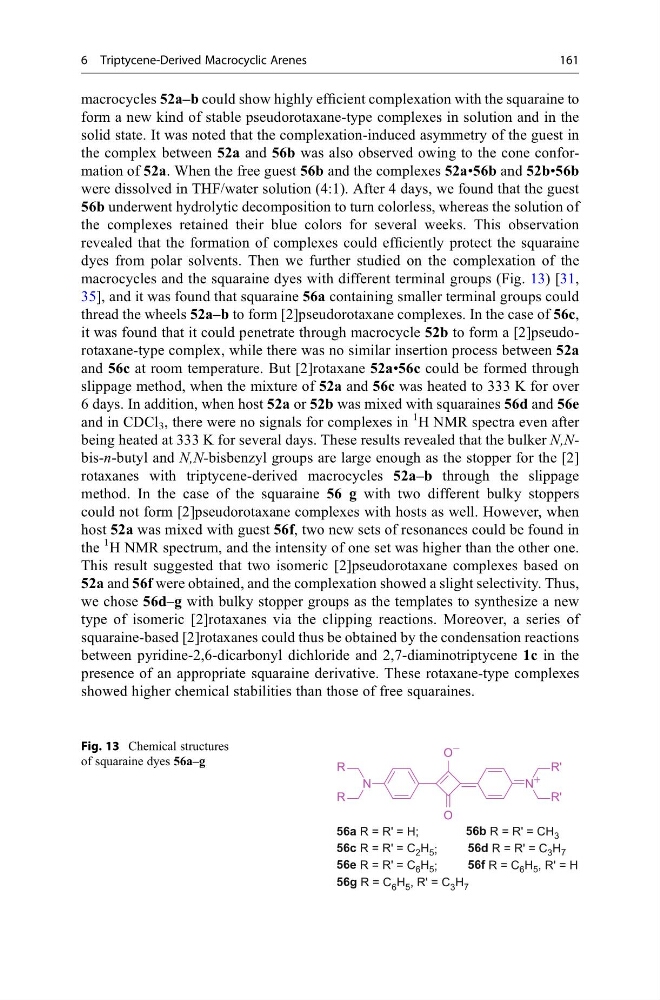
macrocycles and the squaraine dyes with different terminal groups (Fig. 13) [31,
35], and it was found that squaraine 56a containing smaller terminal groups could
thread the wheels 52a–b to form [2]pseudorotaxane complexes. In the case of 56c,
it was found that it could penetrate through macrocycle 52b to form a [2]pseudorotaxane-type complex, while there was no similar insertion process between 52a
and 56c at room temperature. But [2]rotaxane 52a•56c could be formed through
slippage method, when the mixture of 52a and 56c was heated to 333 K for over
6 days. In addition, when host 52a or 52b was mixed with squaraines 56d and 56e
and in CDCl 3 , there were no signals for complexes in
1 H NMR spectra even after
being heated at 333 K for several days. These results revealed that the bulker N,Nbis-n-butyl and N,N-bisbenzyl groups are large enough as the stopper for the [2]
rotaxanes with triptycene-derived macrocycles 52a–b through the slippage
method. In the case of the squaraine 56 g with two different bulky stoppers
could not form [2]pseudorotaxane complexes with hosts as well. However, when
host 52a was mixed with guest 56f, two new sets of resonances could be found in
the
1 H NMR spectrum, and the intensity of one set was higher than the other one.
This result suggested that two isomeric [2]pseudorotaxane complexes based on
52a and 56f were obtained, and the complexation showed a slight selectivity. Thus,
we chose 56d–g with bulky stopper groups as the templates to synthesize a new
type of isomeric [2]rotaxanes via the clipping reactions. Moreover, a series of
squaraine-based [2]rotaxanes could thus be obtained by the condensation reactions
between pyridine-2,6-dicarbonyl dichloride and 2,7-diaminotriptycene 1c in the
presence of an appropriate squaraine derivative. These rotaxane-type complexes
showed higher chemical stabilities than those of free squaraines.
56a R = R' = H;
56b R = R' = CH 3
56c R = R' = C 2 H 5 ;
56d R = R' = C 3 H 7
56e R = R' = C 6 H 5 ;
56f R = C 6 H 5 , R' = H
56g R = C 6 H 5 , R' = C 3 H 7
N +
N
O −
O
R
R
R'
R'
Fig. 13 Chemical structures
of squaraine dyes 56a–g
6 Triptycene-Derived Macrocyclic Arenes
161
form a new kind of stable pseudorotaxane-type complexes in solution and in the
solid state. It was noted that the complexation-induced asymmetry of the guest in
the complex between 52a and 56b was also observed owing to the cone conformation of 52a. When the free guest 56b and the complexes 52a•56b and 52b•56b
were dissolved in THF/water solution (4:1). After 4 days, we found that the guest
56b underwent hydrolytic decomposition to turn colorless, whereas the solution of
the complexes retained their blue colors for several weeks. This observation
revealed that the formation of complexes could efficiently protect the squaraine
dyes from polar solvents. Then we further studied on the complexation of the
macrocycles and the squaraine dyes with different terminal groups (Fig. 13) [31,
35], and it was found that squaraine 56a containing smaller terminal groups could
thread the wheels 52a–b to form [2]pseudorotaxane complexes. In the case of 56c,
it was found that it could penetrate through macrocycle 52b to form a [2]pseudorotaxane-type complex, while there was no similar insertion process between 52a
and 56c at room temperature. But [2]rotaxane 52a•56c could be formed through
slippage method, when the mixture of 52a and 56c was heated to 333 K for over
6 days. In addition, when host 52a or 52b was mixed with squaraines 56d and 56e
and in CDCl 3 , there were no signals for complexes in
1 H NMR spectra even after
being heated at 333 K for several days. These results revealed that the bulker N,Nbis-n-butyl and N,N-bisbenzyl groups are large enough as the stopper for the [2]
rotaxanes with triptycene-derived macrocycles 52a–b through the slippage
method. In the case of the squaraine 56 g with two different bulky stoppers
could not form [2]pseudorotaxane complexes with hosts as well. However, when
host 52a was mixed with guest 56f, two new sets of resonances could be found in
the
1 H NMR spectrum, and the intensity of one set was higher than the other one.
This result suggested that two isomeric [2]pseudorotaxane complexes based on
52a and 56f were obtained, and the complexation showed a slight selectivity. Thus,
we chose 56d–g with bulky stopper groups as the templates to synthesize a new
type of isomeric [2]rotaxanes via the clipping reactions. Moreover, a series of
squaraine-based [2]rotaxanes could thus be obtained by the condensation reactions
between pyridine-2,6-dicarbonyl dichloride and 2,7-diaminotriptycene 1c in the
presence of an appropriate squaraine derivative. These rotaxane-type complexes
showed higher chemical stabilities than those of free squaraines.
56a R = R' = H;
56b R = R' = CH 3
56c R = R' = C 2 H 5 ;
56d R = R' = C 3 H 7
56e R = R' = C 6 H 5 ;
56f R = C 6 H 5 , R' = H
56g R = C 6 H 5 , R' = C 3 H 7
N +
N
O −
O
R
R
R'
R'
Fig. 13 Chemical structures
of squaraine dyes 56a–g
6 Triptycene-Derived Macrocyclic Arenes
161