

Crystals of 62 (Fig. 19a) suitable for X-ray crystallographic analysis were
obtained by slow evaporation of a solution of 62 in THF–CH 3 OH. Its crystal
structure showed that the azacalixarene molecule could self-assemble into a
novel aromatic single-walled organic nanotube [37]. It was found that the unit
cell contains two molecules of 62 (denoted as A and B, Fig. 19b), in the boat-like
conformation with similar cavity in one unit cell. The further study showed that
two molecules of A were located in opposite positions and generated a rectangular
geometry with the four cyano groups and four NH sites in the same direction, while
two molecules of B were also located face-to-face and generated a rectangular
geometry rotated with respect to the former one by 90
. Owing to the two pyridine
rings in one molecule of 62, it can contribute totally four pairs of hydrogen bonds
and participate in two zigzag H-bond chains with other molecules for self-assembly. With the proper geometrical constraints of the building blocks and the relatively strong non-covalent interactions, a nanometrescale cubical organic nanotube
is formed spontaneously (Fig. 19c). This nanotube is generated totally by four onedimensional H-bond chains, which are parallel or approximately parallel to the axis
of tube and lead to the formation of four planes that consist of pyridine rings and
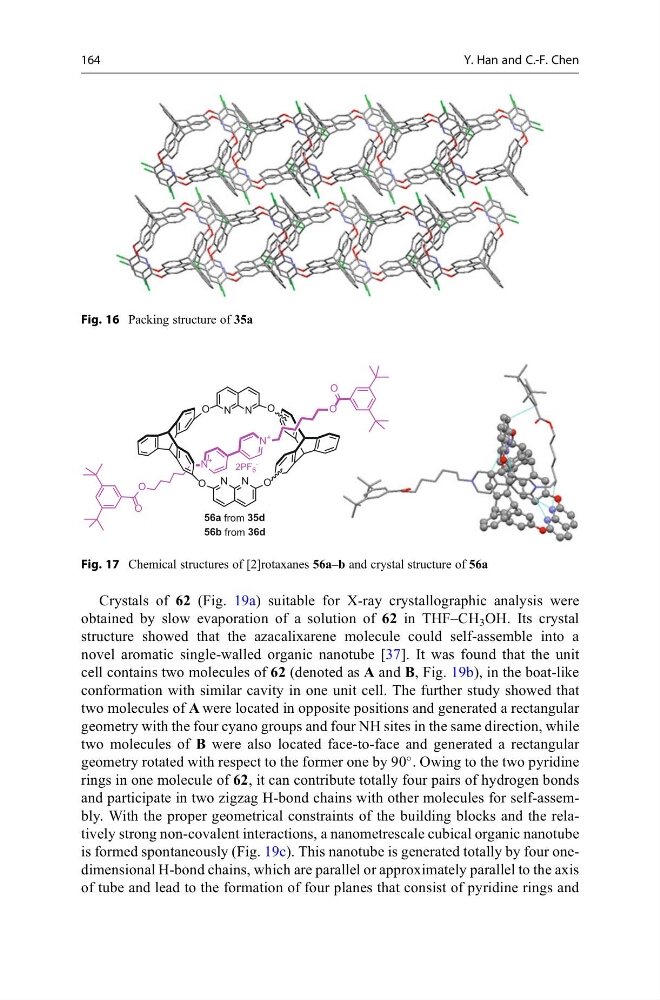
Fig. 16 Packing structure of 35a
O
O
O
O
N N
N
N
O
O
2PF 6
-
N
+
N
+
O
O
56a from 35d
56b from 36d
Fig. 17 Chemical structures of [2]rotaxanes 56a–b and crystal structure of 56a
164
Y. Han and C.-F. Chen
obtained by slow evaporation of a solution of 62 in THF–CH 3 OH. Its crystal
structure showed that the azacalixarene molecule could self-assemble into a
novel aromatic single-walled organic nanotube [37]. It was found that the unit
cell contains two molecules of 62 (denoted as A and B, Fig. 19b), in the boat-like
conformation with similar cavity in one unit cell. The further study showed that
two molecules of A were located in opposite positions and generated a rectangular
geometry with the four cyano groups and four NH sites in the same direction, while
two molecules of B were also located face-to-face and generated a rectangular
geometry rotated with respect to the former one by 90
. Owing to the two pyridine
rings in one molecule of 62, it can contribute totally four pairs of hydrogen bonds
and participate in two zigzag H-bond chains with other molecules for self-assembly. With the proper geometrical constraints of the building blocks and the relatively strong non-covalent interactions, a nanometrescale cubical organic nanotube
is formed spontaneously (Fig. 19c). This nanotube is generated totally by four onedimensional H-bond chains, which are parallel or approximately parallel to the axis
of tube and lead to the formation of four planes that consist of pyridine rings and
Fig. 16 Packing structure of 35a
O
O
O
O
N N
N
N
O
O
2PF 6
-
N
+
N
+
O
O
56a from 35d
56b from 36d
Fig. 17 Chemical structures of [2]rotaxanes 56a–b and crystal structure of 56a
164
Y. Han and C.-F. Chen