

shows chair-like conformation [24]. The crystal structure of cis isomer 35d showed
that it had 1,3-alternate conformation with a cavity of 13.29 Â 10.99 Å
2 (wider rim)
and 8.56 Â 8.84 Å
2 (narrower rim), in which the nitrogen atoms in the 1,8naphthyridine are all positioned inside the cavity (Fig. 6d) [25]. For trans isomer
36d, it adopted a curved-boat-like conformation in the solid state, which was
different from the conformation in solution possibly due to the solvent effect.
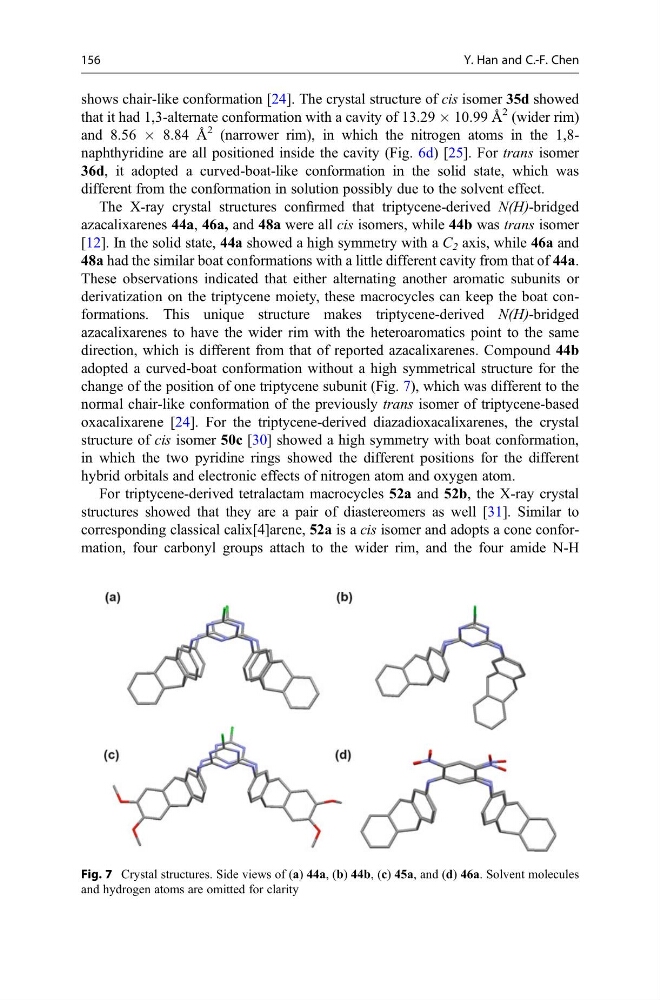
The X-ray crystal structures confirmed that triptycene-derived N(H)-bridged
azacalixarenes 44a, 46a, and 48a were all cis isomers, while 44b was trans isomer
[12]. In the solid state, 44a showed a high symmetry with a C 2 axis, while 46a and
48a had the similar boat conformations with a little different cavity from that of 44a.
These observations indicated that either alternating another aromatic subunits or
derivatization on the triptycene moiety, these macrocycles can keep the boat conformations. This unique structure makes triptycene-derived N(H)-bridged
azacalixarenes to have the wider rim with the heteroaromatics point to the same
direction, which is different from that of reported azacalixarenes. Compound 44b
adopted a curved-boat conformation without a high symmetrical structure for the
change of the position of one triptycene subunit (Fig. 7), which was different to the
normal chair-like conformation of the previously trans isomer of triptycene-based
oxacalixarene [24]. For the triptycene-derived diazadioxacalixarenes, the crystal
structure of cis isomer 50c [30] showed a high symmetry with boat conformation,
in which the two pyridine rings showed the different positions for the different
hybrid orbitals and electronic effects of nitrogen atom and oxygen atom.
For triptycene-derived tetralactam macrocycles 52a and 52b, the X-ray crystal
structures showed that they are a pair of diastereomers as well [31]. Similar to
corresponding classical calix[4]arene, 52a is a cis isomer and adopts a cone conformation, four carbonyl groups attach to the wider rim, and the four amide N-H
Fig. 7 Crystal structures. Side views of (a) 44a, (b) 44b, (c) 45a, and (d) 46a. Solvent molecules
and hydrogen atoms are omitted for clarity
156
Y. Han and C.-F. Chen
that it had 1,3-alternate conformation with a cavity of 13.29 Â 10.99 Å
2 (wider rim)
and 8.56 Â 8.84 Å
2 (narrower rim), in which the nitrogen atoms in the 1,8naphthyridine are all positioned inside the cavity (Fig. 6d) [25]. For trans isomer
36d, it adopted a curved-boat-like conformation in the solid state, which was
different from the conformation in solution possibly due to the solvent effect.
The X-ray crystal structures confirmed that triptycene-derived N(H)-bridged
azacalixarenes 44a, 46a, and 48a were all cis isomers, while 44b was trans isomer
[12]. In the solid state, 44a showed a high symmetry with a C 2 axis, while 46a and
48a had the similar boat conformations with a little different cavity from that of 44a.
These observations indicated that either alternating another aromatic subunits or
derivatization on the triptycene moiety, these macrocycles can keep the boat conformations. This unique structure makes triptycene-derived N(H)-bridged
azacalixarenes to have the wider rim with the heteroaromatics point to the same
direction, which is different from that of reported azacalixarenes. Compound 44b
adopted a curved-boat conformation without a high symmetrical structure for the
change of the position of one triptycene subunit (Fig. 7), which was different to the
normal chair-like conformation of the previously trans isomer of triptycene-based
oxacalixarene [24]. For the triptycene-derived diazadioxacalixarenes, the crystal
structure of cis isomer 50c [30] showed a high symmetry with boat conformation,
in which the two pyridine rings showed the different positions for the different
hybrid orbitals and electronic effects of nitrogen atom and oxygen atom.
For triptycene-derived tetralactam macrocycles 52a and 52b, the X-ray crystal
structures showed that they are a pair of diastereomers as well [31]. Similar to
corresponding classical calix[4]arene, 52a is a cis isomer and adopts a cone conformation, four carbonyl groups attach to the wider rim, and the four amide N-H
Fig. 7 Crystal structures. Side views of (a) 44a, (b) 44b, (c) 45a, and (d) 46a. Solvent molecules
and hydrogen atoms are omitted for clarity
156
Y. Han and C.-F. Chen